

The secular icon who wasn’t: A new book recasts Indira Gandhi

Harun Ur Rashid
Publish: 17 Sep 2025, 11:40 PM
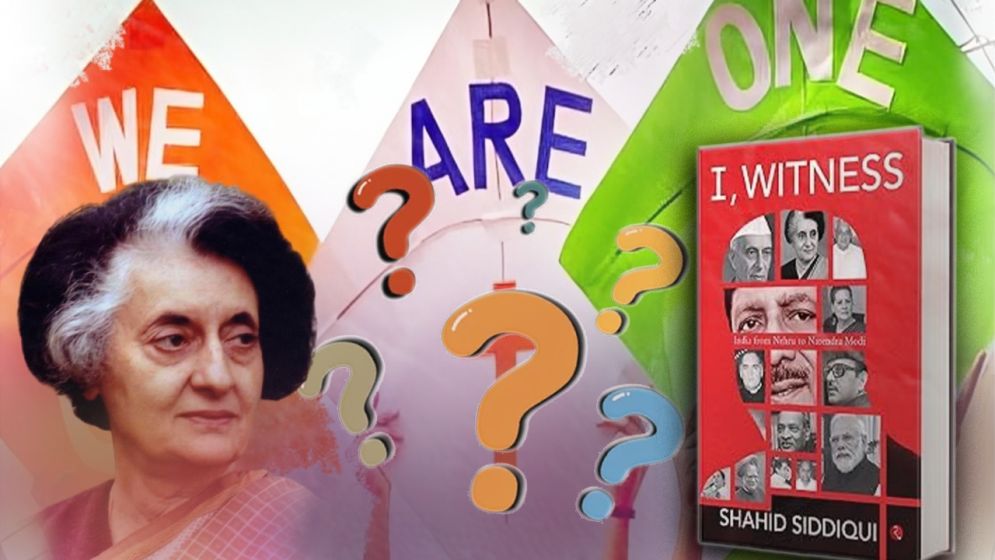
The story of Indira Gandhi is often told as one of fierce conviction, a leader who drew a sharp line between secularism and communal politics, presenting herself as the last bulwark against the Sangh Parivar in India.
In 1976, at the height of the Emergency, she even amended the Constitution to insert the words secular and socialist into the Preamble, cementing her claim to the guardianship of pluralism and social justice.
That move has long been interpreted as a symbol of ideological clarity, if not zealotry. Some even cast her as a fundamentalist of secularism, bent on molding the state machinery–courts, bureaucracy, media–into an obedient army for her cause.
But history, as it so often does in South Asia, looks very different when stripped of its official veneer. Shahid Siddiqui, an influential Urdu journalist and former Congressman, has recently forced us to revisit the myth.
His memoir, “I, Witness: India from Nehru to Narendra Modi,” is a searing indictment of what he calls the hollowness of Indira Gandhi’s so-called secularism–a façade that concealed a ruthless pragmatist willing to play any card, Hindu or Muslim, separatist or nationalist, so long as it secured her grip on power.
Siddiqui cites the 1983 Jammu and Kashmir elections as proof. Following Sheikh Abdullah’s death, Congress campaigned in Jammu by openly appealing to Hindu sentiment while simultaneously playing the Muslim and separatist cards in the Valley.
The duality was not accidental; it was strategy. And Siddiqui’s larger point is brutal in its simplicity: Indira Gandhi had no ideology. Convictions were essentially tools. She was, as he puts it, a political Jekyll and Hyde–polite, and deferential in private.
As a Bangladeshi analyst looking from across the border, one cannot ignore how this duplicity shaped not just India’s politics but South Asia’s wider trajectory. Indira Gandhi’s public image as the liberator of Bangladesh in 1971 often overshadows her later maneuvering.
Yet, Siddiqui’s testimony reminds us that even that decisive intervention can be read less as altruistic solidarity with Bengali aspirations and more as a calculated move to weaken Pakistan and consolidate India’s regional dominance.
Her treatment of India’s Muslim community, however, remains her most damning legacy. The Emergency marked a turning point. Thousands of Muslims were arbitrarily detained, many subjected to forced sterilization in Sanjay Gandhi’s brutal population control campaign.
Siddiqui recounts how his own father, Waheeduddin Siddiqui–a respected Congressman in his eighties–was dragged into jail, emblematic of how the party of Nehru and freedom’s promise had mutated into something monstrous.
For Indian Muslims, these wounds ran deep. The Congress’s claim to be the custodian of secularism no longer rang true; and the disillusionment born in the 1970s and 1980s still reverberates in Indian politics today, where the community finds itself increasingly marginalized.
-68caf2402ee1c.png)
A convoluted political arc
Indira Gandhi’s political arc was nothing if not dramatic.
In the imagination of her admirers, she was once Durga Mata, the nation’s savior after 1971. But in the telling of Shahid Siddiqui, she morphed into Maa Kali–a darker, more ruthless figure whose reverberations continue to shape Indian politics half a century later.
Siddiqui recalls interviewing her during those years, when she was keen to dismiss charges of anti-Muslim bias. She insisted that such claims were “rumors” spread by her enemies. “Only Congress,” she told him, “could protect the interests of minorities and strengthen Indian secularism.”
Yet for Muslims, these assurances rang hollow. In the first post-Emergency general election, they abandoned the Congress en masse. Her party suffered a humiliating rout, and Indira Gandhi herself lost her seat.
When Siddiqui was asked in a recent interview on whether he thought Indira was personally hostile to Muslims, his answer was telling: “No.” But he was quick to add that she flirted with what he called the “soft Hindutva card” when she returned to power in 1980, after the Janata Party experiment collapsed.
He argued she wasn’t even fully aware of the scale of abuses against Muslims during the Emergency–but the deeper problem, in his eyes, was her lack of conviction. “She didn’t really believe in anything,” he told me. “She had no scruples.”
This absence of ideological anchor, Siddiqui suggests, explains both her resilience and her contradictions. She could be ruthless one moment and conciliatory the next, not out of principle but out of expedience.
For him, the most riveting story is not just Indira herself but the Congress Party she embodied.
His proximity to Rajiv Gandhi and other leaders offered him an unfiltered look into a feudal political culture riddled with factional rivalries, murky dealmaking, and cynical calculations.
Disillusioned, he eventually quit the Congress, drifting into the Samajwadi Party and later the Bahujan Samaj Party, before leaving frontline politics altogether.
From a South Asian vantage point–particularly from Bangladesh–this duality in Indira Gandhi’s politics is not a footnote but a central theme. In 1971, she projected herself as a fearless champion of Bengali self-determination, securing India’s position as the regional hegemon.
But just as quickly, she proved willing to pivot, making alliances and compromises that exposed how thin her proclaimed secularism really was. And for Bangladeshis, this is a cautionary tale: India’s embrace in moments of crisis has always carried with it the imprint of Indira’s style–pragmatic but rarely grounded in principle.
-68caf266e377d.jpeg)
Adopting anti-Muslim rhetoric
The Congress’s fraught relationship with Muslims became fertile ground for its rivals, especially the Sangh Parivar.
L.K. Advani, once the Sangh’s most formidable ideologue, coined the terms “minorityism” and “pseudo-secularism” to describe the Congress’s dealings with the community. Those labels outlived Advani’s own political decline and remain potent weapons in today’s BJP playbook.
Meanwhile, the long and uneasy courtship between Indian Muslims and the Congress Party has long since broken down, but its shadow lingers, shaping both political rhetoric and electoral arithmetic.
The relationship, often romanticized as an unbreakable alliance, now exists mostly in memory and myth–dissected in Siddiqui’s books, whispered in political circles, and endlessly debated in drawing rooms.
The pact looked something like this: in the aftermath of Partition, when Muslims reeled from displacement and suspicion in a Hindu-majority India, Congress offered itself as protector. In return, a handful of Muslim elites–clerics, community leaders, and right-leaning Muslim Congressmen–delivered the community’s votes.
To call it a “partnership” would be generous. Siddiqui likens it to a protection racket: Muslim votes in exchange for Congress shielding them from the Hindu right.
But like most protection rackets, it was designed to benefit the middlemen, not the masses. The bargain rarely addressed the real needs of ordinary Muslims: education, jobs, housing, and protection from systemic discrimination.
Instead, it preserved the authority of conservative religious leaders while allowing Congress to bask in its image as the sole custodian of pluralism. Any talk of reform, particularly liberalizing Muslim personal law, was carefully avoided.
The arrangement suited both power brokers, but it left the rank and file alienated.
As younger Muslims began questioning this paternalistic setup, the alliance frayed. Yet when they looked beyond the Congress, they found that the self-styled “secular” alternatives–the Samajwadi Party, the Bahujan Samaj Party, later even the Aam Aadmi Party–were no different.
Each sought the Muslim vote, but none seemed interested in Muslim aspirations. Siddiqui’s own experience in SP and BSP confirmed as much: he was courted as a “Muslim face,” useful for optics but dispensable the moment he expressed independent views.
Expulsion followed, twice over.
And so the question lingers: what next for India’s Muslims, now politically isolated and socially marginalized? Some are tentatively drifting back toward the Congress, resigned to old patterns.
Others are waiting to see if the BJP’s dominance leaves any cracks in which they might find space. A few, frustrated with decades of transactional politics, even flirt with the idea of joining the BJP. But here, too, the door seems firmly closed.
“Not only does the BJP seem uninterested in giving even token representation to Muslims,” Siddiqui observes, “it is also apathetic about their votes.”
—
Harun Ur Rashid is a writer and analyst