

Why the Saudi-Pakistani alliance is more stagecraft than statecraft

Faisal Mahmud
Publish: 19 Sep 2025, 01:15 PM
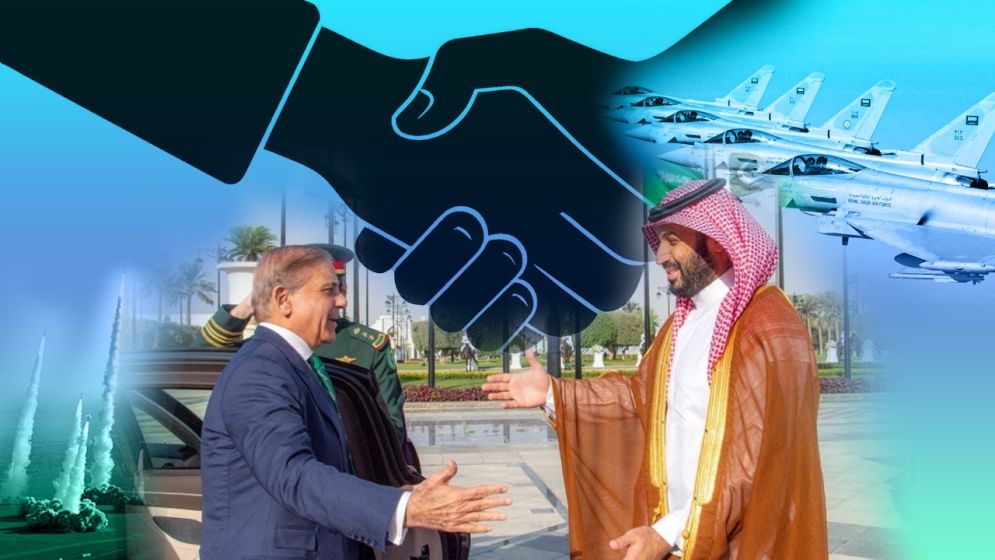
The signing ceremony in Riyadh last week was choreographed to look historic: Saudi Arabia and Pakistan inked a “Strategic Mutual Defense Agreement” (SMDA), flanked by generals and defense ministers, with solemn declarations about standing “shoulder to shoulder” against aggression.
On paper, the deal carries echoes of NATO’s Article 5–any attack on one will be deemed an attack on both. In practice, it is a studied exercise in strategic ambiguity.
Why now? The timing betrays the anxiety simmering in Riyadh.
The kingdom watched uneasily as Washington–its longstanding guarantor of security–proved unwilling, or unable, to halt Israel’s punishing bombardments of Hamas targets in Qatar, even as a major U.S. airbase sits there.
That perceived American hesitancy has pushed Saudi Arabia to dust off an old playbook: lean on Pakistan, the nuclear-armed partner it has propped up with bailouts and oil concessions for decades.
The logic is blunt. Pakistan provides the deterrent muscle, however symbolic, while Saudi Arabia dangles the promise of oil leverage in Islamabad’s perennial confrontation with India.
Should hostilities erupt on the subcontinent, Riyadh could choke off shipments and squeeze New Delhi. It is an arrangement that plays well in the fevered imagination of hawkish strategists in both capitals.
Yet this new defense pact may be less game-changer than stagecraft.
Pakistan has never credibly threatened Israel, beyond rhetorical salvos meant for domestic audiences. Even in wars with India–its declared existential rival–Islamabad has refrained from crossing the nuclear threshold.
To think it would brandish that arsenal against Israel, on Saudi Arabia’s behalf, stretches belief.
What the SMDA reveals, instead, is Saudi Arabia’s search for symbolic hedges as U.S. reliability wanes and Israel’s shadow lengthens. For Pakistan, it is another transactional embrace with a patron it cannot afford to alienate.
-68cd02aced5b3.png)
Where lies the pitfall?
The danger is not that the pact will radically redraw the security map.
The danger is that it convinces both publics–and perhaps their rivals–that more has changed than actually has.
For all the martial language of the Saudi-Pakistan defense pact, one must remember the quiet realities of Riyadh’s diplomacy. Israel and Saudi Arabia, despite their bitter posturing over Palestine, are closer than many care to admit.
Unlike Qatar, Saudi Arabia does not host groups Israel designates as terrorists. Security coordination between Riyadh and Tel Aviv has been an open secret for years, even if normalization remains politically unpalatable for now.
The same holds for India.
New Delhi is one of Riyadh’s largest oil customers, and the two are locked into ambitious infrastructure dreams like the India-Middle East-Europe Economic Corridor (IMEC)--announced with great fanfare at the G20 summit in Delhi before being shelved in the fog of the Gaza war.
Saudi Arabia has every incentive to preserve that relationship, even as it pays lip service to Pakistan’s grievances over Kashmir.
The idea that Riyadh would jeopardize its energy ties or impose an oil embargo on India to back Islamabad is little more than fantasy.
Here lies the crux: just as Pakistan has never credibly threatened Israel beyond fiery slogans, Saudi Arabia has never credibly threatened India despite its rhetorical solidarity with Pakistan.
The defense pact, then, is not a harbinger of new military alignments. It is political theater–a carefully staged gesture to soothe bruised egos after Israel’s strike on Qatar and to reassert the notion of Muslim military solidarity at a time when that solidarity looks increasingly fractured.
-68cd02c6e0079.png)
More symbolism than actual deterrence
The SMDA is thus less about deterrence and more about symbolism.
For Saudi Arabia, it is a reminder to its domestic audience and the broader Muslim world that it is not merely America’s client state.
For Pakistan, it is validation that its nuclear status still buys relevance in Riyadh. The strategic calculus of the region, however, remains unchanged.
Strip away the grand declarations, and the only plausible scenario where this pact might translate into real military cooperation is far more parochial: a resumption of Houthi strikes on Saudi soil.
Even then, history counsels skepticism.
When Riyadh called on Islamabad in 2015 to send ships, aircraft, and troops to support its bombing campaign in Yemen, Pakistan’s parliament refused. Unless Washington itself twists Islamabad’s arm, the likelihood of Pakistan rushing to Saudi Arabia’s defense remains slim.
The more sensational hypotheticals–that Pakistan would threaten Israel with nuclear weapons if Tel Aviv were to strike Saudi Arabia, or that Riyadh would choke off oil supplies to India in solidarity with Islamabad–border on fantasy.
Both scenarios ignore decades of restraint, transactional pragmatism, and the cold calculus of self-preservation that has defined Saudi and Pakistani choices.
That is why the Strategic Mutual Defense Agreement is best read not as a harbinger of a new security order but as an act of political theater.
Analysts and pundits–sometimes motivated by ideology, sometimes by wishful thinking–have rushed to inflate its significance.
But symbolism should not be mistaken for strategy. The SMDA is more a mirror of anxieties in Riyadh and Islamabad than a blueprint for future wars.
—