

Why the China factor shapes how New Delhi handles Ladakh

Faisal Mahmud
Publish: 05 Oct 2025, 10:29 PM
Shortly after India gained independence, a small delegation from the Himalayan region of Ladakh traveled to New Delhi to make a simple but prescient appeal to recognize their distinct identity.
The delegation was led by Kushok Bakula Rinpoche, a revered Buddhist monk and later India’s ambassador to Mongolia, whose vision helped carve Ladakh’s path toward administrative separation from Jammu and Kashmir.
Seven decades later, that vision culminated in 2019, when Ladakh became a Union Territory of India.
But the jubilation was short-lived. What was framed as an act of empowerment effectively stripped the Buddhist-Muslim enclave, perched at the sensitive tri-junction of China, Pakistan, and India, of the very autonomy it had long sought.
Since 2021, Ladakh has been simmering with discontent, as residents push for constitutional protections and genuine self-governance.
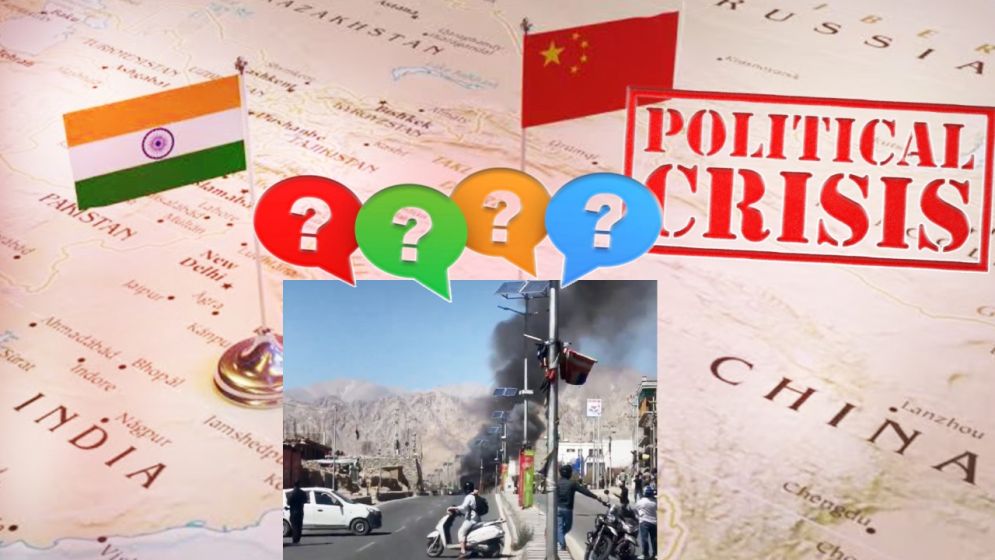
That anger boiled over on September 24, when a peaceful rally in Leh demanding statehood and inclusion under India’s Sixth Schedule, a provision granting special autonomy to tribal areas in the Northeast, descended into violence.
When tear gas and baton charges failed, security forces opened fire. Four people were killed, more than 50 injured, and the town’s calm was replaced with burned-out vehicles and bitterness.
The unrest has once again put the spotlight on Sonam Wangchuk, the engineer-turned-environmentalist whose hunger strike in September symbolized Ladakh’s deep frustration.
His subsequent detention under the draconian National Security Act of India–justified by authorities as a preventive measure–only reinforced perceptions that New Delhi views dissent in border regions as a security threat, not a democratic demand.
At the heart of Ladakh’s grievances lies the Sixth Schedule. Designed for India’s Northeastern tribal areas, it grants extensive powers to Autonomous District Councils, from land control and resource management to the preservation of cultural practices.
It also guarantees one crucial safeguard: protection against land transfer to outsiders, an issue that resonates deeply in a sparsely populated region where demographic shifts could alter the delicate balance between its Buddhist and Muslim communities.
Ladakh’s demand for Sixth Schedule protection is not new. It emerged immediately after the region’s separation from Jammu and Kashmir in 2019, when locals realized that Union Territory status meant direct rule from New Delhi–without the buffers of state representation or constitutional autonomy.
The India home ministry’s high-powered committee formed in early 2023 has moved at a glacial pace.
Talks in May yielded little beyond a vague promise of a domicile policy; the next round, tentatively slated for tomorrow (October 6), may again be postponed.
-68e29cbe035f9.png)
Simmering discontent
For Ladakhis, each delay deepens the sense that promises of autonomy were a mirage–traded away for central control.
For New Delhi, hesitation may stem from strategic calculus. The region borders China’s restive Xinjiang and Tibet, and Beijing’s incursions since 2020 have kept Indian forces on alert.
Extending Sixth Schedule autonomy to a border territory could be seen in the security establishment as politically risky, even if constitutionally justified.
But what New Delhi sees as strategy, Ladakh’s people increasingly see as betrayal. The region that once rallied behind the tricolor in defense of Indian sovereignty now finds itself demanding the same rights guaranteed to other tribal regions.
“There is no democracy in Ladakh, and the Sixth Schedule promise made to the public has not been fulfilled,” Sonam Wangchuk declared shortly before his detention.
The engineer-turned-climate activist, who famously inspired Aamir Khan’s character in 3 Idiots, has emerged as the conscience of Ladakh’s restive citizenry.
His words cut to the heart of a growing crisis: a sense of betrayal among Ladakhis who feel that New Delhi’s promises of autonomy have evaporated into bureaucratic control.
Local leaders warn that without constitutional safeguards, Ladakh’s fragile high-altitude ecosystem and indigenous culture risk being eroded by the influx of outsiders.
The protesters’ demands go beyond the Sixth Schedule’s tribal protections; they are also seeking full statehood, which would grant Ladakh an elected assembly, a chief minister, and authority over local governance, from law and order to public health and agriculture.
At present, the Union Territory is run directly from New Delhi through a lieutenant governor, leaving Ladakhis with limited say over their own affairs.
Officials argue that centralized administration ensures tighter security and more efficient governance in such a sensitive frontier. But that logic has worn thin since June 2020, when Chinese troops crossed into eastern Ladakh’s Galwan Valley, sparking the deadliest India-China clash in decades.
Twenty Indian soldiers and, by Beijing’s admission, four Chinese were killed. The standoff dragged on for nearly four years, underscoring how militarization has come to define Ladakh’s identity more than democracy ever did.
-68e29cd86a3a4.png)
Legal conundrum
The Sixth Schedule demand also poses a constitutional conundrum for India.
Extending it to Ladakh would require an amendment and could embolden other regions with sizable tribal populations to seek similar autonomy.
In Manipur, for instance, the Kuki-Zo communities are pushing for a Sixth Schedule-style arrangement amid ongoing ethnic tensions. New Delhi fears that Ladakh could become a precedent, not an exception.
Yet denying Ladakh these safeguards has its own risks. With a population of just 300,000, the demand for full-fledged statehood may seem ambitious, especially when even Jammu and Kashmir, a larger Union Territory with a legislative assembly, still awaits restoration of state status.
But for Ladakhis, the struggle is not about numbers, it’s about recognition.
The Centre’s recent outreach reflects that unease. On September 29, the Home Ministry said it was “always open to dialogue” with the Leh Apex Body (LAB) and the Kargil Democratic Alliance (KDA), expressing confidence that talks would “yield the desired results.”
But the LAB has already walked away from the negotiating table, insisting it will return only “if the right steps are taken” to restore normalcy before the next scheduled dialogue on October 6.
The standoff captures the paradox of India’s Himalayan frontier: a region celebrated for its patriotism and strategic value, yet governed as though its people cannot be trusted with self-rule.
In trying to keep Ladakh secure, Delhi may have made it feel less a part of India and more a subject of it.
The Leh Apex Body and the Kargil Democratic Alliance have now hardened their stance. They are demanding a judicial inquiry, led by a retired Supreme Court judge, into the September 24 killings, and the immediate release of all detainees, including Sonam Wangchuk.
For many in Ladakh, these demands are not merely about justice for one tragic day, but about restoring the moral contract between New Delhi and a region that feels increasingly governed through coercion rather than consent.
—