

Data, policy or procurement: What went wrong in Bangladesh’s measles outbreak?

Shaquib Ahmed
Publish: 01 May 2026, 09:37 PM
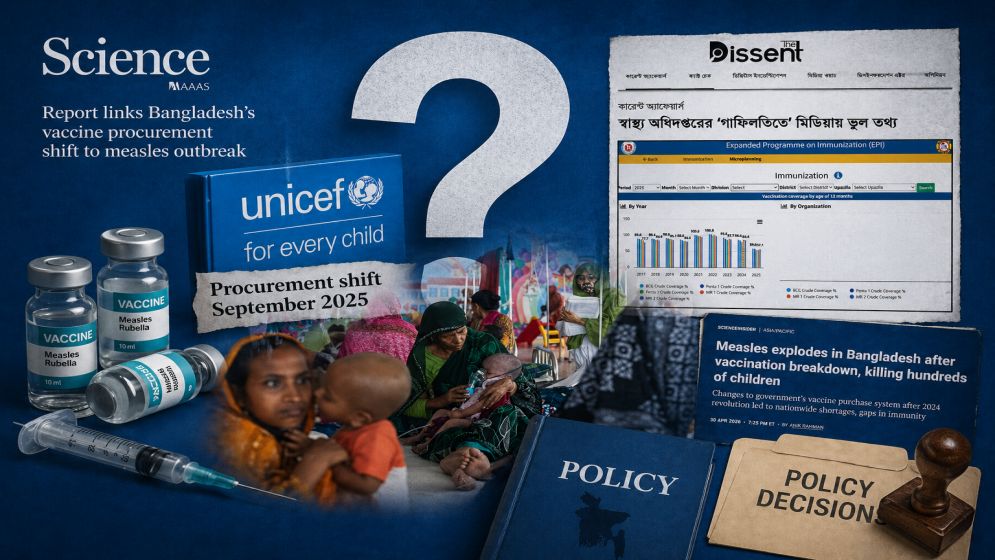
A report published Friday in the US--based Science magazine highlighted a specific policy shift in Bangladesh’s immunisation system, noting that the interim administration led by Muhammad Yunus replaced UNICEF-based vaccine procurement with an open tender mechanism in September 2025.
The report linked that change to subsequent vaccine shortages and argued that the disruption contributed to the country’s current measles outbreak.
The scale of the outbreak is no longer disputed. Bangladesh has recorded more than 37,000 suspected measles cases since March 2026, with over 5,000 confirmed infections.
Official figures indicate at least 49 confirmed deaths and more than 200 additional deaths with measles-like symptoms. Other aggregated estimates cited in reporting place the total number of child deaths above 250 when suspected cases are included.
The outbreak has spread across most districts, indicating systemic rather than localised failure.
For decades Bangladesh’s vaccine procurement system relied on UNICEF as its primary channel, supported by Gavi financing. The arrangement ensured predictable supply, standardised quality control and insulation from procurement delays.
The interim government replaced this with an open tender system, arguing that procurement through UNICEF had been conducted under an emergency provision not intended as a permanent arrangement.
The shift was framed as an attempt to normalise procurement under public financial rules, increase transparency and reduce reliance on a single external intermediary.
In practice, the change had immediate operational consequences.
Reporting by multiple Bangladeshi outlets indicates that the tender process introduced additional administrative stages—bid solicitation, evaluation and approval—that extended procurement timelines.
At the same time, a planned nationwide measles-rubella campaign, already postponed from 2024, was cancelled. Vaccine stocks fell below required levels, and routine immunisation coverage declined in several areas.
Internal estimates cited in reporting suggested that effective coverage may have fallen to around 59 percent in some cohorts, well below the threshold required to prevent measles transmission.
Warnings preceded the shift. UNICEF officials reportedly cautioned that a transition without parallel supply guarantees risked interruption, as pointed out by Science magazine’s report.
The government proceeded nonetheless. By early 2026, shortages of measles-containing vaccines were being reported, and immunisation sessions were scaled back or delayed across multiple districts.
How credible is the health adviser’s explanation?
The explanation offered publicly by Sayedur Rahman, health adviser to the chief adviser during the interim period, does not dispute the sequence of events but assigns causation differently.
His argument rests on three propositions: that Bangladesh’s immunisation system had already weakened before the procurement change; that measles outbreaks are inherently multi-factorial and cannot be attributed to a single administrative decision; and that the procurement reform itself was justified on governance grounds.
The first proposition is indeed supported by available evidence. Routine immunisation disruptions during the COVID-19 period are well documented by the World Health Organization and UNICEF.
Global coverage of the first dose of measles-containing vaccine fell from about 86% in 2019 to roughly 81% in 2021, leaving millions of children without protection. Bangladesh was part of this wider disruption.
Although national administrative coverage remained comparatively high, service delivery was affected by lockdowns, reduced outreach sessions and limited access to health facilities.
These disruptions meant that a proportion of children missed scheduled doses during 2020–2021, creating gaps that were not immediately visible in national averages but were epidemiologically significant.
Efforts to recover those losses were incomplete. Bangladesh planned large-scale measles-rubella catch-up campaigns after the pandemic, but these were repeatedly delayed and, in some cases, cancelled.
Reporting indicates that a nationwide campaign scheduled for 2024 was postponed and later not implemented in 2025, leaving a backlog of unvaccinated or partially vaccinated children.
At the same time, outbreak data from 2026 show that around 70–75% of infected children were unvaccinated, according to national surveillance cited in Bangladeshi media reports.
This pattern suggests that missed vaccinations during and after the pandemic translated into identifiable cohorts of susceptible children rather than a uniform decline in coverage.
Even where national coverage remained near or above 90%, evidence indicates increasing unevenness across regions and communities.
Immunisation systems in countries like Bangladesh typically exhibit variation between urban and rural populations and in hard-to-reach areas; when combined with disrupted services, these disparities can widen.
Measles is particularly sensitive to such variation because it requires very high population immunity—around 95%—to prevent sustained transmission, a threshold consistently cited by the World Health Organization.
Even modest declines or localised gaps can therefore enable outbreaks.
The pattern observed in Bangladesh—high overall coverage alongside significant transmission in multiple districts—aligns with this dynamic, where clustered immunity gaps rather than nationwide collapse drive disease spread.
The second proposition—that outbreaks are multi-causal—is analytically correct but does not resolve questions of proximate causation. Measles transmission depends on the presence of susceptible populations, but outbreaks of the scale observed in 2026 typically require a trigger that expands those populations or connects them.
In this case, the timing of the procurement change, the cancellation of campaigns and the reported supply shortages coincide with the expansion of the outbreak.
The third proposition—concerning the rationale for procurement reform—reflects a standard policy trade-off. Moving from a single-channel procurement system to open tendering can, in principle, increase competition and transparency.
Yet such transitions carry execution risk. Vaccine procurement differs from other forms of public purchasing in that supply interruptions have immediate epidemiological consequences.
The shift in Bangladesh occurred without a phased transition or guaranteed continuity of supply, increasing the likelihood of short-term disruption.
Questions and controversy over data
A further complication lies in the quality of vaccination data during the period.
A report by the fact-checking outlet The Dissent found that the Directorate General of Health Services published incorrect coverage figures on its official dashboard, indicating that measles vaccination coverage had fallen to around 57 percent in 2025.
These figures were widely cited in national media and entered public debate as evidence of systemic decline.
DGHS officials later acknowledged that the data were outdated and methodologically flawed. The dashboard reportedly combined incompatible indicators, including presenting second-dose coverage for age groups not yet eligible to receive it.
Internal immunisation data and external estimates indicated substantially higher coverage, with first-dose rates above 90 percent and second-dose rates around 90 percent.
The discrepancy matters for two reasons. First, it alters the interpretation of causation. A collapse from above 90 percent to 57 percent would imply a prolonged systemic breakdown.
A decline from around 90 percent to lower but still relatively high levels suggests instead a system with latent vulnerability, exacerbated by recent disruptions. Second, inaccurate data complicates policy response.
Overstating decline risks misallocating resources, while mischaracterising disruption delays corrective action.
The data problem also intersected with official communication. Statements by senior health officials suggested at one point that measles vaccination activities had been absent for years, contradicting administrative records indicating continued, if uneven, immunisation.
The combination of incorrect data and inconsistent messaging reduced clarity about baseline conditions at the onset of the outbreak.
Taken together, these elements essentially point to a more constrained explanation than either dominant narrative alone. Bangladesh entered 2025 with an immunisation system that had been weakened but not collapsed.
Coverage remained relatively high at the national level but uneven and incomplete in recovery from pandemic disruption, creating latent susceptibility, particularly in underserved areas.
The procurement change introduced in September 2025 altered supply conditions. By replacing UNICEF procurement with an open tender system without a transition buffer, the government increased the probability of delay.
Reporting indicates that such delays occurred, resulting in vaccine shortages and the cancellation of planned campaigns. These developments reduced effective coverage in specific cohorts and locations.
The outbreak that followed can therefore be understood as the interaction between pre-existing vulnerability and a contemporaneous supply shock.
Neither factor alone is sufficient to explain the scale of transmission; together they likely account for both its timing and its reach.
—