

World Press Freedom Day: The scope of press is being narrowed in Bangladesh

Publish: 02 May 2024, 11:57 PM
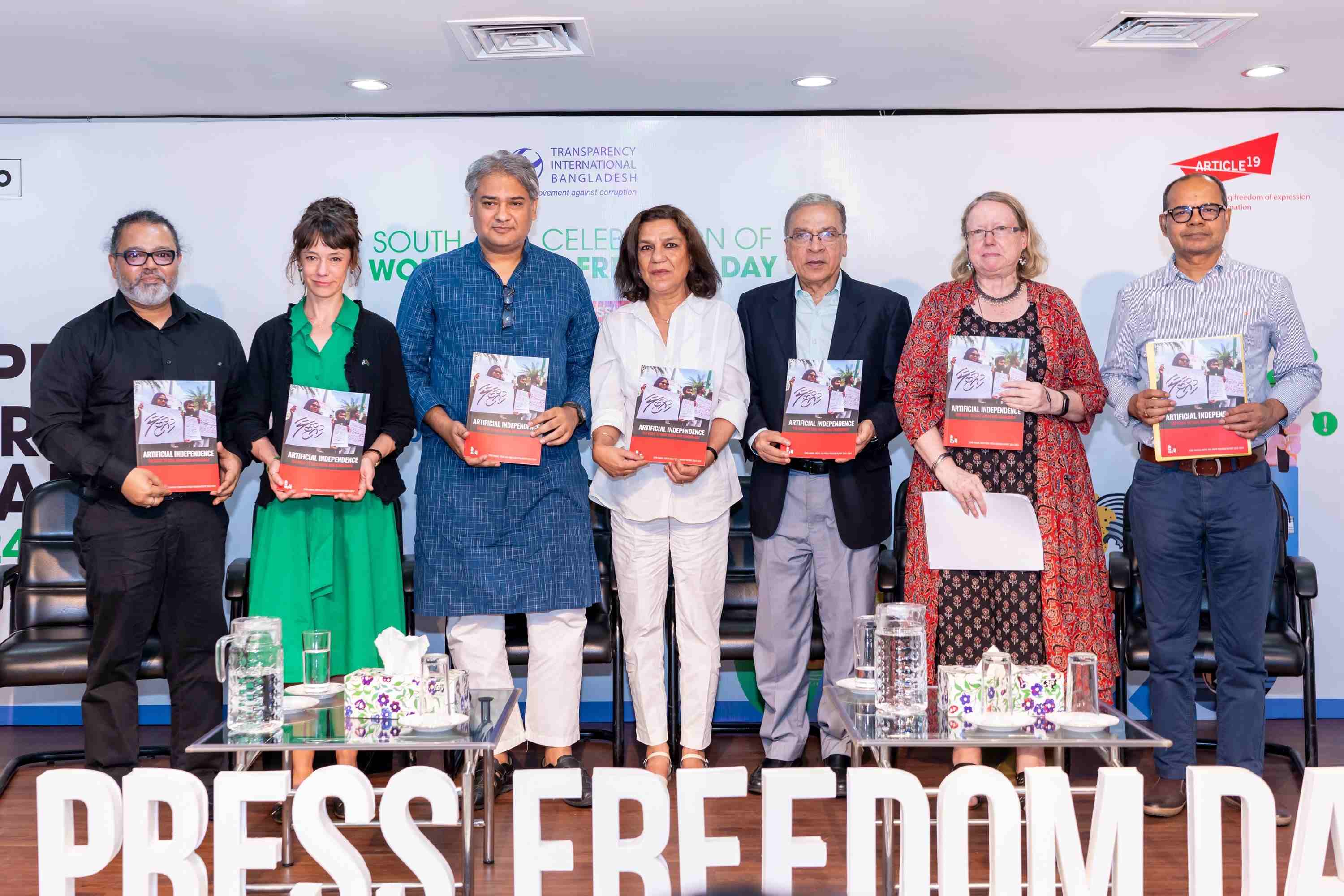
Participants unveiled the publication on the safety of journalists in South Asia region (Courtesy of TIB)
Media in Bangladesh is facing a multitude of challenges, including the shrinking space for press and civil society, the misuse of laws, and the politicization of state institutions responsible for ensuring accountability.
These concerns were raised at a discussion held today at the office of Transparency International Bangladesh (TIB) in Dhanmondi, Dhaka, to mark World Press Freedom Day, which is observed globally on May 3.
Participants in the discussion expressed concern over the increasing pressure on the media, which they said is leading to self-censorship and hindering investigative journalism. They also pointed to the misuse of laws, such as the Digital Security Act, to silence critical voices.
In addition, the politicization of state institutions, such as the police and the judiciary, is undermining their ability to hold the government accountable. This is creating an environment of impunity, where those in power can act with impunity.
State Minister for Information and Broadcasting Mohammad Ali Arafat however offered a different perspective on the issues. He said that the government is committed to upholding freedom of the press and that it has taken steps to improve the working conditions of journalists.
However, Arafat's comments were met with skepticism by many of the participants in the discussion. They argued that the government's actions do not match its rhetoric and that the situation for the media in Bangladesh is deteriorating.
Today’s discussions centered around the WPFD theme of this year – “A Press for the Planet: Journalism in the Face of the Environmental Crisis.” There were two separate panel discussions where the panelists talked about issues like the ongoing oppression against journalists and their safety concerns in the context of climate-related issues, freedom of expression and the press, tackling misinformation, and access to information.
Dr. Iftekharuzzaman, Executive Director of Transparency International Bangladesh (TIB), painted a concerning picture of press freedom in Bangladesh, particularly regarding environmental reporting. At the discussion, he revealed that 23 media outlets were attacked and 43 journalists were tortured while covering environmental issues from 2022 to 2023.
He also pointed out that 12 individuals, including environmental activists, were killed between 2016 and 2021 for opposing coal-based power plants. “The very people responsible for environmental protection are often the ones causing damage,” he said, adding that the need for an environment where journalists and civil society can hold these actors accountable.
However, he argued that the Digital Security Act and other repressive measures are shrinking this space. “The ‘zero-sum political game’ where journalists and activists are harassed through the misuse of laws must be stopped,” he added.
During her speech at the discussion, Susan Vize, Head of Office and UNESCO Representative to Bangladesh, stressed the importance of raising public awareness about climate change and other environmental issues. She identified the media as the “single most influential source of credible information for the public.”
Alexandra Berg von Linde, Ambassador to Bangladesh, Sweden Embassy, emphasized the strong link between public interest, climate change, and environmental degradation. She pointed out that the negative effects of climate change are becoming increasingly evident in people's daily lives and stressed the public's desire for information about the consequences of climate change.
During the Q&A session, when asked about the misuse of repressive acts like ICT, DSA & CSA, and safety concerns of journalists, State Minister Arafat got defensive and came up with a rebuttal. “We always talk about ensuring freedom of the press. However, in some cases, vested interests exploit this freedom to publish agenda-driven news and disseminate misinformation.”
He gave examples of such misinformation regarding Rampal or Adani power plants and said alongside ensuring media freedom, accountability must also be ensured. “If media freedom is misused to spread false information or disinformation, appropriate legal action should be taken. However, I will take necessary steps to ensure the protection of journalists in the country who report on environmental crises or climate issues based on truth and scientific evidence,” he added.
The first panel discussion titled “A Press for the Planet: Free Press and Freedom of Expression in the Context of Current Global Environmental Crisis” kicked off with the presentations of Shamsuddin Illius, Bureau Chief-Chittagong, The Business Standard, and Usraat Fahmidah, Freelance Journalist, regarding the challenges of journalism in environmental issues and training young journalists.
It was moderated by Sheikh Manjur-E-Alam, Regional Director, ARTICLE 19, while Mohammad Ali Arafat, State Minister of the Information and Broadcasting Ministry, was the chief guest. Alexandra Berg von Linde, Ambassador to Bangladesh, Sweden Embassy; Dr. Iftekharuzzaman, Executive Director, TIB; and Rejoan Haq, Editor-in-Chief, Maasranga Television, participated as panelists. A book on the Safety of Journalists in the South Asia Region was launched during the session.
The second panel discussion focused on the safety issues of journalists under the theme of “Media Defense for Crisis Reporting,” where journalists and experts from Bangladesh, Bhutan, Nepal, India, the Maldives, and Sri Lanka participated.
It was moderated by Shafiqul Alam, Bureau Chief, Dhaka, Agence France-Presse (AFP). The second session kicked off with the presentations of Ms. Sabina Inderjit, Vice-President, International Federation of Journalists, and Ms. Princess Giri Rashir, Meghalaya State Correspondent, EastMojo.
The panelists for this session were Hezekiel Dlamini, Advisor for Communication and Information for South Asia UNESCO New Delhi Regional Office; Ms. Yeshi Pelmo, Programme Officer, Journalist Association of Bhutan; Ms. Radhika Roy, Litigation Counsel, Internet Freedom Foundation; Mr. Mohamed Junayd Saleem, Senior Member, Maldives Journalist Association; Mr. Viranjana Herath, Chairperson/Founder, Media Law Forum; and Ashita Singh, Associate Project Officer, UNESCO New Delhi Regional Office.