

ESG compliance reporting system essential to boost trade, investment: DCCI President

UNB
Publish: 19 May 2024, 02:24 AM
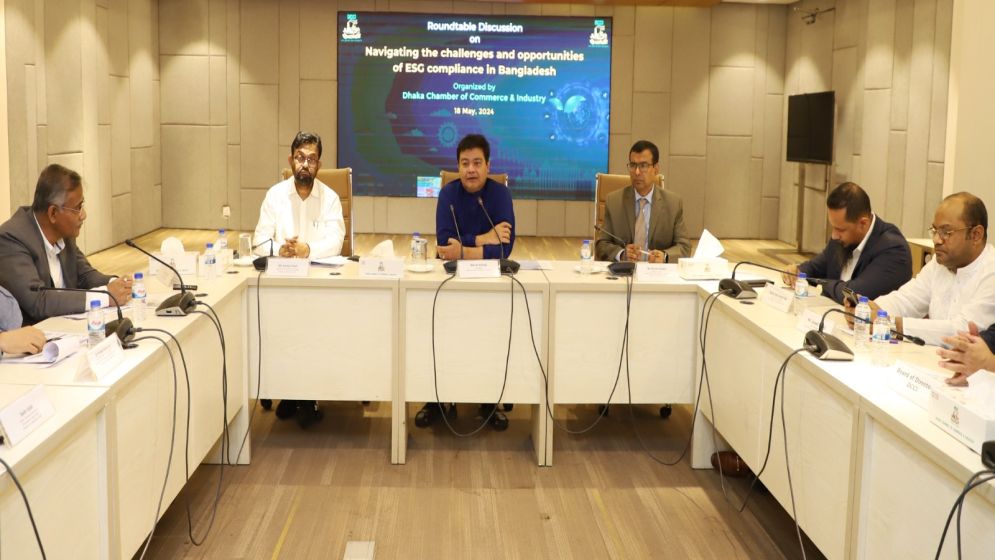
Dhaka,
May 18 (UNB)-Dhaka Chamber of Commerce and Industry (DCCI) President Ashraf
Ahmed said embracing Environmental, Social and Corporate Governance (ESG)
compliance framework will not only allow the businesses to align their values
and strategies with sustainability objectives, foster economic growth but also
remain competitive beyond LDC graduation.
The absence of culture,
weak corporate governance and lack of data are few of the challenges to adopt
ESG in Bangladeshi Industries, he also said.
The business leader said
these in a round table discussion titled "Navigating the Challenges and
Opportunities of ESG Compliance in Bangladesh" organised by DCCI on
Saturday.
He said as Bangladesh is
being more connected to the world and the country's international trade is also
increasing day by day, the ESG compliance is becoming mandatory for businesses.
Investors consider ESG factors when assessing a business's potential since it
is a sign of resilience and long-term financial health.
It may be mentioned that
the trend of ESG reporting is going upward in Bangladesh. Organisations in
different industries have started reporting on their ESG performance, and the
government bodies have also taken initiatives to promote and encourage ESG
reporting.
Taking into account the
importance of ESG compliance, the DCCI president recommended developing
effective ESG compliance strategies in alignment with the global value chain
and integrating ESG considerations into decision-making processes and
organization culture.
He also underscored the
need of educating the stakeholders including employees, management, investors,
regulators and the mass public about the importance of ESG compliance and its
reporting.
Moreover, ESG compliance
needs to be prioritized in embedding in other policies such as industrial
policy, SME policy etc., he added.
Md. Munim Hassan,
Director General of Department of Patent, Design and
Trademarks, Ministry of Industries, said that in every sector compliance
is mandatory and compliance always increases the credibility of business.
He said that for
environmental or social compliance all individuals should take responsibility
on their own shoulders. All should not look into what others do.
The DG later informed
that during 2016 to 2022 a total of 17 Bangladeshi products got GI whereas
since 2023 to till date already 14 products have got GI certification and 30
more are in pipeline to get GI.
Md. Anwarul Alam,
Director General (Additional Secretary), Bangladesh Accreditation Board (BAB),
Ministry of Industries, said Bangladesh Accreditation Board is directly linked
with ESG and it works for ensuring quality of goods and services and BAB's
certification is accepted world-wide.
He urged all to be
compliant and suggested the lab owners get accredited from BAB. The ESG is also
interlinked with the vision of Smart Bangladesh.
Keynote speaker Zaku Uz
Zaman, Country Representative of UNIDO, Bangladesh, said the term
"ESG" came into use in the early 2000s, but its foundations were laid
in the 1990s. ESG works as an evaluation of a firm's seriousness in engaging
with environmental, social and governance factors. Nowadays investors are
progressively focused on how a company influences society.
He said that there is no
defined format for ESG reporting that makes it challenging for the management
to understand what is required to be reported. Compliance with ESG reporting
can help Bangladeshi companies to be competitive after graduation from LDC.
Dr. M Niaz Asadullah,
Visiting Professor of Economics, University of Reading, UK, Mohammad Bin
Quasem, Director, Echotex Ltd., Yeasmin Akther, Business Manager, Knowledge,
Health and Nutrition, SGS Bangladesh Limited, M Abu Horairah, former Vice
President, DCCI, Enamul Haque Patwary, former Director, DCCI and Rashid Shah
Shamrat, former Director, DCCI also spoke on the occasion.
Speakers stressed the
need for an ESG policy, creating awareness, having monitoring and reporting
systems.
They also suggested
orienting people about what the ESG is. For the sake of environmental safety a
massive afforestation across the country is needed and a concerted effort to
implement the rules and regulations for the ESG in the country.
End/UNB/MK/SU