


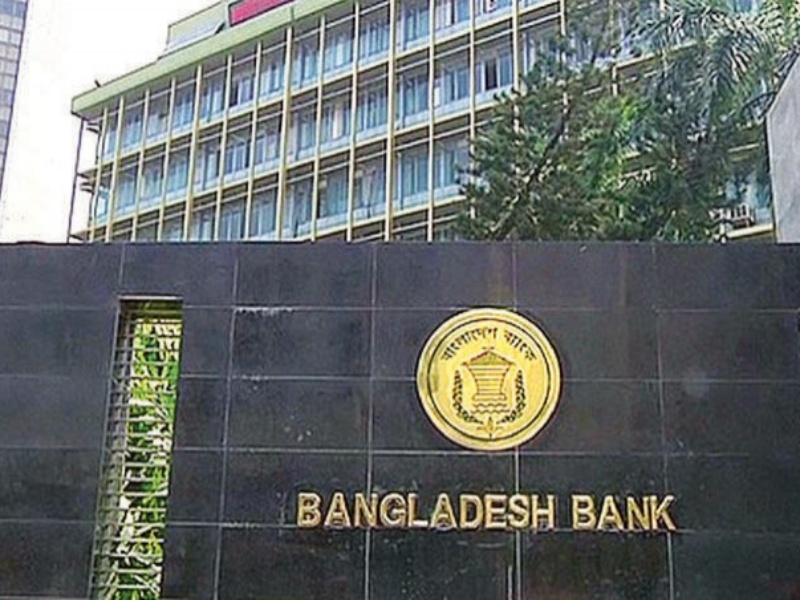
Bangladesh Bank advised the government to halt loan issuance by printing money. On Monday, Prime Minister Sheikh Hasina chaired a meeting of 78 secretaries and heads of various autonomous government institutions, where Bangladesh Bank's advice was shared in a PowerPoint presentation.
The PowerPoint presentation by Bangladesh Bank highlighted the recent challenges faced by the country's economy amid the global uncertainties, including high inflation, an unstable exchange rate, increasing debt problems in the banking sector, and pressure on foreign exchange reserves. To address this situation, Bangladesh Bank emphasised on the need for austerity in fiscal policy and other measures for the second half of the current fiscal year 2023-24 in order to control inflation and enhance efficiency in the financial sector.
According to the central bank's report, the government's debt from the central bank was Tk 1 lakh 28 thousand crores in September 2022, which decreased to Tk 71 thousand crores by September 2023, indicating a decrease of Tk 57 thousand crores in the given timeframe.
To control inflation, Bangladesh Bank outlined several essential steps currently being implemented, including increasing the policy rate for interest policy, introducing an interest corridor by transitioning from targeting reserve money to interest structure, removing the interest rate limit on deposits and loans, suspension of lending to the government through overprinting money, controlling import costs, managing the increase in export income and remittance inflow, introducing a single exchange rate for foreign currency, enhancing supervision in the foreign exchange market, and meeting the import costs of essential goods from reserves.
Furthermore, various funding schemes have been initiated for vital sectors such as agriculture and import-substitute industries to alleviate supply-side constraints. These schemes involve selling US dollars (around $5.0 billion sold during July-December 2023) to shrink the liquidity crisis in the local currency market. Additionally, specific steps have been outlined in the monetary austerity policy for the second half of the current financial year, aiming to reduce overall inflation to 6 per cent by the end of June 2024.
Last October, food price inflation surged to 12.56 per cent, the highest in recent times. Overall inflation also increased, with headline inflation averaging 9.93 per cent in October, the highest in five months.
Bangladesh Bank has adjusted the interest rates to address inflation in the country. To enhance liquidity management within banks, the policy interest rates on the upper limit of the corridor Standing Lending Facility (SLF) have been reduced by 25 basis points to 9.50 per cent from the previous 9.75 per cent. Additionally, the lower limit of the corridor Standing Deposit Facility (SDF) has been increased by 75 basis points from 5.75 per cent to 6.50 per cent.
Furthermore, a new exchange rate system has been introduced to stabilise the Tk-Dollar exchange rate. This move is accompanied by continued efforts to provide necessary credit to more productive sectors such as agriculture and import-substitute industries. As a result of these policy measures, along with a downward trend in global commodity prices, anticipated production of Aman paddy and increased supply of winter vegetables, inflation is expected to decrease in the coming months.