


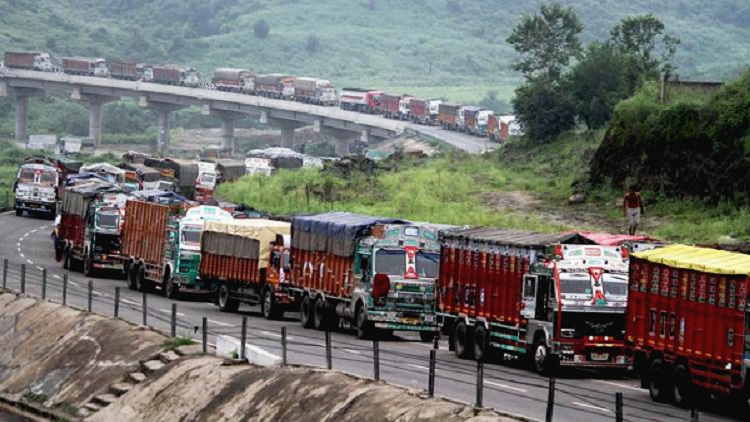
To maintain the supply of products in the Bangladesh market during Ramadan, the government has announced a reduction in import duties on eight remaining daily food items, including chickpeas, onions, and oil. However, according to sources from the Ministry of Commerce of Bangladesh, India remains sceptical about Bangladesh's yearly import commitments for these products.
Concerns have been raised regarding the uncertainty surrounding Bangladesh's regular import of these products from India. This uncertainty has hindered the Commerce Ministry's proposal to import eight products at reduced prices, especially amidst the ongoing boycott movement against Indian products. As a result, the proposal has yet to materialise, dampening hopes for its implementation.
Speaking anonymously, an official from the Ministry of Commerce expressed hope that at least eight products, including sugar and onions, would be imported from India ahead of Ramadan, even if they don't meet the quota. The commerce ministry is currently banking on the Narendra Modi government's approval for sugar imports.
Another official negotiating the import quota of eight products with India mentioned, "We have a plan to import eight products," referring to India's perspective. However, there remains uncertainty as to whether the government of Bangladesh can guarantee the annual import of these eight products from India. In times of need for extra food grain, the Indian government might instruct local farmers to produce more for Bangladesh. The mechanism for ensuring this arrangement is causing concern on both sides.
He further explained that the issue is more complex than it may seem. Many believe that if traders are brought to all parts of the country through the Trading Corporation of Bangladesh (TCB), the prices of everyday products could be reduced. Additionally, our government has sufficient production of onions and rice. So, the question arises: why do we need to import these products?
He highlighted that the production of various food grains in Nepal and Bhutan faces challenges due to their terrain, which is characterised by more rock than soil. Consequently, these countries heavily rely on quota imports of food grains from India to meet their population's needs. Conversely, in Bangladesh, food grains are predominantly produced from the soil.
The official emphasised that while Bangladesh intends to import the same amount annually, the Indian government remains sceptical about this commitment. Bangladesh has sought assurances from India for the supply of 45 lakh tonnes of wheat, 7 lakh tonnes of onions, 30 thousand tonnes of lentils, 20 lakh tonnes of rice, 15 lakh tonnes of sugar, 10 thousand tonnes of garlic, and 1 lakh 25 thousand tonnes of ginger every year.
In addition, State Minister for Commerce Ahsanul Islam announced last week that Bangladesh plans to import 1.5 lakh tons of sugar and onions from India before Ramadan.
Agricultural economist Dr. Jahangir Alam emphasised enhancing diplomatic trade with India. He expressed concerns that relying solely on sudden imports during fasting periods could be impractical.
Dr Alam also criticised the government for creating dependence on food grain imports by heeding the demands of local traders. He suggested that efforts should be directed towards increasing domestic food grain production.
In January, Bangladesh Bank issued a circular allowing traders to import the remaining eight daily commodities under payment agreements within 90 days before Ramadan. These commodities include edible oil, chickpeas, pulses, peas, onions, spices, sugar, and dates, which can be imported under supplier and buyer credit until next March. However, the Indian government has imposed restrictions on the export of almost all products, with various conditions in place.
Even India has announced its refusal to reduce the export duty on sugar, onions, and rice. Consequently, Bangladeshi businessmen are forced to import daily necessities, including foodstuffs, at higher prices. As a result of India's stringent conditions, imports have decreased by 1,61,104 tons compared to the same period in the previous financial year.
Furthermore, the National Board of Revenue (NBR) has alleviated the impact by reducing the import duty on rice, onions, and sugar. Import duties on dates, refined and unrefined sugar, rice, and edible oil have been decreased. The import duty on dates has been set at 15 per cent, down from the previous 25 per cent. Previously, the import duty on each tonne of unrefined sugar was Tk 3,000, but it has now been reduced to Tk 1,000.
On January 24, during a courtesy visit by the High Commissioner of India to Bangladesh, Prannoy Verma, to the secretariat, the Minister of State for Commerce Ahsanul Islam Titu handed over a list of essential products to the Indian government. The list included onions, sugar, rice, pulses, flour, and ginger-garlic, urgently needed for import into the country. Notably, Bangladesh has been requesting quota benefits from India for eight essential products to meet daily demand.
Previously, former Commerce Minister Tipu Munshi had written multiple letters and held meetings with relevant authorities regarding the quota facility, but no progress was made. However, after assuming office, the new Minister of State for Commerce resumed efforts on this matter. Even during the courtesy meeting with the Indian High Commissioner, the issue was paramount.
During the meeting, Prannoy Verma informed the Minister of State for Commerce that the Government of India was closely monitoring the matter and assured that India would support Bangladesh on any issue beneficial to both countries.
The State Minister for Commerce reiterated that the Bangladesh government would provide India with essential products, particularly items such as onions, sugar, and ginger-garlic, to facilitate emergency imports.
Furthermore, the Minister emphasised the importance of signing a memorandum of understanding to formalise this process. He stated that India is a sincere friend of Bangladesh and has consistently supported Bangladesh during times of crisis, promising continued support.