

40% of families borrow to purchase food despite surge in millionaires

Publish: 19 Mar 2024, 07:44 PM
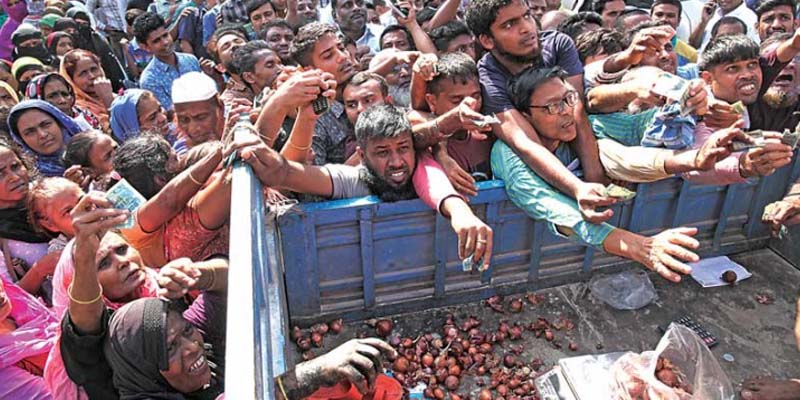
The number of customers holding crores of taka in banks is on the rise, indicating a growing population of millionaires in the country. Concurrently, United Nations data reveals that at least 40 per cent of households have resorted to buying food on credit since last December amidst escalating inflation and economic crises. The latest figures from Bangladesh Bank show approximately 117,000 individuals and institutions possessing crores of taka in their bank accounts.
According to the United Nations World Food Program (WFP) report on Bangladesh's food security, in January of this year, 43 per cent of the country's families resorted to borrowing to purchase food, while 17 per cent of the total population faced food insecurity.
In December of the preceding year, 40 per cent of families needed to borrow for food purchases, with 15 per cent of the total population experiencing food insecurity. In November, the month before, 42 per cent of families borrowed for food, and 18 per cent of the total population faced food insecurity.
Meanwhile, stakeholders within the banking sector highlight that the surge in commodity prices disproportionately affects the lower and middle classes, rendering them unable to manage their household expenses. Consequently, many individuals withdraw their previous savings instead of depositing funds into banks. Despite this scenario, a particular segment of society is experiencing an increase in income, comprising the affluent and large corporations.
The latest data from the central bank indicates that as of December 2023, the total number of depositors in the banking sector amounted to 15 crore 35 lakh 60 thousand 937. Among these, deposits totalling 17 lahks 49 thousand 132 crores taka were recorded. Notably, there are 1 lakh 16 thousand 908 bank accounts with deposits exceeding one crore taka, totalling 7 lahks 41 thousand 466 crores. This signifies that 42.39 per cent of the total deposits in the country's banking sector originate from account holders with one crore taka balances.
Central bank officials clarify that the calculation of crores doesn't necessarily imply that the corresponding number of individuals are millionaires. This is because the list includes numerous institutions alongside individuals holding more than one crore taka in the bank. Moreover, there isn't a specific limit on the number of bank accounts individuals and organisations can open, leading to instances where one entity or individual possesses multiple accounts. These accounts often include those of various government institutions and organisations with significant balances in crores of taka.
During the third quarter of last year (July-September), 113,586 bank accounts held deposits exceeding one crore taka, totalling 7,25,550 crores. Subsequently, in the following quarter (October-December), the number of such accounts increased by 3,322, while the total deposits surged by 15,912 crores.
According to Bangladesh Bank's data until December 2023, the number of accounts holding deposits between 1 crore and five crores reached 92,516, amounting to 1,94,336 crores. Deposits ranging from 5 crores 1 to 10 crores totalled 89,451 crores across 12,652 accounts. Additionally, there were 4,082 accounts holding deposits between 10 crores and 15 crores, 2,002 accounts between 15 crores and 20 crores, 1,345 accounts between 20 crores and 25 crores, and 912 accounts between 25 crores and 30 crores. Furthermore, there were 512 accounts between 30 crores and 35 crores, 480 accounts between 35 crores and 40 crores, and 738 accounts between 40 crores and 50 crores. Lastly, the number of accounts with deposits exceeding 50 crores stood at 1,812.
According to data from the Bangladesh Bureau of Statistics (BBS), the number of millionaire depositors in the country has seen a significant increase over the years. In 1972, just after independence, there were five millionaire depositors, which rose to 47 in 1975 and further increased to 98 in 1980. Subsequently, there was a notable rise, with 943 millionaire account holders in 1990, 2,594 in 1996, 5,162 in 2001, 8,887 in 2006, and 19,163 in 2008.
By the end of December 2020, the number of millionaire depositors had reached 93,890, rising to 1,00,1976 in December 2021 and further to 1,09,946 in December 2022. Finally, as of December 2023, the number of such accounts increased to 1,16,908.
However, alongside this economic growth, Bangladesh is facing chronic food insecurity, with nutritionists warning of potential negative consequences in the future. This includes an increase in malnutrition, particularly among children, leading to visible signs of extreme thinness. Moreover, unemployment is expected to rise, potentially impacting the country's demographic dividends. Long-term effects of food insecurity include decreased human productivity, which could have adverse effects on the economy.
The country has been experiencing high inflation for the past two years, exacerbated by the Russia-Ukraine war. Inflation has consistently outpaced wage growth for 24 consecutive months, leading to a decrease in people's purchasing power. This has resulted in reduced savings, increased cost of living, and a reliance on borrowing or depleting savings to purchase essential goods, especially rice and pulses.
Beyond essential goods, people have also reduced their purchases of other products, leading to reduced sales for industrial companies and potential layoffs. However, economists note that the impact of these factors has been somewhat mitigated by monetary policy.
A report from the World Food Program (WFP) highlights the challenges faced by low-income individuals, particularly daily wage workers, rickshaw pullers, and van drivers, who were unable to work for most of the day due to severe winter conditions in January. Female-headed households, in particular, faced increased difficulties in providing food, with women workers receiving lower wages than men. Some families had to rely on financial support from relatives or acquaintances.
Seven out of ten households have adopted strategic livelihood measures in response to the crisis, including borrowing money and selling productive assets. The prominence of borrowing for food purchases has made it increasingly challenging for the middle class, raising concerns about the potential emergence of a generation facing malnutrition and food shortages.