


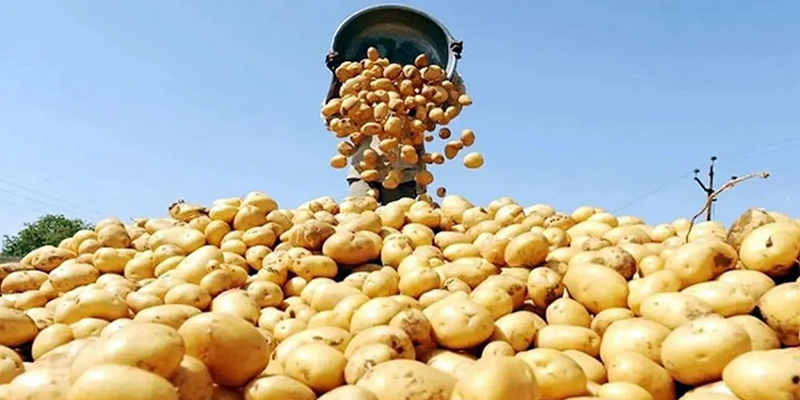
There might be a decrease in potato production in the country in the current season. Despite this, local businessmen have shown reluctance in importing Indian potatoes. Economists fear that this situation could lead to an increase in prices, making potatoes a lucrative commodity for profiteers.
According to economists, a conspiracy among government-nominated importers has become apparent. Due to low profits and the beginning of the local potato harvest, Bangladeshi businessmen are not interested in importing potatoes from India.
Last year, potato prices consistently increased, reaching 60 to 70 BDT per kilogram. As a result, in the last week of October, the government allowed businessmen to import potatoes for the first time, permitting the import of 159,000 metric tons of this carbohydrate-rich vegetable. However, until March 24, importers had only brought in 3,150 tons of potatoes.
An importer from Parbatipur, Dinajpur, who wished to remain anonymous, mentioned that potato prices in West Dinajpur, West Bengal, and its surrounding districts are almost the same as in Bangladesh. After accounting for transportation costs and potential crop damage, it has become challenging to even maintain a 5% profit margin.
He mentioned that the wholesale prices in Dinajpur, Rangpur, and Nilphamari are currently between 27-30 BDT, which is almost 20% higher than last year. This makes it more expensive to bring these potatoes to the local market for sale.
The importer pointed out three reasons for not importing Indian potatoes: they spoil quickly, selling Indian potatoes is not profitable, and the 'Boycott India' movement, which has led to customers refusing to buy Indian potatoes.
According to the Department of Agricultural Extension (DAE), last year's potato production was 10.4 million tons. This year, the government has set a target to collect 11.6 million tons of crops. So far, farmers have collected 9 million tons or 84% of the target.
Market insiders say the annual demand for potatoes in the country is around 10 million tons.
Md. Kazi Mahbub Morshed, Organizational Secretary of the Bangladesh Potato Exporters Association, informed the media that potato fields in the Rangpur and Rajshahi regions were damaged by diseases due to excessive cold in January and February this year.
He advised providing accurate information on crop damage and its impact this year, recalling similar damage seen in potato fields in 2007. Back then (2006-07), farmers had to sell potatoes at 3 to 4 BDT per kilogram towards the end.
A DAE official stated that the government would continue to allow imports as there are concerns about crop damage this year.
He mentioned that if local production is not sufficient to meet the demand, importers might bring in potatoes from India for extra profit. On the other hand, hoarders might not be able to profit from low domestic production.
He also noted that potatoes produced in the northern districts were affected by fungus, but Munshiganj, another potato-producing area, had a good harvest this year.
Professor Golam Hafiz Kennedy from the Department of Agricultural Economics and Banking at Bangladesh Agricultural University mentioned that, besides fungal diseases, the tendency to harvest immature potatoes during January-February and potential price drops have also contributed to higher potato prices this year, adversely affecting consumers.
He suggested that, for better market management, the Bangladesh Bureau of Statistics (BBS) should provide accurate production data immediately after the harvest season in January-February.