

The interim government’s reform agenda faces a tipping point

Zia Hassan
Publish: 31 May 2025, 10:21 PM
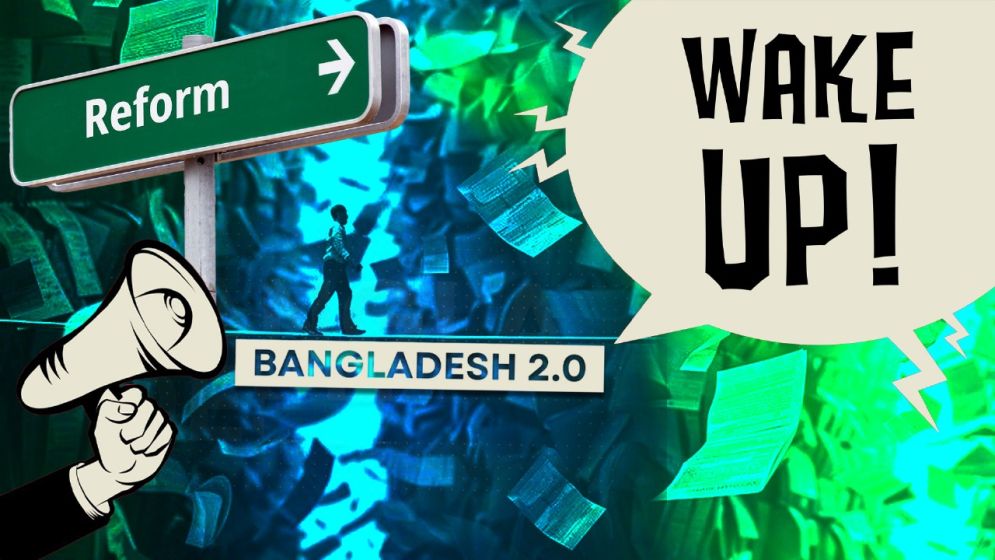
Nation-building is an endless chain of choices–each fork leading to a dozen more, all tangled with trade-offs. And without a coherent vision to navigate that maze, reform turns into roulette. You spin, you guess, you hope.
Want to boost GDP? Sure, pump public money into development. Deficits swell, people get hired, projects take off. But soon enough, so do debt repayments–fueled by the usual corruption and inefficiency.
Prefer a leaner government? You might empower citizens and invigorate the informal economy. But the formal job market–propped up by government spending–will shrink. Lay off too many bureaucrats, and the system sputters.
Try governing with ironclad integrity, and you’ll hit another wall. Bureaucrats–already risk-averse–go into paralysis. They stall, mostly out of fear.
Yet the money saved from plugging leaks in the system? That could be redirected to real services–education, infrastructure, healthcare–that actually work. Productivity rises, employment follows.
Or take law enforcement. Want to clean up the police? Fine. Fire the corrupt. But prepare for a temporary surge in instability. Order, it turns out, isn’t just about uniforms–it’s about transitions managed wisely.
We’ve seen this all before. The Women’s Reform Commission, for example, revealed just how fractured stakeholder interests can be. Ignore that, and your grand vision collapses under the weight of its own contradictions.
Which brings us to today. Amid this chaos of options, what was the leadership’s response? To anchor the reform process in a singular, guiding vision. No. Instead, you cobbled together six experts from wildly different backgrounds and called it a commission.
No cohesion, no strategy–just a patchwork committee tasked with solving foundational issues.
Predictably, the outcomes clashed. On women’s representation, the Constitution Reform Commission proposed adding 100 seats. Meanwhile, the Election Commission Reform Commission proposed fitting the same 100 seats within the current 300!
And what did the leadership do when faced with these contradictions? Nothing. You froze. You paused every initiative, claiming you were “waiting for consensus.” But consensus, like vision, doesn’t come from waiting. It comes from leadership.

Into deaf ears
Amid all the talk of reform, the loudest signal from the mass uprising–the demand to overhaul the police–remains deliberately undermined.
Let’s be clear: the police force in Bangladesh was the sharpest instrument of Awami League authoritarianism. Torture cells weren’t hidden; they were institutionalized. The people responded in the only language they felt was left–by burning down nearly 80% of the country's police stations.
That was essentially a rejection. A referendum. A line drawn in fire. And what have you done since?
You’re restoring the very machinery of repression that people risked their lives to dismantle. You’ve made no structural changes. You’ve brought back the same personnel, with the same loyalties, under the same culture of impunity.
You haven’t just failed to act–you’ve chosen betrayal over courage.
Even the Police Commission’s report–however flawed or incomplete–hasn’t been allowed to surface in the Consensus Commission’s discussions. Reform was supposed to be the first order of business. You’ve made it the last.
But let’s not pretend you’re short on ideas. You're drowning in them.
As someone working inside a government ministry on a development project, I’ve seen it firsthand. Shelves stacked with reports–costing crores of takas–meticulously laying out what needs to be done and how to do it. You don’t need new research. You need resolve.
To be frank, the reform roadmap doesn’t require some elite think tank to reinvent the wheel. It requires two or three capable people in every ministry to extract the actionable items already sitting in those reports, prioritize them, and drive them forward.
It requires leadership to say: This is what we’re doing, this is who’s responsible, and this is how we’re funding it. Because none of this matters unless it shows up in the national budget.
Until reform is budgeted, it's just noise. Until priorities are operationalized with actual line items, it’s all theater.
-683b2c15d65d9.png)
Reflections of incapabilities
The proposed 2025–26 budget tells us everything we need to know.
There is not a single line item dedicated to implementing reforms. No allocations, no operational plans, no signals of commitment. Which means you’re about to waste another fiscal year–squandering time, public trust, and whatever remains of this rare national momentum.
You can spin narratives for political parties. You can give talking points to the press. But what will you say to those of us who have spent the last decade mapping out reforms, policy frameworks, and visions for a better Bangladesh?
You’ve turned reform into a buzzword–one that now rings hollow. So when political actors treat “reform” as just another tool to extend their grip on power, don’t act surprised. You’ve handed them the blueprint for cynicism.
Frankly, I don’t know a single serious economist who believes you’re sincere. Not one. Among professionals, there’s broad consensus: in the name of reform, you are methodically wasting a once-in-a-generation opportunity to reshape this country’s future.
And yes, that may sound harsh. But someone needs to say it plainly.
Because what we’re witnessing is basically sabotage, cloaked in process. The door to genuine transformation was opened. And rather than walk through it, you stood there, hedging, delaying, making sure no one else could pass through either.
And the heart of the matter is painfully simple: You have no vision. No clear idea of what kind of Bangladesh you’re trying to build. No philosophy guiding your choices. Just noise, contradictions, and commissions without a compass.
Reform doesn’t fail because of complexity. It fails because of cowardice–because when the moment demanded clarity and conviction, you offered neither. And the clock is still ticking.
—
Zia Hassan is a writer and an analyst