

Two uprisings, one liberation war, yet no Democracy: Bangladesh’s cycle of democratic disillusionment continues to linger

Touhid Faruq
Publish: 06 Jun 2025, 12:57 PM
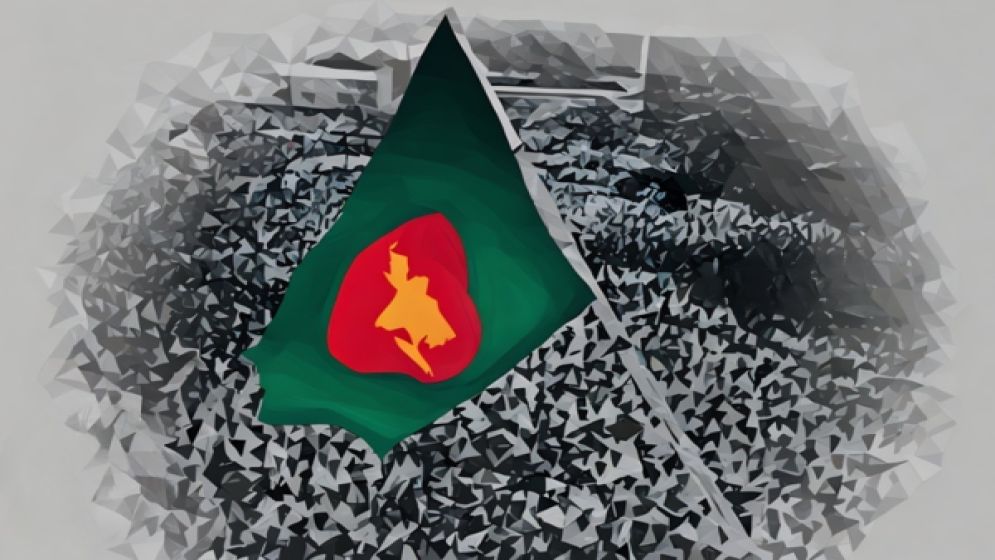
The birth of Bangladesh in 1971 was way more than a geopolitical realignment or ethnic division. It was the violent outcome of a failed military attempt to crush a democratic mandate.
When the Awami League, representing what was then East Pakistan, swept the 1970 general elections, the ruling establishment in West Pakistan refused to cede power. Instead of accepting the people’s verdict, they sent in tanks.
On the night of March 25, 1971, the Pakistani military launched Operation Searchlight–a massacre designed to obliterate the democratic will of an entire region. It failed. After nine months of brutal war and genocide, Pakistan surrendered on December 16, and the People's Republic of Bangladesh emerged, baptized in the conviction that sovereignty must be earned, not granted.
But if liberation promised democracy, the decades that followed told a grimmer story.
The nation’s founding leader, Sheikh Mujibur Rahman–beloved as the "Father of the Nation"--dismantled the very institutions he once fought to establish. In 1975, Mujib abolished multiparty democracy and imposed a one-party system under the banner of BAKSHAL.
Fundamental freedoms were curtailed, the press muzzled, and elections turned into farce. Ballot boxes were infamously looted and flown by helicopter, only to announce outcomes that reeked of orchestration instead of democracy.
His assassination later that year triggered a cycle of coups, ushering in direct military rule. A cabal of officers seized power, and democracy was shelved. Amid the chaos, General Ziaur Rahman rose from house arrest during "Sipahi-Janata Biplob" (Soldier-People Uprising), eventually becoming president and restoring a veneer of multiparty politics.
His legitimacy, too, was ratified through elections–but his life, like Mujib’s, ended in assassination.
The power vacuum invited yet another general: Hussain Muhammad Ershad, who seized control in 1982 and ruled for nearly a decade. Under his regime, two national elections were held. Both were boycotted. Both were won–conveniently–by his own Jatiya Party, running virtually unopposed.
It took a student-led uprising to unseat him. In 1991, under a neutral caretaker government, the nation finally held a credible election. Khaleda Zia, widow of Ziaur Rahman, became the country’s first female prime minister, marking a rare moment of democratic clarity in an otherwise stormy political landscape.
Yet the lesson lingers: Bangladesh was born in the name of democracy, but its institutions have rarely been allowed to flourish without interruption.
From ballots stolen by helicopter to generals ruling with impunity, the country’s political history reads less like the chronicle of a republic, and more like a perpetual struggle to reclaim the promise of 1971.
A new system and its collapse
The fragile experiment with democracy in Bangladesh took a more convoluted turn in 1996, when a caretaker government–originally lacking constitutional basis–triggered yet another political crisis.
The ruling Bangladesh Nationalist Party (BNP), hoping to avoid further unrest, staged elections without the caretaker framework and unsurprisingly declared victory. But the legitimacy of that win collapsed under public pressure, forcing the BNP to pass legislation institutionalizing the very system it had initially bypassed.
A second election that same year, under a newly sanctioned caretaker government, brought an unexpected coalition to power: the Awami League, allied with the Islamist Jamaat-e-Islami. For a brief moment, the democratic process appeared to recalibrate.
By 2001, another transfer of power through the caretaker system returned Khaleda Zia and her BNP-led four-party alliance to government. Yet by 2006, the system imploded. A military-backed caretaker regime hijacked the process and overstayed its constitutional mandate, ruling by fiat for over two years.
This period marked a cold suspension of democracy. Both Sheikh Hasina and Khaleda Zia–the twin pillars of Bangladeshi politics–were imprisoned. A now-infamous “Minus Two” formula, allegedly backed by foreign diplomats and promoted by Army Chief Moeen U Ahmed, attempted to exile both leaders from politics entirely.
Eventually, a compromise was struck. Hasina was released, reportedly through negotiations brokered by military intermediaries and foreign actors. Khaleda Zia followed.
But the 2008 election that ensued was anything but free from controversy. Redistricting efforts, critics argued, were carefully engineered to deliver the Awami League a two-thirds parliamentary majority. The outcome confirmed their fears.
The international community, eager to support democratic transitions, hailed the election as a success. In truth, it was the start of a monopoly on power.
Once in office, the Awami League moved quickly to consolidate control over every lever of the state. The judiciary lost its independence. Dissenting voices in the press and civil society were targeted.
A massacre of Islamist protesters at Shapla Chattar in 2013 sent a chilling signal: opposition, whether religious or secular, would be crushed. Enforced disappearances, arbitrary arrests, and extrajudicial killings became tools of governance.
The caretaker system–the last procedural safeguard of electoral fairness–was abolished by the very party that had once benefited from it.
As BNP-backed candidates began to win key municipal races, the government changed the rules of the game. The 2014 general election was a spectacle of manufactured consent. Half the parliamentary seats went uncontested.
Jatiya Party leader H.M. Ershad–himself a former dictator–later claimed he was forced at gunpoint to participate in the vote, lending a patina of credibility to an otherwise empty ritual.
From 2008 to 2014, Bangladesh shifted from soft authoritarianism to something far more severe. International watchdogs sounded the alarm. Amnesty International, Human Rights Watch, and the UN Human Rights Commission all issued scathing critiques.
Foreign lawmakers and pro-democracy voices warned of an accelerating descent.
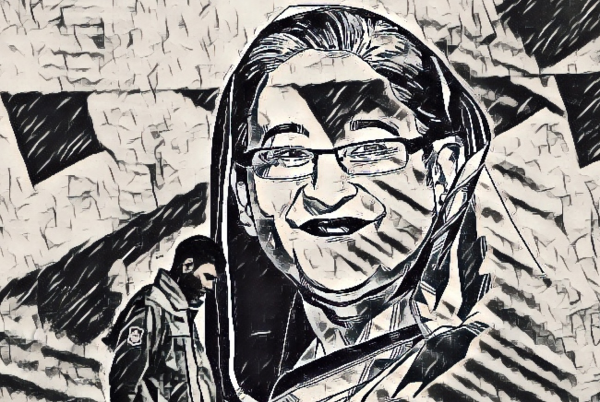
Emergence of a ruthless dictator
By 2014, it was no longer a democracy in any meaningful sense. Sheikh Hasina ruled with unchecked authority. Protests were violently suppressed. Political rivals were jailed, vanished, or silenced.
The 2018 arrest of Khaleda Zia on what many deemed fabricated corruption charges signaled the regime’s final break with democratic pretense.
Bangladesh started living under a government that has weaponized the law, the military, and the bureaucracy to preserve its own power.
In 2018, Bangladesh’s opposition made a calculated decision. Rather than boycott another predetermined election, they chose to participate–if only to expose the farce to the world. Every opposition candidate contested under the BNP’s symbol, attempting to challenge the illusion of legitimacy that Sheikh Hasina’s government had perfected over the years.
But even this symbolic resistance was crushed before it could begin. Though polling was scheduled for December 30, the votes had already been cast–illegally–the night before. State security forces and party loyalists orchestrated what became known as the “midnight election.” Ballots were stuffed, results were written, and the people were silenced.
The global democratic community was stunned. That such brazen manipulation could happen in the 21st century–under the watch of international observers–seemed unthinkable. Yet it happened. The Awami League’s victory was so sweeping, so absurdly complete, that comparisons to North Korea were no longer hyperbolic.
This fraud came on the heels of explosive student protests earlier that year–first against a discriminatory civil service quota system, then for road safety following the killing of two students by reckless drivers tied to ruling party interests.
Hasina’s response was brutal suppression. The anger was palpable. But the regime remained unmoved. International pressure mounted, and then quietly receded.
Fast forward to 2024. By now, the rot in the electoral system was total. Most major democratic parties refused to legitimize the sham by participating. Only the Jatiya Party–a longtime political prop of the ruling class–chose to run.
The January 7 election was a coronation in everything but name. Awami League loyalists running as “independents” took more seats than the Jatiya Party itself. One such candidate, A.K. Azad, even suggested these independents could "form the opposition" if the Prime Minister so desired. The irony was grotesque. The charade was complete.
This was not just the death knell of Bangladesh’s democracy–it was the moment Hasina overreached.
Desperate to tighten her grip over the bureaucracy, Hasina moved to reinstate the controversial civil service quota system. Students at Dhaka University once again rose in defiance. This time, the backlash was faster, angrier, and more widespread.
What began as a campus protest exploded into a national movement. Private universities joined in. Workers, professionals, rural youth–people from all walks of life rallied behind the students.
Hasina’s response was textbook
authoritarianism: abductions, beatings, and killings–many carried out by the
Rapid Action Battalion, her favored instrument of repression. The internet was
cut. The military was deployed. But the people did not back down.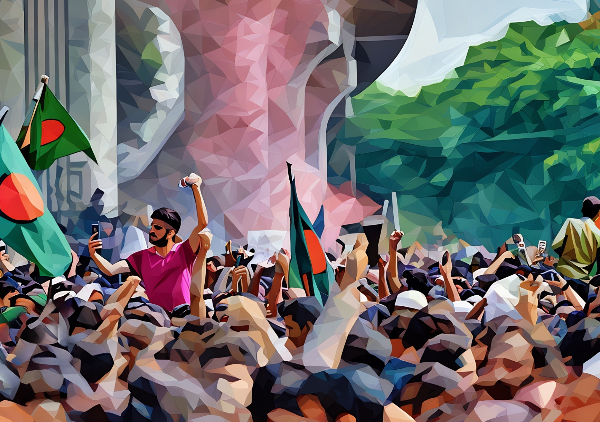
The monsoon uprising
By July, the movement had grown too large to contain. The original nine-point charter had boiled down to a single, non-negotiable demand: Hasina must go.
The "March to Dhaka" was a tidal wave of dissent. Thousands converged on the capital, determined to reach the Prime Minister’s residence. In the decisive moment, the military did something few expected: it refused to fire on its own people.
On August 5, 2024, Sheikh Hasina and her sister quietly fled the country. One of the world’s longest-serving–and most repressive–leaders was ousted by the very citizens she had tried to subdue for over a decade and a half.
Ten months have passed since Professor Muhammad Yunus–Nobel laureate, reformer, and now reluctant statesman–was appointed Chief Adviser of Bangladesh’s interim government following the ouster of Sheikh Hasina on August 5, 2024. And yet, the promise of democratic renewal remains frustratingly out of reach.
The regime is gone, but its shadows linger.
Despite international applause for the nonviolent uprising that toppled one of the world’s most entrenched autocrats, meaningful reform has stalled. No national consensus has emerged. No electoral roadmap has been announced.
And perhaps most troublingly, some of the same bureaucrats and loyalists who once enabled authoritarianism have quietly resurfaced in key roles.
For the families of those killed or maimed during the July uprising, justice still remains a slogan. Compensation has been piecemeal. Medical care, delayed. A generation that risked everything for freedom now finds itself waiting–for answers, for accountability, for leadership.
Meanwhile, the institutions of state violence remain disturbingly intact. The Rapid Action Battalion (RAB)--a force sanctioned by the United States and accused of systematic extrajudicial killings–has not been dismantled. It remains a symbol of unresolved injustice, a ghost of the regime that fell but was never fully buried.
In this vacuum of authority, chaos creeps in. Mob violence is on the rise. Fringe extremists are becoming more visible. Lawlessness is filling the void where democratic process should be.
With no national election held in nearly 16 years, an entire generation has grown up without casting a single vote. Democracy, for them, is not a lived experience–it’s a theoretical ideal. A fragile one.
On May 21, forty-one Australian senators and MPs sent a pointed letter to Chief Adviser Yunus urging immediate steps: dismantle RAB, deliver justice for victims of the uprising, and above all, set a clear and irreversible path toward elections.
The letter shook Dhaka’s political establishment. On a visit to Japan shortly after, Yunus claimed only one political party opposed early elections. The truth is more stark: out of 50 parties registered with the Election Commission, nearly all–except the Awami League, whose legal status is now under scrutiny–have demanded elections by December. So have over 100 unregistered parties and civil society coalitions.
The calls are growing louder. The patience of a politically awakened population is running thin.
The world once stood with Bangladesh when its people rejected tyranny in 1971, and again in 1991, and once more in 2024. Today, it must not look away. The stakes are clear: either this transition ends in a credible, inclusive, and timely election–or the window for democratic recovery may close for another generation.
Bangladesh has ousted its worst dictator. Now it must prove that what follows is more than just a different face atop the same broken system.
—
Touhid Faruq is a writer and political analyst