

DUCSU election has shattered many myths..and we need to understand the gravity of it for the greater good

Md Ashraf Aziz Ishrak Fahim
Publish: 10 Sep 2025, 01:41 PM
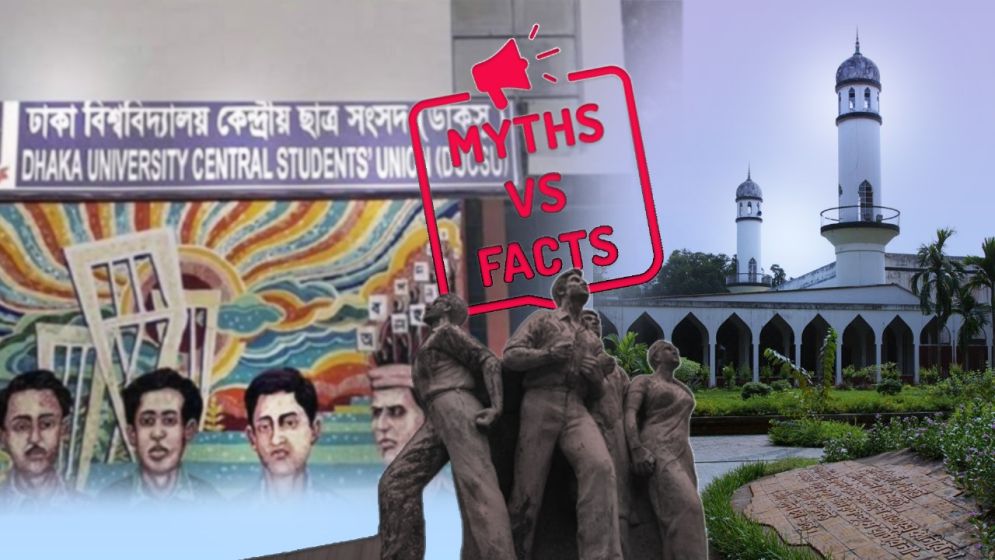
The Dhaka University Central Students’ Union (DUCSU) election has never been just a campus affair. It has always functioned as a mirror–sometimes polished, sometimes cracked–of the nation itself.
And this year that mirror reflects something unsettling. The myths that Bangladesh’s elites have long clung to are shattering, one by one.
For decades, civil society’s secular guardians have recited a familiar catechism. Women, they said, were natural allies of secularism. Education was the cure to Islamist politics.
Communalism, they lectured, was an affliction unique to Muslims. And most of all, they assured us, the “nation” had already outgrown Islamist politics. Yet as every ballot was pulled from the box, these supposed certainties collapsed under their own weight.
Let’s loot at myth number one that women are against Islam. Few stereotypes have been pushed as relentlessly as this one that women, by virtue of gender alone, stand firmly against Islamist politics.
The liberal imagination has often cast them as instinctive feminists, instinctive secularists, their votes preordained.
The DUCSU results tell another story. Bright, young women–students with ambition and agency–chose to support Shibir-backed candidates. They refused to play the role scripted for them. They voted as they wished, not as elites expected.
That act of choice is a radical assertion in itself. To reduce women to a singular political category is its own violence; it denies agency, and infantilizes half the nation.
Then there is the myth that Bangladesh is inherently “secular.” For years, we have been told this in a very specific sense that the country is secular as opposed to Muslim. The airwaves, the classrooms, the op-ed pages have all dutifully echoed this refrain.
But the DUCSU results force us to confront a possibility we’ve long ignored: perhaps the “nation” described by the secular elite was never the nation at all.
Students–the supposed vanguard of the future–voted in significant numbers for Shibir candidates almost breaking that long established assumption.
-68c12b3dd8526.jpeg)
Stereotypical reduction
of Islam and Muslims
What if the secular consensus was always a mirage? What if it was never consensus at all, but rather projection–a carefully crafted fiction in which some voices were amplified while others were dismissed as illegitimate?
Today, that fiction lies in pieces. The ballots do not lie. The young men and women who cast them are the nation. And their choices tell us, with unsettling clarity, that the story we have been sold about ourselves no longer holds.
Myth number three is that education is the Antidote to “Islamism.” Few assumptions have been repeated with such confidence that education–especially secular education–inevitably dissolves faith, instills inquisitiveness, inoculates against Islam, and produces liberal, modern citizens.
The university, we were told, was a finishing school for secularism.
And yet here we stand. Dhaka University, the nation’s highest seat of learning, has produced leaders from Shibir. These students attended the same lectures, read the same texts, and were taught by professors steeped in secular thought.
They were molded by a state system explicitly suspicious of Islamist politics. Still, when the ballot reached their hands, they defied the script.
The lesson is as uncomfortable as it is undeniable: education does not erase faith. Nor does it guarantee loyalty to elite secularism. The belief that “more education” would automatically neutralize Islamist politics now looks less like wisdom and more like wishful thinking–or worse, manipulation.
Myth number four is almost universally crafted: Muslims Are the Communal Ones. The caricature has long been that Muslims alone suffer from a “communal mindset–that their votes are driven by sectarian loyalties.
But DUCSU’s results turned that caricature upside down.
-68c12b6084de7.png)
Tides turned but what lessons are
learned
The most rigid bloc voting came from a non-Muslim dormitory, where nearly half the residents backed a Hindu candidate tainted by allegations of violence, and open hostility toward Muslims, including the assault of a BUET professor by ruling-party affiliates.
Even a Muslim candidate from the BNP could not break that wall of solidarity.
If communalism means voting as a bloc for someone tied to one’s own community’s grievances, then the myth of the “communal Muslim” collapses. Communalism is not a Muslim monopoly. At Dhaka University, it was a non-Muslim one.
And then there is the last myth that the People hold power. Perhaps the most bitter illusion is this: that ordinary people–in this case, students–hold power through their vote.
If that were true, these myths would not have survived for decades. Their very persistence is evidence of elite dominance.
DUCSU’s results will not magically redraw the national map. On the contrary, Shibir’s modest gains may provoke backlash. The specter of a military intervention looms, as does the possibility of yet another authoritarian regime–one that elites would eagerly embrace if it promises to stamp out Islamist politics.
Students may cast ballots, but the levers of power remain firmly in the hands of those who have always controlled them.
And no one should mistake a student council election for a national revolution. But DUCSU has already achieved something extraordinary by exposing these myths that elites have used to police Bangladesh’s story of itself.
It has shown that women are not predictable. That education is not the enemy of faith. That communalism is not the preserve of Muslims. That the “nation” imagined by elites is not the nation that exists.
And that power still resides far above the ballot box, in hands that decide which voices to amplify and which to silence.
—
Md Ashraf Aziz Ishrak Fahim graduated in Contemporary Islamic Studies from Hamad Bin Khalifa University in Qatar. Reach him at [email protected]