

Did Dr Hossain Zillur intentionally misread the direction of Bangladesh’s economic shift?

Abu Jakir
Publish: 10 Sep 2025, 11:34 PM
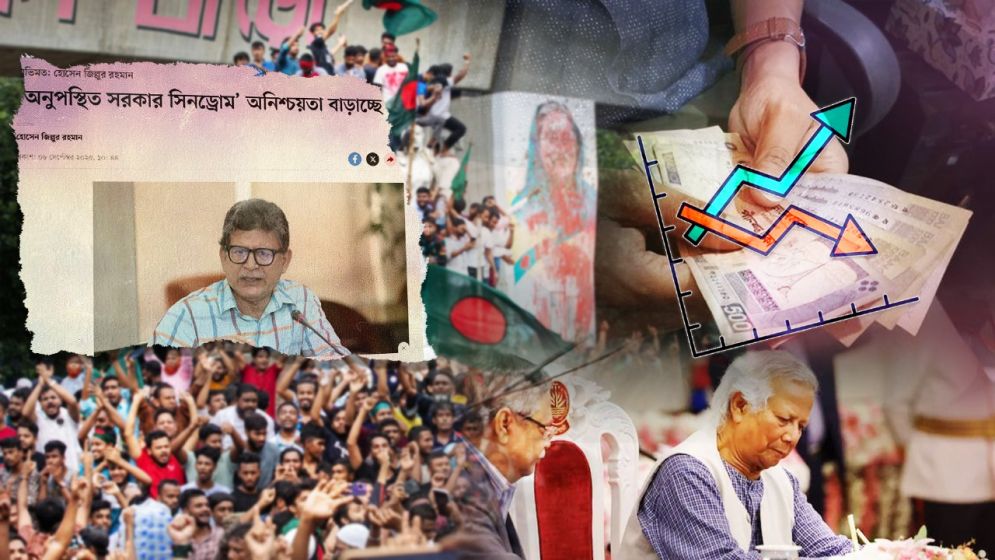
At a recent Bangladesh Business Forum organized seminar in
Dhaka, economist Hossain Zillur Rahman, head of the Power and Participation
Research Centre, dropped some troubling data.
Poverty, he said, has soared to 28 percent, compared with the
government’s 2022 figure of 18.7 percent. “We are going in the opposite
direction,” he warned, blaming a slowing economy.
On the surface, the claim is damning: more than a 10-point
spike in just three years. But Dr Zillur’s presentation carried a glaring
omission. He never clarified when the increase took place–before or after the
interim government assumed power on August 5, 2024.
That omission matters as it leaves listeners with the
impression that poverty exploded under the current administration, a claim that
stretches credulity.
Poverty rates rarely balloon in a vacuum. Historically, sharp
spikes are tied to twin shocks: mass job losses and runaway inflation. When the
two collide–as in Indonesia during the 1997-98 Asian financial crisis–millions
can fall into poverty almost overnight.
Political collapse can have the same effect, as Sri Lanka’s
recent meltdown showed.
Bangladesh, however, has experienced neither. Since taking
over, the interim government has steered the economy away from the brink,
stabilizing an IMF-dependent system, keeping growth in positive territory, and
even taming inflation.
None of the classic triggers of poverty explosions–economic
contraction, spiraling prices, mass unemployment–have been present.
Which raises the question: how plausible is it that poverty
has surged in a growing economy where the cost of living is easing?
Unless one is prepared to believe that the interim government has achieved the rare feat of shrinking poverty data while expanding poverty itself, Zillur Rahman’s figures deserve far closer scrutiny than they received in Dhaka.
-68c1b595979fc.png)
Vagueness in methods and
definitions
Besides, the credibility of the PPRC’s findings is shaky at
best. Dr. Zillur has yet to disclose how the survey was conducted, what
sampling methods were used, or even who carried it out.
No serious researcher would accept numbers without that basic
transparency. Sound methodology is meaningless without competent execution, and
absent those details, the dramatic claim that 28 percent of Bangladeshis now
live in poverty collapses under its own weight.
Even more troubling is Dr Zillur’s slippery use of
definitions. He invokes “poverty” as if it were a universally fixed concept,
but fails to specify whether he means income poverty, extreme poverty, or
multi-dimensional poverty.
These distinctions matter. Lumping them together only muddies
the debate and confuses the public. Precision, not rhetorical flourish, is what
the conversation demands–particularly from someone of Hossain Zillur’s stature.
The same pattern of vagueness mars his remarks on employment.
Citing “disguised unemployment” at “epidemic levels,” he points to youth
frustration as proof.
But what does “disguised unemployment” even mean in the 21st
century? The global labor market has been transformed by freelancing platforms,
remote work, and cross-border digital employment.
Thousands of young Bangladeshis now code, design, or consult
for multinational firms from laptops in their bedrooms or coffee shops. They
don’t fit neatly into traditional employment categories, yet Zillur’s sweeping
claim makes no room for this reality.
Worse, he offered no data–only anecdotes dressed up as social diagnosis.

Careful omissions to support
narratives
To his credit, Dr. Zillur ended on a note of clarity. He was
right: the global economy is undergoing seismic shifts, and Bangladesh cannot
lean forever on garments and remittances.
Diversification into pharmaceuticals, agriculture, IT
services, and leather is imperative. For this, he deserves commendation.
But here again, his analysis is incomplete. He fails to
acknowledge that the interim government has already begun laying the groundwork
for precisely the kind of transformation he prescribes.
Separating tax policy from collection at the National Revenue
Board–a reform long resisted–was a structural step forward.
The launch of the National Single Window, integrating more
than 20 agencies and streamlining over 50,000 licenses at the click of a
button, marks a real leap in cutting red tape.
Tariff and logistics policies are being fast-tracked, port
operations upgraded, and sector-specific bottlenecks in pharmaceuticals,
leather, electronics, shipbuilding, and agro-processing actively addressed.
These are reforms in motion, aligning squarely with the
vision Zillur outlines.
This is why his choice of alarmist soundbites over balanced
recognition is so disappointing. As one of Bangladesh’s most respected
economists, Dr Zillur has the stature to elevate public discourse with rigor
and fairness.
Instead, his reliance on selective citations and vague
assertions risks reducing him to a populist commentator. That undermines not
only his credibility, but also the seriousness of the debate over how Bangladesh
can graduate into a more resilient, competitive economy.
—