

Trump’s rhetoric at the UN risks making the Rohingya genocide a forgotten matter

Faisal Mahmud
Publish: 29 Sep 2025, 10:08 PM
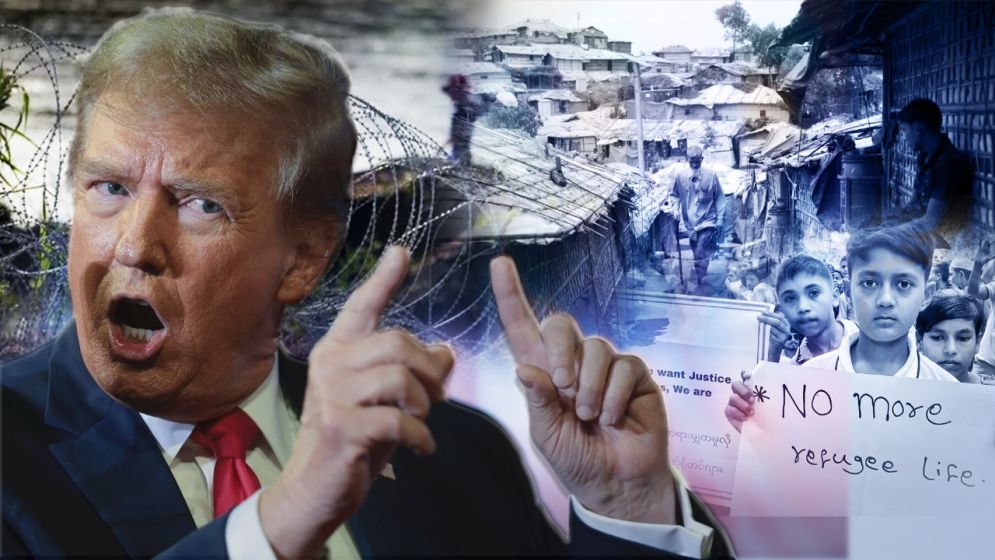
When
Donald Trump strode into the United Nations General Assembly on its 80th
anniversary, his message was as blunt as it was chilling.
In
his customary tone he mentioned that migration is a menace and foreigners are a
threat. He said most nations should seal themselves off to survive.
Cloaked
in the familiar rhetoric of sovereignty, his denunciation of a so-called
“globalist migration agenda” was way more than a red-meat applause line for his
domestic base.
It
was a gift, an endorsement, for regimes already committed to exclusionary
nationalism.
Nowhere
was that gift more consequential than in Myanmar, Bangladesh’s eastern
neighbour. For decades, the country’s rulers–military and civilian alike–have
sought to erase the Rohingya, rendering them stateless, alien and unwanted.
Trump’s
exhortation to “close borders” and guard against migrants “you’ve never seen
before, that you have nothing in common with” might have been drafted in
Naypyidaw itself.
For
generals who have long insisted that the Rohingya are “Bengali” intruders
rather than indigenous inhabitants of Rakhine state, the language was
legitimizing.
The
persecution of the Rohingya did not begin with the world’s cameras trained on
the refugee exodus of 2017.
Its
architecture was laid decades earlier, most starkly in the 1982 Citizenship Law
that stripped the Rohingya of recognition as one of Myanmar’s “national races.”
From
that legal exclusion flowed an escalating campaign of discrimination,
surveillance and violence that culminated in the August 25, 2017 “clearance
operations”--a euphemism for systematic atrocities: mass killings, the torching
of villages, the weaponization of rape.
Within
weeks, more than 700,000 Rohingya staggered across the border into Bangladesh,
joining previous waves of the displaced.
I
have seen firsthand how Cox’s Bazar, now home to nearly a million refugees, has
become both a humanitarian lifeline and a prison without walls.
For
those left behind in Rakhine, the conditions resemble apartheid with segregated
villages and deprivation by design.
Eight years on, nothing fundamental has changed. The Rohingya remain stateless and cornered, trapped between refugee camps and a homeland that denies their existence.
-68daae8aeb063.png)
A genocide by all means
Human
Rights Watch, the United Nations, and even the U.S. government have called the
campaign against them by its proper name: genocide.
That
is why Trump’s words at the U.N. matter far beyond the theatrics of an American
election cycle. When the leader of a superpower frames migration as an existential
threat, regimes bent on erasure hear a license to proceed.
The
Rohingya know too well what such legitimization means. Their suffering is not
just ignored by the world, it is essentially rationalized.
By
dressing up chauvinistic expulsion as national self-preservation, Myanmar’s
military rulers now hear in Donald Trump’s words the echo of their own
playbook.
And
the calculus shifts instantly. What was once condemned as a violation of
international law begins to look like a defensible policy choice. If Washington
shrugs at expulsions, others will assume that treaties are flexible, that human
rights are optional.
For
minorities like the Rohingya, the implications are chilling, even fatal.
The
United Nations was born to safeguard human dignity. Yet when its stage is used
to normalize exclusion, the institution itself risks inversion, turned from
guarantor of rights into a megaphone for their erosion.
International
law is not enforced by police; it is sustained by precedent, example and the
fear of censure. Abandon the rhetoric of protection at the global podium, and
the political will to act collapses soon after.
Myanmar’s
generals hardly need foreign inspiration to persecute the Rohingya. Their
machinery of displacement, denial and violence long predates Trump.
But
external affirmation still matters. It signals that the costs of repression are
falling, that isolation is less certain, and that ASEAN, the UN and
humanitarian actors will face even greater difficulty holding Naypyidaw
accountable.
In
geopolitics, perception is power.
The
danger extends far beyond Myanmar. In a world beset by economic shocks and
security anxieties, scapegoating the vulnerable has become a convenient outlet.
Trump’s
speech does not just embolden one regime; it contributes to a global climate
where targeting minorities is politically defensible.
The Rohingya’s tragedy, then, is a part of an unsettling trend, the normalization of expulsion as statecraft.
-68daaec5a6604.png)
Wrong message to the world
This
is precisely why words at the United Nations matter.
The
General Assembly podium is not a stage for fleeting theatrics; it is a compass
for global norms. In the last century, leaders used that same forum to rally
against apartheid, dismantle colonialism and summon solidarity across borders.
Today,
it risks being repurposed to justify exclusion and persecution.
For
Southeast Asia, the stakes are acute. Myanmar is not an outlier on the margins
of the world, rather it is a member of ASEAN. The persecution of the Rohingya
is therefore not just Myanmar’s shame; it is ASEAN’s credibility test.
If
the bloc allows one of its own to strip a people of their rights and dignity,
its claim to stand for peace and stability collapses into empty rhetoric.
Trump’s
words only sharpen this dilemma. What may have been intended as a message to
his political base at home reverberated abroad as a green light for the
generals in Naypyidaw.
For
the Rohingya, it deepened an already suffocating uncertainty. And for ASEAN,
silence now risks complicity. Regional leadership cannot claim neutrality when
the very language of sovereignty is being weaponized against a vulnerable
minority.
The
larger lesson is this: rhetoric from great powers reshapes the global atmosphere.
When it leans toward exclusion, it emboldens those who see minorities as
expendable.
When
it affirms universality, it strengthens those fighting for justice. Trump’s
address was thus a signal, one that authoritarian rulers will seize upon unless
the international community pushes back.
Myanmar
has already internalized this logic. The question is whether the rest of the
world will.
To
stay silent is to allow Trump’s words to become precedent and to consign the
Rohingya, and countless others like them, to a fate dictated by the politics of
expulsion.
—