

A large part of Europe’s Renaissance was built on Islam’s intellectual breakthrough

Arefin Al Imran
Publish: 29 Sep 2025, 11:49 PM
Bertrand
Russell, in his much-celebrated History of Western Philosophy, dismissed the
Arabs as mere couriers of Greek wisdom–scribes who copied, translated, and
handed Europe its intellectual inheritance.
It
is a claim that has endured for decades in the West, flattering Europe’s
self-image while belittling the true scale of Arab contributions.
But
to accept Russell’s framing is to flatten history and to commit an injustice to
the civilization that, more than any other, lit the path to the Renaissance.
Yes,
the Arabs absorbed and preserved Greek learning. But what they passed on to
Europe was way more than simply a well-guarded library.
They
transformed and revolutionized it. If Europe’s rebirth had depended solely on
Greek antiquity, the Renaissance would have arrived a thousand years earlier.
The
uncomfortable truth is this: the Greeks laid a foundation, but it was the Arabs
who built the house in which modern science could finally live.
Greek
achievement, for all its brilliance in art and philosophy, was thin in the
sciences. Beyond Archimedes’ work on hydrostatics, the record is meager.
Worse,
the intellectual climate of Greece was hostile to the very conditions required
for scientific progress. Socrates was executed for encouraging free thought.
Archimedes was cut down by a Roman soldier mid-calculation.
In
Sparta, scientific writings were banned outright. Even in Athens, that supposed
beacon of democracy, inquiry led to exile, imprisonment, or death.
The
soil was too barren for a scientific revolution to take root.
Contrast
this with Europe before its scientific awakening. Consider Gerbert of Aurillac,
better known as Pope Sylvester II, who, after visiting Muslim Spain in the 10th
century, returned with Arabic texts and instruments like the astrolabe.
His
curiosity earned him suspicion instead of admiration: he was accused by his
peers of sorcery, even possession by the devil. Such was the intellectual
climate of Christian Europe, where knowledge itself was heresy.
So, across the ancient world, before the rise of Islam, intellectual freedom was nearly nonexistent. Scientific thought flickered only in isolated bursts, never allowed to ignite into something transformative.
-68dac5f7c8b0b.png)
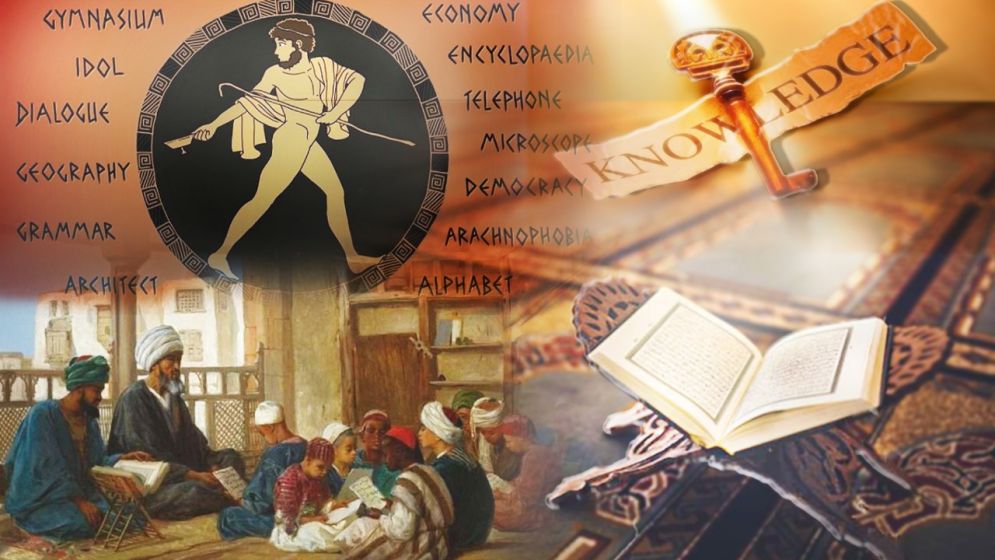
The quest for knowledge
Thousands
of minds were born with the capacity for discovery, but their insights were
smothered by censorship, and fear. Sometimes with indifference.
The
Renaissance, then, was not Europe rediscovering Greece. It was Europe finally
breathing the air of intellectual freedom distilled through centuries of Arab
inquiry and innovation.
To
deny that debt is not merely a distortion of history, it is a theft of
civilization’s truest legacy.
If
Greece never produced the conditions for a scientific revolution, Islam did
something radically different: it created them.
Islam
was the first to draw a clear line between religious knowledge and natural
knowledge, a distinction that would become the cornerstone of intellectual
freedom.
Revelation,
in this framework, was sacred and inviolable, preserved in its pure form in the
Quran. But when it came to the natural world, inquiry was open-ended.
Islam
gave men and women the freedom–indeed the responsibility–to ask, to experiment,
and to arrive at their own conclusions.
One
hadith captures this revolutionary spirit with striking clarity. Recorded in
Sahih Muslim, one of the most authoritative collections of the Prophet
Muhammad’s sayings, it tells of an incident when the Prophet observed farmers
hand-pollinating date palms.
Curious,
he suggested it might not be necessary. Out of deference, the farmers stopped.
The result was disastrous: their yield plummeted.
Hearing
of it, the Prophet Muhammad corrected himself: “If it benefits them, let them
continue. I merely gave an opinion. You need not follow me in worldly matters.
But when I speak of God, that must be obeyed, for I never speak falsely about
Him.”
This
was a declaration of principle. The Prophet himself insisted that divine
authority governs the spiritual realm, but the natural realm belongs to human
reason, experimentation, and discovery.
And the message was unmistakable: revelation is not a substitute for science. Faith has its domain, and knowledge of the world has its own.
-68dac616b0847.png)
The magnificent nuances
It
is difficult to overstate how radical this separation was.
In
an age when questioning authority could mean death, as it did for Socrates and
countless others, the Prophet of Islam carved out a sacred space for
intellectual independence.
Here
was a religion that not only tolerated free inquiry but safeguarded it,
encouraging believers to explore creation without fear of heresy.
This
framework, more than any borrowed Greek manuscript, was the true engine of
progress. It made possible the flourishing of science, mathematics, medicine,
and philosophy in the Islamic world and later, through transmission, in Europe.
Without
this intellectual architecture, the Renaissance would have remained an
unfinished dream.
The
same incident was later recounted not only by Aisha, the Prophet’s wife, but
also by his closest companions, Thabit and Anas.
The
lesson they all remembered was simple yet transformative: the Prophet
ultimately told the farmers, “You know best about the affairs of your world.”
That
sentence is nothing short of revolutionary. It signaled, with extraordinary
clarity, the boundary between the sacred and the secular: divine authority
governs matters of faith, but in worldly affairs–science, agriculture,
medicine, technology–human beings must rely on their own observation,
reasoning, and experience.
This
was a declaration of intellectual independence, a principle that broke with
centuries of dogma where religion and science were fused, often to the
suffocation of both.
Islam,
in that moment, established a precedent that would echo across history:
revelation guides the soul, but discovery belongs to human reason.
—
Arefin Al Imran is a music director,
producer and sound designer