

Why the interim government’s election delay wipes out the possibility of a true democratic future..

Md Ashraf Aziz Ishrak Fahim
Publish: 01 Oct 2025, 12:45 AM
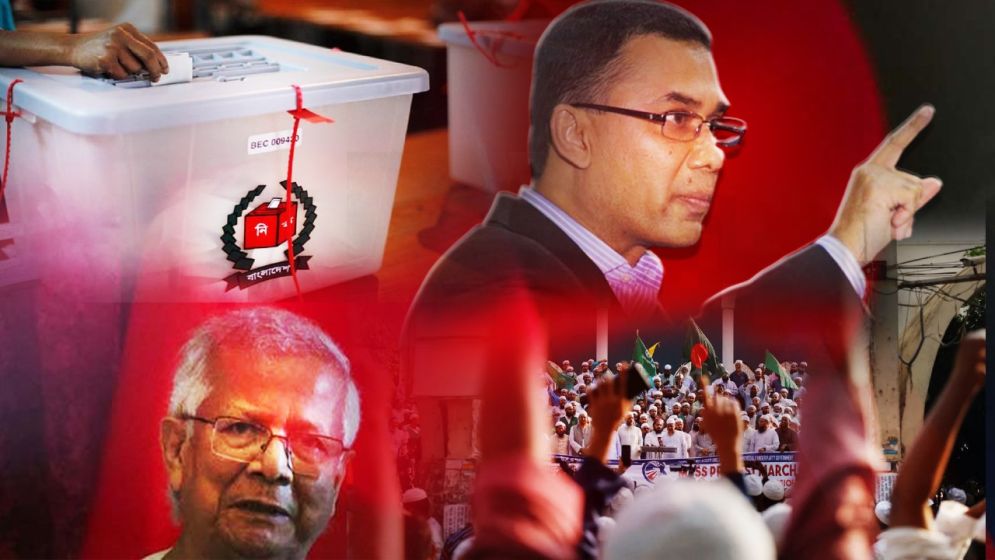
The political crisis we are living through today was not inevitable. It was manufactured through delayed elections, miscalculations on the part of Jamaat and NCP leaders, and the pettiness of our self-proclaimed “civil society.”
If an election had been held within three months of August 5, the contours of power and opposition would have looked very different.
Imagine that scenario: even if the BNP had won 290 seats, it would not have been a “strong” government. The country would still have been under the spell of July’s revolutionary mood.
NCP, the rising student-based party, would have had the breathing room to regroup in opposition, to present itself as the voice of the ordinary people, rather than a yet another political party engulfed in controversies.
Instead, the refusal to hold elections on time distorted the entire political map.
The so-called bhodrolok class–the respectable middle-class intellectuals and commentators ruined this possibility by attempting to delay the elections.
Immediately after the Revolution, Daily Star’s Mahfuz Anam and his peers met Yunus and urged him to stay in office for at least two years. Shahdin Malik cautioned against holding an election soon, fearing that BNP will get a landslide.
Other civil society figures went even further, arguing that the country did not need elections at all for five years. Calling for elections on Facebook would draw massive backlash from the prototypical representative of Bangladesh’s bhodrolok class.
At the same time, this very class fanned the flames of fascist narratives against BNP.
From obscene cartoons mocking Tarique Rahman and Khaleda Zia, to endless jibes of “khamba,” “ten percent,” and “tempo stand,” they normalized ridicule and delegitimization.
Satirists like Mehdi Haque fed the marketplace of humiliation, and the civil society elites nodded along.
This was way more than just satire. It was a political project: to paint BNP as beyond redemption, a corrupt dynasty unfit for governance, while leaving the door wide open for unelected technocracy or for a carefully contained BNP return.
-68dc24df3a1ad.jpeg)
Political strategy or miscalculation?
On the back of these narratives popularized by the bhodrolok class, a section of NCP and Jamaat strategists embraced a disastrous policy: let BNP rot.
Delay elections long enough, and BNP’s support would wither away. They calculated that with every passing month, BNP would lose popular credibility because of the bhodrolok detest for BNP, coupled with grassroots BNP’s lawlessness.
The outcome of this cynical strategy is now before our eyes.
The very bhodrolok who once demonized BNP have quietly reconciled with it. They no longer want Yunus. They no longer want reform. What they want now is BNP itself, precisely the BNP they once mocked and delegitimized.
Why? Because they think that only BNP can keep the “Islamist energies” of NCP and Jamaat in check. Only BNP, in their view, stands between them and an Islamist wave.
It is not love for democracy that drives their change of heart, but fear of alternatives.
Meanwhile, the public mood has shifted. Rumors, deliberate deterioration of law and order, panic over Islamist mobs, the machinations of men in uniform, and relentless propaganda about NCP’s corruption have all taken their toll.
The people who took to the streets in July have retreated into their homes.
And just as they stood by silently during massacres against BNP and Jamaat supporters–when being tagged as “BNP-Jamaat” was enough to justify repression–these same civil society voices have readied themselves now to be silent about possible future state violence against NCP-Jamaat.
They will not protest in the streets. They will not even post on Facebook.
Thus, if elections were held today, BNP might not win 290 seats again. But paradoxically, the BNP government that emerges would be far stronger than the hypothetical BNP government of three months after August 5.
Why? Because today the narrative of no alternative that undergirded Hasina’s fascist rule has made a comeback.
-68dc24f7ae481.jpeg)
Back to the binary choice
The public is now presented with a familiar binary: do you want democracy, or do you want stability?
Do you want a little democracy with a heavy dose of Muktijuddho narrative, or do you want to risk full democracy and the possible return of the Razakars? Doesn’t this sound eerily familiar?
The irony is bitter. A strong BNP government today is the direct product of the bhodrolok’s narratives and of NCP-Jamaat’s suicidal decision to dance to their tune.
Had elections been held within three months of August 5, BNP would have returned to power in a weakened, transitional capacity.
BNP’s constitutional power would not have been echoed in the streets or in the civil society. It would have had to negotiate, to compromise, to share political space. NCP would have had time to consolidate itself as a genuine opposition force.
Instead, we face a BNP government poised to be “ultra-strong”--not because it commands the moral authority of the people, but because it now has the backing of the bhodrolok class that fears an Islamist takeover and a silent population once again willing to look the other way.
The credit, or rather the blame, goes to those who delayed elections and those in NCP-Jamaat who followed them down that path.
By refusing to push for timely elections, by trusting the whispers of the bhodrolok, they manufactured today’s crisis.
Had we chosen differently–had we insisted on elections within three months of August 5–the crises we see now would never have materialized.
Now BNP has assumed BAL’s role: there is no alternative to it insofar as the likes of Mahfuz Anam do not want to see a government that they label as Islamist.
—
Md Ashraf Aziz Ishrak Fahim graduated in Contemporary Islamic Studies from Hamad Bin Khalifa University in Qatar. Reach him at [email protected]