

Khaled Muhiuddin built his brand. But the public now sees the bluff
Shaquib Ahmed
Publish: 28 Oct 2025, 03:38 PM
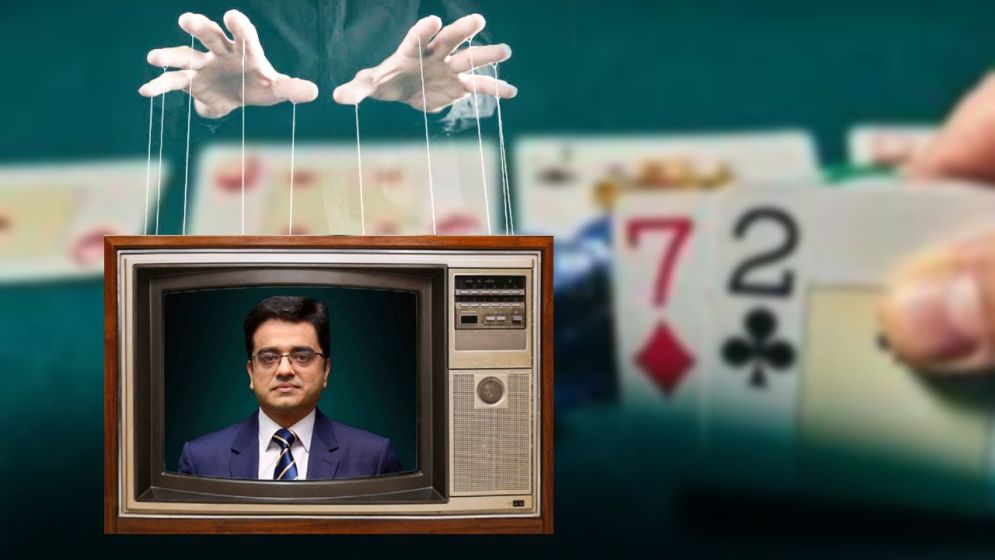
Khaled Muhiuddin has what one might call an irresistible “on-screen charm.” He has this mix of confidence and impeccable appearance that few journalists in Bangladesh can match.
In a recent talk show, he appeared in a crisp white shirt, navy jacket, and a red cravat that only someone with his particular flair could pull off. Even writer and analyst Faham Abdus Salam (who was in that show)–himself no stranger to elegance and top notch fashion sense–seemed momentarily eclipsed.
But what makes Khaled Muhiuddin truly stand out isn’t just his tailored charm. It’s that he’s not a sellout, at least not in the way so many of his peers became during Sheikh Hasina’s fifteen-year autocracy, when journalism in Bangladesh largely morphed into public relations for power.
While editors grovelled at Hasina’s press conferences, asking why she hadn’t yet received a Nobel Peace Prize, Khaled had the rare audacity to stand and ask what mattered.
And yet, therein lies the paradox. Khaled Muhiuddin represents the intellectual malaise of the Bangladeshi “secular semi-elite.” He’s sharp and articulate–and yet, his body language betrays a quiet condescension.
The posture, the tone, the faint and sly smile of amusement–everything signals a man too aware of his own refinement and intellect and perfectly aware of whom to belittle and before whom to bow.
During his stints with Independent TV, DW Bangla, and now Thikana after the fall of Hasina’s regime, Khaled maintained that effortless, casual-formal rhythm that set him apart from other hosts.
His quick wit, and conversational ease have made him a master of disarming political guests. And yes, even during the Hasina era, sometimes, he did just that–pressing some Awami League stalwarts with uncomfortable questions.
But what he never did was confront [Awami] power with the sharpness that real journalism demands. During that era of dicatorship, he seldom allowed himself to sound angry or morally charged when facing the powerful–quite unlike the swagger he now displays toward the “powerful” figures of the interim era.
I’ve written before about this –how he belittled Nasiruddin Patwary on one show, or posed nonsensical juxtapositions to Dr. Ali Riaz.
At that time, Khaled Muhiuddin got “cancelled,” probably for the first time on a mass scale. But as I mentioned at the beginning of the article, his shows remain compulsively watchable.
His presence and reach still make him a force in a landscape bereft of compelling journalistic voices. There is, quite simply, no one like him.
But the second cancellation came harder and louder. Once again, it wasn’t about his reporting or his questions, but about his tone and unmistakable sense of superiority–that subtle disdain he projects toward those he deems beneath him or he thinks can’t really cause any harm to him.
-69008edf2094a.png)
Subtle
disdain and “unethical” stance
When Khaled returned to Bangladesh for the first time after the July uprising, he was received like a celebrity. But at a public seminar, he made two faux passes that ignited fresh outrage.
First, he declared that he would interview the ousted Prime Minister Sheikh Hasina “because it’s too big an interview to refuse,” adding that he would even go to jail for it.
The reaction was instantaneous–a mix of shock, moral outrage, and betrayal from those who had fought to end Hasina’s autocracy. In truth, Khaled was probably right on one count that any journalist, given the chance, would crave that interview.
The idea of speaking to one of the world's worst [former] dictators is historic. But Khaled’s delivery of assuring that, not his declaration, was the issue.
The real backlash came when he mentioned two leaders of the July uprising, Hasnat Abdullah and Sarjis Alam, who had implored him not to “betray the blood of the martyrs” of the uprising by interviewing Saddam Hossain, the fugitive leader of the Chhatra League–a terrorist organization.
Khaled mentioned the whole incident with a smirk, a breezy shrug, and that now-familiar tone of amused detachment.
It was the kind of moment that crystallizes what people already suspect about the semi-elite [Bangladeshi] intelligentsia he represents–too urbane to feel, too clever to care about people whom they deem as “powerless.”
This attitude of his might have played well on television in another era, but to an audience that lived through the brutality of the July uprising, it came off as tone-deaf arrogance.
Because they [heros of July uprising] were not abstract “martyrs” to them. They were fellow protesters who gave blood for Bangladesh 2.0.
And there lies the central flaw in Khaled Muhiuddin’s brand of journalism–he knows precisely whom to challenge and whom to appease. He bullies downwards and bows upwards, executing both with a polished elegance that masquerades as neutrality.
For years during Hasina’s dictatorship, this sleight of hand–this careful choreography between defiance and deference–allowed him to pose as the country’s last bastion of “objective journalism.”
But objectivity, in Khaled’s world, is a performance. He has mastered the art of trivializing atrocity, especially those committed under Sheikh Hasina’s regime, by casually juxtaposing them with the missteps of the interim government.
The trick works because it looks like fairness. In truth, it is a kind of moral laundering, where everything becomes relative, and therefore nothing truly matters.
From that vantage point, he can strut as the “revolutionary journalist” defending press freedom, knowing full well that this time, unlike before, such performance carries no risk.
-69008ef96edbb.png)
Fully
aware of the consequences
Khaled has been lauded by a quarter for his “tough questions” directed at figures linked to the interim government and those he branded as “auxiliary powers” of the uprising. But it was a safe rebellion–precisely calibrated for the times.
Had Khaled attempted this act during Hasina’s reign, his flight to Dhaka would have ended in custody instead of a public seminar. Of course, he never tested that possibility; he never had to. The courage always came after the danger was gone.
And now, the mask has slipped. The Gen Z generation, the very audience that grew up watching his sleek talk shows and tailored suits, has seen through the act. A recent facebook post on social media exposed the dissonance between his rhetoric and his record.
In 2022, when journalist Tasneem Khalil first uncovered the existence of Aynaghar–the secret torture cell operated under Hasina’s government–Khaled invited him to his show, “Khaled Muhiuddin Jante Chay.”
Opposite him sat government-aligned journalist Naimul Islam Khan. Khaled, with a smirk and studied irony, kept returning to the absurd detail that prisoners were given “Mum Pani to drink and Energy Plus biscuits” to eat–reducing the horrors of extrajudicial detention and torture to a grotesque punchline.
That is quintessential Khaled–able to recast barbarity as banality, to replace outrage with irony. For him, a secret prison becomes a quirky detail and a massacre becomes a misunderstood nuance.
He chooses which deaths to grieve, which injustices to highlight, and which atrocities to gently laugh away.
After July, he essentially showed little grief for the thousands killed. Instead, his sympathies were conspicuously reserved for broken shrines and the narrative of “minority persecution.”
Every word, every shrug, every “balanced” question serves a purpose: to preserve his position as the unassailable, urbane moderate in a nation aflame with moral extremes.
In truth, Khaled Muhiuddin is less a journalist than a technician of perception, crafting the illusion of fairness while keeping one eye firmly on which way the political wind blows.
And perhaps that’s why, today, the country’s youth no longer see him as an icon but as a relic of an old order where cunning passed for courage.
—