

We must consciously and intellectually confront the ethics of giving media space to a mass-murdering autocrat like Hasina…

Abu Taib Ahmed
Publish: 05 Nov 2025, 10:26 AM
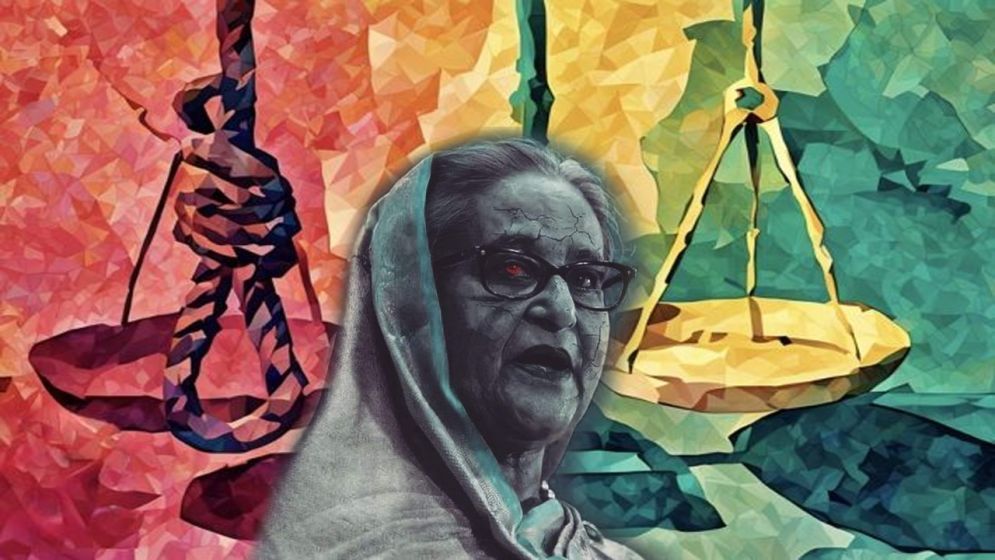
In the aftermath of autocrat Sheikh Hasina’s downfall, toppled by a student-led, people-powered uprising, the country’s mood was unmistakable.
The air was thick with anger and grief, a raw and righteous resentment against her and the Awami League that had ruled through fear and deceit. In those early months, no credible journalist would have dreamed of offering her “side of the story” under the pretense of balance or neutrality.
The wounds were too deep and the memories too fresh.
But time, as it often does, dulls outrage. That fire of collective fury has cooled just enough for the machinery of media normalization to stir.
In recent months, a string of interviews with the ousted autocrat has appeared in prominent international outlets, each presented as a gesture of journalistic evenhandedness, but in truth revealing something far more troubling.
These coverages raise not merely questions of editorial judgment, but of the very foundation of journalism itself.
What is the role of the press in a nation trying to claw its way back to democracy? And more pointedly: how should journalists engage a fallen despot who once muzzled dissent and ruled through systematic violence?
There is, of course, no “legal barrier” yet to interviewing Sheikh Hasina. But legality is beside the point. The issue is not whether journalists can interview her–it is why they would.
What intellectual or ethical premise underpins such an act? What public purpose does it serve?
Will it serve to publicize the ousted autocrat, allowing her to craft a narrative of victimhood or renewed political relevance? Or will it serve the public interest by holding her to account for the years of extrajudicial killings, enforced disappearances, and institutional decay that defined her reign?
The difference lies in intent and rigor. Journalism, at its core, is a public service. It exists to scrutinize power, not to humanize or rehabilitate it.

The rigor in intent
When a media outlet offers a platform that is soft, deferential, or “balanced” without the ballast of confrontation and evidence, it risks legitimizing the very crimes it should expose.
On that note, an interview with Sheikh Hasina, the fallen autocrat–must not devolve into a public-relations exercise. If she is allowed to recast her record without interrogation, the journalist becomes a conduit for propaganda.
If the exchange avoids hard questions about the regime’s corruption, its assaults on civil liberties, or the blood spilled in its name, it ceases to be journalism.
The true measure of such an interview is whether it advances accountability. That means challenging falsehoods with documented facts, amplifying the voices of victims, and resisting the lure of spectacle.
Anything less transforms the press from watchdog to stagehand, helping a discredited ruler script her redemption before the uninitiated audience.
In this moment of fragile democratic rebirth, the media must decide what kind of history it wants to write– one that flatters power, or one that serves the truth.
There is a legitimate and urgent concern that any interview with Sheikh Hasina could collapse into a spectacle of self-redemption rather than a pursuit of truth.
Hasina has long mastered the art of narrative manipulation. Her public persona thrives on confrontation, her rhetoric unburdened by fact.
In past exchanges with even the most seasoned international journalists, she has displayed an uncanny ability to bulldoze critical questions and convert scrutiny into stagecraft.
To hand her a microphone or space for print now is to risk turning journalism into theater, a platform for spin and self-exoneration.
A blunt question such as, “Why and how did you kill 1,400 people?” might sound cathartic, but it accomplishes little. Her answer, defensive and rehearsed, would neither console the bereaved nor advance the cause of justice.
It would, however, grant her something far more valuable. An opportunity to justify or even deny her alleged crimes. The result is distortion—a performance masquerading as accountability.
At this moment, no conceivable line of questioning can yield genuine public service without simultaneously legitimizing the figure responsible for staggering human rights abuses.
The act of engagement itself becomes ethically fraught. To converse with an unrepentant autocrat on equal journalistic footing risks validating her authority, not dismantling it.
This crisis of ethics is most visible in the language journalists use. To refer to her as “former Prime Minister Sheikh Hasina” may seem neutral, but language is never neutral.
That title privileges her political identity while erasing the moral reality of her rule. It subtly restores dignity to a figure who presided over state-sanctioned violence, extrajudicial killings, enforced disappearances, and systemic torture.
It all boils down to optic
Hasina is not simply a “former leader.”
She is a deposed autocrat whose regime left thousands dead and tens of thousands wounded in the July 2024 uprising alone. Her barbarity was structural, methodical, pointed and historic in scale.
To grant her the honorifics of political office without moral qualification is to whitewash atrocity itself.
For journalism to fulfill its duty in a post-authoritarian era, it must recognize that some platforms can do more harm than silence. The challenge before the press is not merely what to ask Sheikh Hasina but whether the public is served by asking at all.
Language is not a neutral instrument. It carries the weight of power, legitimacy, morality and history. When journalists refer to Sheikh Hasina as “Former Prime Minister,” they are perhaps unwittingly, concealing her crimes beneath the decorum of office, recasting an autocrat as a conventional political figure.
The phrase legitimizes a title she never rightfully earned. She was not an elected leader of Bangladesh in any democratic sense; she was the head of a regime that clung to power through coercion, intimidation, and monumental electoral fraud.
For the press, this is not a matter of semantics but of ethics.
Journalism’s most sacred duty is to call a spade a spade, to describe reality as it is, not as power wishes it to be remembered. Nowhere is that duty more urgent than when confronting those who once ruled through fear.
The journalist’s mission is not to appear balanced or “objective” toward tyranny, but to pursue what might be called functional truth–truth that exposes power and serves the public good.
If an individual presided over mass killing and repression, the journalist’s task is not to soften the vocabulary. A killer must be named as such. A usurped government must be identified as such. Euphemism is complicity.
In this fragile moment of democratic transition, linguistic precision is moral clarity. To describe Sheikh Hasina in sanitized terms is to distort the record and dilute the enormity of the crimes committed under her rule.
As Bill Kovach and Tom Rosenstiel remind us in The Elements of Journalism, the first loyalty of the journalist is to citizens, and the first obligation is to the truth.
Anything less is a betrayal of that covenant.
—
Abu Taib Ahmed is a doctoral candidate in sociology of news at Colorado State University, USA