

How Indian media describes the lives of Awami League leaders sheltering in India after the uprising

Abu Jakir
Publish: 08 Dec 2025, 12:56 PM
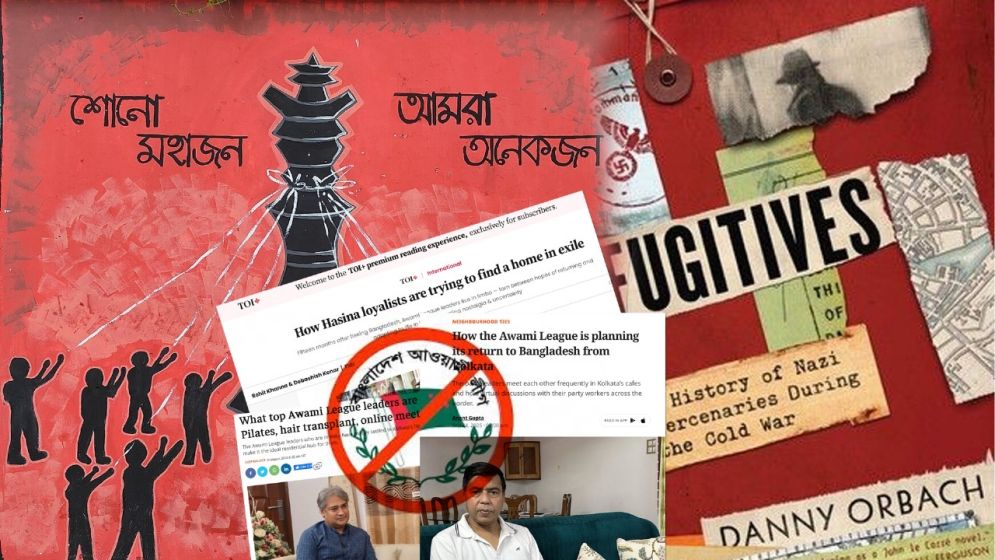
Fifteen months after the July uprising that forced scores of Awami League (AL) leaders to flee the country, a new political geography has quietly taken shape across the border.
Kolkata—and especially its satellite township of New Town—has become an improvised refuge for a dispersed political class that once dominated Dhaka’s power corridors.
What began as a panicked escape in the weeks after Sheikh Hasina’s fall has hardened into a strange, suspended existence: part survival, part routine, part political preparation for a return that remains a distant possibility.
According to Times of India, Kolkata has become “a home away from home” for senior and mid-level AL leaders who crossed into India during and after the “July Revolution” of 2024.
Many came in waves: first former ministers and MPs, then district-level politicians, activists, and their families—some accompanied by children, others alone, still unsure whether their stay would last weeks or years.
The paper notes that for many of them, the lingering question has become almost existential: whether Kolkata is merely a holding ground until the next “political opening”, or whether the city might become an unexpected “long-term exile.”
A report by Scroll recounts one of the starkest escapes—that of former MP Habibe Millat. He spent seven weeks hiding in Dhaka, he says, without seeing sunlight, before beginning a 22-hour journey through backroads and border villages to reach India.
When he arrived in Kolkata, he slept on the floor for days because he had no money and nowhere to go. His wife eventually arranged a modest apartment. Millat’s story, while dramatic, is far from unique among those who fled.
Today, nearly 1,300 AL leaders and activists are estimated to be living across India, with New Town emerging as the largest cluster. According to The Print, the area’s anonymous apartment towers, quiet lanes, fitness studios, and easy airport access have made it an attractive, if temporary, sanctuary.
For many senior leaders, life has settled into an uneasy rhythm that blends the mundane with the political—early morning prayers, shared apartments, gym visits, Zoom meetings, and a steady, quiet effort to hold together a party in exile.
The lives of others
No one describes their daily routine better than a former MP (whose name was not published) interviewed by The Print. He shares a three-bedroom flat with a colleague, both without their families.
“I wake up at the crack of dawn and offer my Fajr prayers,” he told the publication. Afterwards they walk to a neighbourhood fitness studio where he lifts weights and his flatmate attends Pilates classes.
But exile has its peculiarities. One young MP, also living in New Town, used the relative anonymity of his displacement to undergo a hair transplant in Delhi.
As The Print reports, he joked that “in such trying times, a new head of hair is something to feel good about.”
Others admit that living alone has forced them to learn basics like cooking, with wives back home guiding them via video calls. One MP even quipped that he might return to Bangladesh with a new career option—as a chef.
According to the report in Times of India, wives of many exiled Awami League (AL) leaders have tried to create a semblance of communal solidarity and emotional support by forming a dedicated Whatsapp group among themselves.
Though the article gives limited detail, it notes that within this group, these women have been sharing not just news and updates from home but also everyday banter to cope with long stretches of uncertainty.
Despite these everyday details, their presence is far from apolitical. Exile has not paused Awami League’s political activity; it has merely displaced it geographically.
Meetings, according to Scroll, now take place in cafés, rented banquet halls, or small gathering spaces across New Town. The Print reports that some leaders travel to Delhi every week to meet policymakers, diplomats or intermediaries who might support their political survival.
Virtual meetings with party workers take up the evenings. “Daily life is all about work, work, and more work,” one former MP told The Print.
One of the most debated spaces in this exiled ecosystem is a modest commercial office in a suburban building. Various publications have described it as a “secret party office,” though AL leaders reject this phrasing.
The Print quotes a senior leader saying, “There are almost 1,300 party leaders in Kolkata. We can’t possibly meet at the former home minister’s living room! But to call it an office would be a gross exaggeration.”
The space—windowless, stripped of party insignia, furnished with discarded chairs from a previous tenant—serves as a neutral meeting ground.
According to Times of India, this discreetness is intentional: the goal is to avoid creating the impression of a formal external headquarters for a party that is banned back home.

Dream of political comeback
The Scroll report notes that encrypted messaging channels, long-distance coordination, and frequent small-group gatherings have kept AL’s organisational machinery running despite the physical distance from Bangladesh.
Some leaders have taken on the task of documenting abuses they say were committed against AL workers since the upheaval.
Millat told Scroll that exiled activists have recorded “637 instances of AL workers being lynched by mobs” and claimed that over a hundred MPs have been jailed.
He now works with a Canadian-registered think tank to compile documentation for international advocacy and to push for the lifting of the ban on the party ahead of Bangladesh’s 2026 election.
This political work takes place against a backdrop of personal dislocation and uncertainty. Several former ministers and MPs share apartments because of restricted finances. Some have switched to public transport; others split ride fares or eat frugally.
A former MP quoted by The Print said, “I don’t even have any particular time to sleep. Sometimes I get confused between dawn and dusk.”
Another insisted: “We have not come here to relax and stay indefinitely. We have come here to stay alive and be ready to fight tomorrow.”
The mental landscape of exile is perhaps the most complex part of their new life. They are neither refugees nor migrants. Kolkata is familiar—linguistically, culturally, even emotionally— yet not quite home.
Times of India captures this feeling, noting that many leaders admit the city was never meant to be anything more than a temporary base.
But as weeks turned into months, and months into more than a year, some have quietly wondered whether this temporary state might stretch into permanent displacement, much like earlier generations of Bangladeshi political exiles who remade their lives in London or Toronto.
Yet despite the displacement, most leaders insist that return—not resettlement—is their only objective. Their days of prayer, fitness, messaging, and quiet strategizing are framed as preparation rather than resignation.
The Print cites former state minister Mohammad A Arafat saying, “Bangladesh has been staring at the abyss since Hasina left. I have this one goal: to make things right in Bangladesh again.”
—