

Acting AG cleared bail for Chattogram ‘top criminal’ in seven murder cases without contest

Zulkarnain Saer
Publish: 23 Dec 2025, 11:09 PM
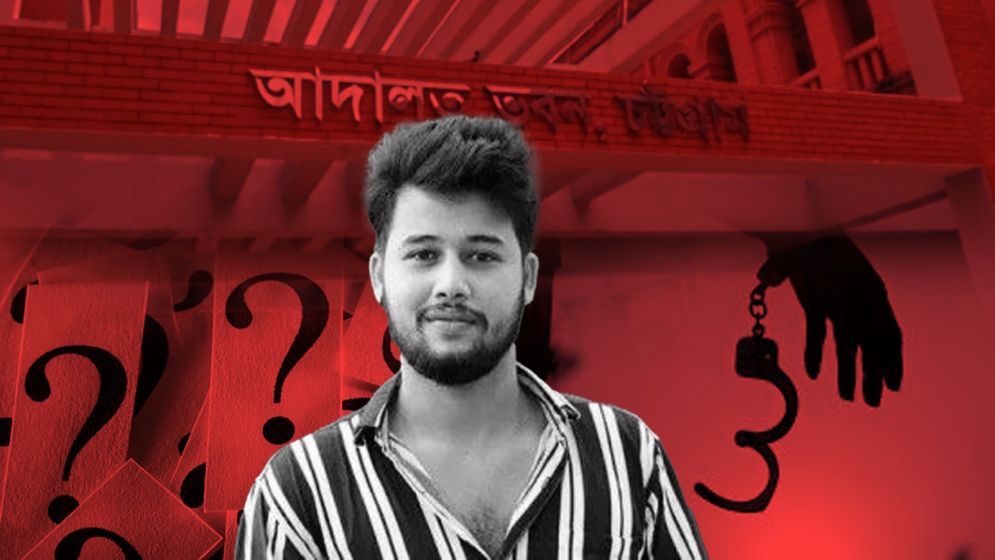
One of Chattogram’s most feared criminal figures quietly obtained bail in several murder cases earlier this September.
Internal government documents reviewed by Bangla Outlook show the attorney general’s office, under the then acting attorney general, chose not to challenge the High Court’s orders.
Sazzad Hossain, better known as “Chhoto Sazzad” and formally listed by police as a top criminal leader in the port city, was granted bail in seven separate murder cases between September 15 and September 22.
Despite facing multiple murder charges and being designated by law enforcement as a high-risk accused with a long criminal history, the state did not seek stay any of the bail orders.
The absence of opposition allowed the orders to proceed unchallenged through the judicial system.
The decisions not to contest the bail orders were authorised by Mohammad Arshadur Rouf, a senior Additional Attorney General who was serving as acting attorney general at the time while Attorney General Md Asaduzzaman was abroad.
Internal records from the attorney general’s office show that Rouf endorsed the bail orders with “no-objection” markings, without citing any exceptional legal reasoning or justification.
According to Chattogram Metropolitan Police, Sazzad is a “top criminal” accused of involvement in murder, extortion and armed violence across the Bayezid, Oxygen and Chandgaon areas.
Police have identified him as a close associate of Sajjad Hossain, also known as “Boro Sajjad,” another notorious criminal who fled the country and is believed to be living abroad.
Investigators say Sazzad ran criminal operations on behalf of his patron, including extortion networks and control over segments of the garment waste trade.
After his arrest, senior police officials publicly linked him to several high-profile killings carried out in public spaces across Chattogram.
Sazzad was arrested on March 15, 2025, from Bashundhara City Shopping Complex in Dhaka in what police described as a major breakthrough. Officers cited his alleged involvement in multiple murders, including a double killing in the Oxygen area and a separate shooting in Chandgaon.
Court and police records indicate that he currently faces 19 cases, including 10 murder charges.
His wife, Sharmin Akhter Tamanna, is also accused in eight criminal cases, several of which involve murder. Tamanna was arrested on May 10, roughly two months after her husband’s detention, following public controversy triggered by social media statements she made regarding bail proceedings and court outcomes.
Both were initially held in Chattogram Central Jail before being transferred to separate facilities. Sazzad is now detained in Rajshahi Central Jail, while Tamanna is held in Feni District Jail.
High Court records show that in September, the court granted bail to both Sazzad and Tamanna in seven murder cases. Four of the cases were filed with Chandgaon Police Station and three with Panchlaish Model Police Station.

The cases relate to incidents connected to the July 2024 uprising and other episodes of violence in Chattogram. Bail orders were issued on multiple dates in mid-to-late September.
However, although signed in September and early October, the bail documents did not reach Chattogram courts or prison authorities until December 8—nearly two and a half months later. During that period, the existence of the bail orders remained unknown to local prosecutors, law enforcement officials and the public.
Documents examined by Bangla Outlook show that the state, represented by a deputy attorney general, initially contested the bail petitions in the High Court.
After bail was granted, the deputy attorney general forwarded internal review notes to the attorney general’s office, a standard procedure used to determine whether the state should seek a stay from a higher court, particularly in serious or high-profile murder cases.
According to a source familiar with the office’s procedures, the act of forwarding such notes typically signals that a case requires heightened scrutiny.
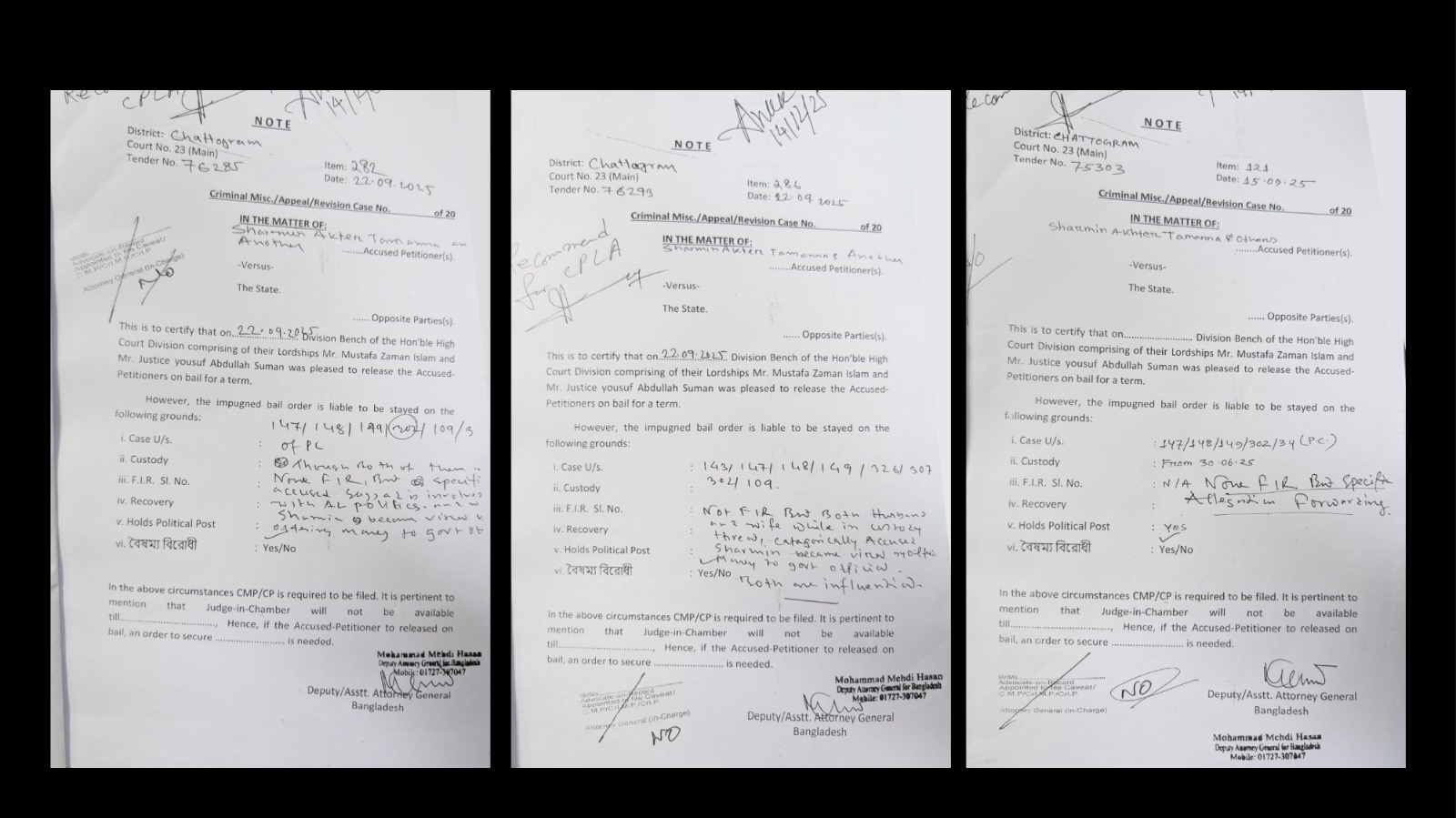
In this instance, however, internal paperwork shows that the cases were marked for no further action. The documents list bail orders issued on September 15 and September 22 under multiple High Court case numbers, all designated for non-opposition.
Each document carries a handwritten “No” next to the official seal reading “Attorney General (In-Charge),” indicating Rouf’s authorisation not to pursue stay petitions.
Two separate sources familiar with the internal documentation process confirmed that this paperwork is used exclusively within the attorney general’s office and that cases are categorised “Yes” or “No,” with “No” meaning the state will not challenge the order.

Legal experts said such a blanket decision not to contest bail in multiple murder cases involving an accused identified by police as a top criminal is highly unusual. In most comparable cases, the state routinely seeks a stay from the Appellate Division.
Attorney General Md Asaduzzaman told Bangla Outlook that Rouf had full authority to make decisions on whether the state would challenge High Court bail orders while serving as acting attorney general.
He said the office generally considers how the Appellate Division has treated similar cases, noting that the apex court often declines to interfere with bail orders when the prosecution case appears weak—such as when an accused is not named in the first information report or when police submissions lack specific allegations.
Asaduzzaman said it is not uncommon for the state to give no-objection in murder cases under certain circumstances, but added that he was unaware of the specific reasoning behind the decisions taken in Sazzad Hossain’s cases.
He said the attorney general’s office sought stay orders only after the issue became public.
Public scrutiny intensified in mid-December after bail documents began arriving at Chattogram Central Jail. Attention sharpened further with the resurfacing of social media videos in which Tamanna claimed she would secure her husband’s release by spending “bundles and bundles of money.”
Following the disclosure, the state moved to reverse course. On December 17, the Appellate Division’s Chamber Court stayed all seven bail orders after hearing petitions filed by the state, preventing the release of both Sazzad and his wife.
Internal records show that Rouf’s non-opposition decisions allowed the bail orders to advance through the system without challenge and reach prison authorities before the state intervened.
Mohammad Arshadur Rouf did not respond to repeated requests for comment. BanglaOutlook attempted to contact him by phone, text message and email.
The handling of Sazzad’s bail applications has taken on added significance as Rouf’s name is being discussed in legal circles as a potential candidate for attorney general, following Md Asaduzzaman’s announcement that he intends to resign in order to contest the upcoming parliamentary election.
—