

Tarique Rahman’s public meeting with the NSI chief was routine. Why recast it as a ‘secret’ one then?

Shafin Rahman
Publish: 05 Jan 2026, 05:03 PM
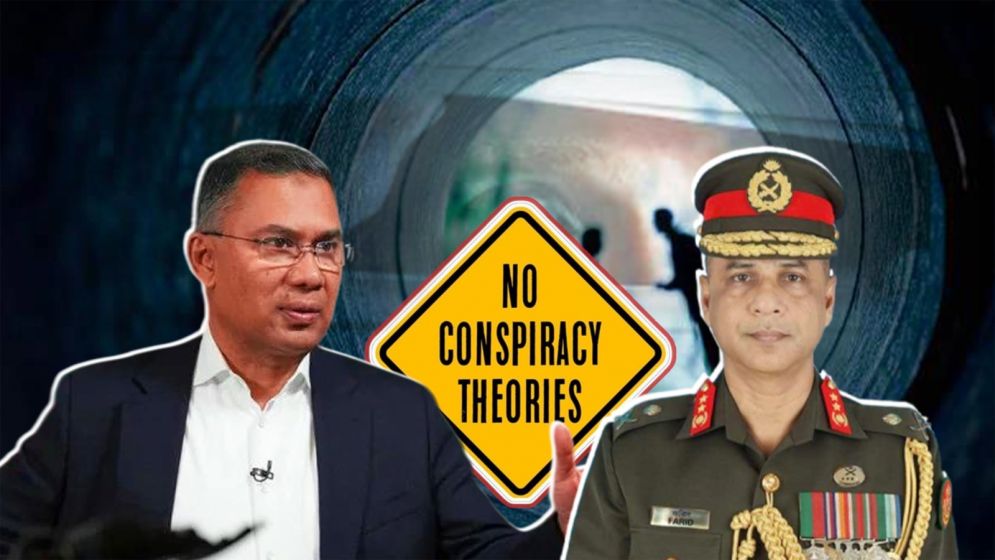
Since Tuesday, a swirl of conspiracy theories has taken hold in political circles and on social media over a meeting between Tarique Rahman, the chairman of the Bangladesh Nationalist Party, and Major General Sarwar Farid, the director general of the National Security Intelligence agency.
The meeting has been labeled a “secret meeting.” A small but vocal group in social media has sought to portray an ordinary process as something clandestine.
The facts however are straightforward.
When Begum Khaleda Zia, the former prime minister and BNP chairperson, was admitted to Evercare Hospital in critical condition, the interim government formally designated her a VVIP, a status reserved for the country’s highest national figures.
As a result, she was accorded Special Security Force protection, placing her protocol standing on par with that of the chief adviser. After her death, that status shaped the arrangements surrounding her burial.
She received the highest state honors, including a Guard of Honor. In keeping with established protocol, the chiefs of the Army, Navy and Air Force, along with the heads of major state agencies, conveyed condolences to her family.
The BNP opened a condolence book at its office for senior officials and diplomats to sign.
The process unfolded over multiple days. The military chiefs and the director general of the Directorate General of Forces Intelligence signed the book on the first day. The director general of the National Security Intelligence agency did not, owing to scheduling constraints.
He did so later.
On the day Major General Sarwar Farid arrived at the BNP office, the inspector general of police, the Dhaka Metropolitan Police commissioner, ambassadors from three countries and representatives from four others had already signed the condolence book earlier that day.
At 2:40 p.m., Major General Farid arrived in his official vehicle, following standard protocol, to perform the same duty.
While he was inside the BNP office, Tarique Rahman was informed of his presence. Tarique stepped out, asked to confirm his identity, and briefly greeted him, according to multiple sources in the BNP office.
The two exchanged a handshake and then Tarique asked whether the intelligence chief had a moment to spare.
Then Tarique Rahman and Major General Farid spoke openly, in full view of party officials, journalists and visitors moving through the BNP office.
The discussion, which lasted roughly 35 minutes, unfolded as a public exchange.

No ‘secret meeting’
According to those present,Tarique Rahman commended the intelligence agencies—including the Directorate General of Forces Intelligence, the National Security Intelligence agency and the Special Branch—for their role in maintaining security during Begum Zia’s funeral.
At one point, he asked the NSI chief what was the country’s most pressing challenge?
Major General Farid pointed out the continued presence of “collaborators of fascism” embedded across state institutions and termed it as a major problem. He said such problems could only be resolved by removing them and replacing them with officials committed to the state.
This exchange, conducted openly, at a party office, in daylight, is the entirety of what has since been portrayed as a “secret meeting.”
The initial amplification of the claim came from the NorthEast News portal, and the news was written by Chandan Nandy, a journalist whose family and professional background have drawn scrutiny in Bangladesh’s political circles.
Critics point to his father’s past role as India’s RAW station chief in Dhaka during the 1980s and argue that the outlet often reflects Indian strategic narratives. Whether or not that interpretation is accepted, the targeting of the NSI chief has not gone unnoticed.
Among military-appointed agency heads, the director general of the NSI occupies a uniquely sensitive position. His prominence has grown, supporters say, because of an unusually aggressive internal overhaul of the agency—including sidelining officers perceived as loyal to the previous Awami League government.
Operating, by some accounts, with a fraction of the agency’s sanctioned manpower, he has emerged as a consequential and therefore vulnerable figure. Seen in that context, the “secret meeting” allegation appears strategic.
In recent days, similar claims have surfaced elsewhere: reports of an alleged “secret meeting” between Jamaat-e-Islami’s ameer, Dr. Shafiqur Rahman, and Indian diplomats followed a strikingly similar pattern.
The effect, critics argue, is cumulative—to associate Bangladesh’s opposition mainstream, particularly the BNP and Jamaat, with covert engagement involving India, a country that carries significant negative political weight in domestic public opinion.
Who’s benefitting from convoluted narrative
In Bangladesh’s polarized environment, India functions less as a neutral reference point than as a political liability. Attach it to a narrative, and the arithmetic is predictable as the sum turns negative.
That, observers suggest, is precisely the objective—reputational subtraction.
At the center of the latest speculation lies a more ambitious claim that TariqueRahman has struck an understanding with India. There is no evidence to support it. No agreement exists.
What did occur, according to people familiar with the exchanges, was closer to what diplomats describe as an ice-breaking—a clarification of intent between actors who had long viewed each other with suspicion.
Such encounters are simple acknowledgments. They mark a recognition that misunderstanding, not coordination, has often defined past relations.
That distinction matters. While the BNP has not aligned itself with India, Indian policymakers would plainly prefer such an outcome. The attempt to reframe routine or exploratory contact as covert collaboration—including the exaggeration of the NSI chief’s public interaction with Tarique Rahman fits neatly into that broader strategic interest.
The same logic has been applied to Jamaat-e-Islami.
In recent days, reports have circulated claiming that Jamaat’s ameer, Dr. Shafiqur Rahman, met in London with Amitabh Mathur, a former RAW station chief in Bangladesh.
The meeting did occur. What did not occur, according to those briefed on the matter, was any negotiation, commitment or political understanding. But nuance rarely survives a headline.
The phrase “Jamaat Ameer met RAW station chief” is often sufficient to trigger political damage, regardless of substance.
In politics, meetings are not endorsements, and contact is not complicity. Leaders routinely engage with a wide range of interlocutors—foreign officials and intelligence veterans —particularly while operating in exile or opposition.
Those amplifying these encounters understand that reality. Their decision to omit context appears less careless than calculated.
There is also a secondary target. By feeding narratives that pit the BNP and Jamaat against each other—or suggest secret dealings that erode trust—a third force stands to benefit.
A functional, discreet understanding between the two would dramatically alter Bangladesh’s opposition landscape. Preventing that convergence, some observers argue, is the unspoken aim behind the noise.
—
Shafin Rahman is an independent analyst with particular interest in defense and security issues