

Bangladesh’s politics is still fighting the past

Mahtab Uddin Chowdhury
Publish: 16 Jan 2026, 07:31 PM
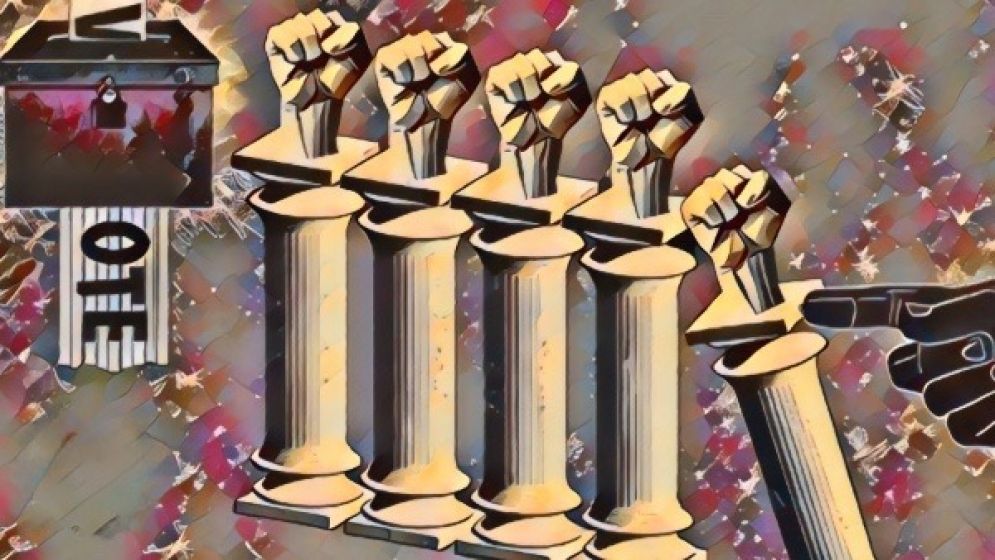
World politics, political economy, and electoral democracy tend to advance along two distinct tracks.
One is anchored in historical argument, where the past dictates the terms of the present. The other is driven by policy, where political imagination is oriented toward the future.
Both approaches have value. But the construction of a modern welfare state depends decisively on the latter.
Social protection, economic security, and institutional resilience do not emerge from nostalgia or grievance; they require a governing culture that treats forward-looking policy debate as a central political function rather than a peripheral exercise.
Bangladesh remains largely confined to the first track. Public political discourse—across tea stalls and television studios, podcasts and panel discussions—revolves obsessively around history.
The national conversation is saturated with arguments over past actions and past betrayals. And probably past injuries. Which party did what, who erred first, whose legacy deserves redemption—these questions dominate political life.
This is probably not merely a failing of politicians.
Civil society leaders, academics, activists, and even policy professionals routinely reproduce the same backward gaze.
In mature democracies and welfare states, history serves primarily as a source of learning, accountability, and scholarly inquiry. In Bangladesh, by contrast, history continues to function as the primary engine of politics itself.
Political identity, legitimacy, and mobilisation are still forged through selective narratives of the past. Policy debate is not enriched by historical reflection; it is crowded out by it.
The result is a political culture that privileges memory over method and emotion over design.
The election game
The national election scheduled for Feb. 12, 2026, is formally intended to be a democratic exchange—an opportunity for citizens to choose among competing visions for the country’s future.
In principle, a free and fair election should translate popular will into a mandate for governance.
In reality, Bangladesh confronts a persistent twofold failure.
Political parties have long treated manifestos as symbolic documents rather than binding commitments, while voters rarely evaluate them as serious policy blueprints.
Electoral decisions continue to be shaped less by proposals for reform than by historical loyalty, emotional storytelling, identity politics, and unresolved conflicts from the past.
Until policy displaces history as the primary currency of politics, elections will remain exercises in repetition rather than moments of choice—and democratic progress will continue to stall where it matters most.
That failure is now unmistakable. Since Aug. 5, 2024, Bangladesh has entered a fluid and unsettled political moment. An informal opposition alignment, led by the Bangladesh Nationalist Party, has begun to redraw the political map.
Jamaat-e-Islami, long positioned as a secondary rival to the BNP, has sought to reinvent itself as a principal force in a post–Awami League landscape. Alliances have shifted, counter-alliances have formed, and the chessboard has been reset.
Yet the substance of political debate has barely moved.
The BNP has spent months promoting its 31-point reform agenda, a document that gestures toward governance reform, economic fairness, institutional accountability and democratic renewal.
On paper, it is one of the more comprehensive political platforms in recent years.
In practice, it has struggled to animate public debate. Organisational weaknesses play a role, but the deeper problem is structural: Bangladesh’s political culture does not reward patient, policy-driven persuasion.
Visibility still flows to confrontation, not to proposals.
Only recently has the party attempted to convert its reform language into concrete ideas—initiatives like farmer cards or family cards aimed at targeted welfare delivery.
These proposals suggest an overdue shift toward programmatic politics. But they arrived late, and they entered a media ecosystem still consumed by historical accusation and reactive counter-narratives.
Policy, once again, was drowned out by memory.

Absence of concrete thought on policy
Other major players have offered even less. Jamaat-e-Islami and affiliated platforms, including the National Citizen Party, have yet to articulate a coherent economic or social policy vision.
With the election now weeks away, voters remain largely in the dark about what many contenders actually plan to govern with. This absence is not a campaign oversight; it is the predictable consequence of a political system that has long privileged retrospective argument over prospective design.
Even the language of “reform,” now ubiquitous in political speeches and talk shows, has failed to break this pattern. What might have become a forward-looking framework for change has instead been hollowed out into a tool for historical reckoning.
Reform has come to mean cataloguing past failures rather than outlining future choices.
The exposure of yesterday’s mistakes has replaced the hard work of explaining tomorrow’s policies.
The result is a political moment rich in rhetoric but poor in direction—an election season defined less by competing visions of the future than by an endless debate over who should be blamed for the past.
The cost of this fixation is now visible in what went missing. Core policy domains—environmental protection, transport and communications, agricultural productivity, farmer welfare, job creation and urban services—barely registered in the reform conversation.
Even issues that once seemed unavoidable, like police reform, media independence and institutional accountability, surfaced briefly before being submerged again. The reform moment produced no real pressure for policy innovation.
Instead, it recycled the familiar habit of treating politics as a courtroom for the past rather than a laboratory for the future.
No welfare state has ever been built on grievance alone. Nostalgia may mobilize, resentment may energize, but neither designs institutions nor delivers services.
Societies that succeed in expanding social protection do so by arguing relentlessly about what comes next—how resources will be raised, how risks will be shared, and how the state will be made to work for ordinary citizens.
The conclusion, then, is not that Bangladesh must turn away from its history.
Democratic accountability depends on memory, and justice requires reckoning. But when historical narratives consume the political space, they crowd out policy thinking and flatten the horizon of possibility.
The deeper problem is not that Bangladesh remembers too much, but that it governs as if memory were a substitute for imagination.
Until politics breaks free from this enclosure—until the future is allowed to compete seriously with the past—elections will continue to replay old arguments, and reform will remain a word in search of substance.
—
Mahtab Uddin Chowdhury is an independent researcher specialising in South Asian politics, local governance and media freedom.