

Why and how Khaleda Zia was the epitome of Bangladesh’s politics of dignity and restraint

Salahuddin Ahmed Raihan
Publish: 29 Jan 2026, 08:06 PM
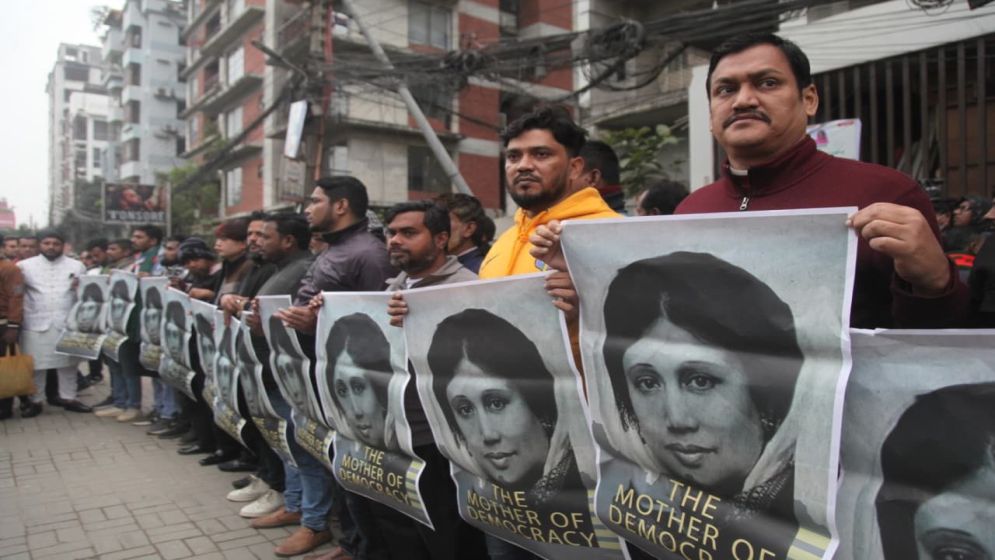
Photo Credit: Nazmul Islam
Independent Bangladesh has produced no shortage of political figures. Few, however, have combined prolonged persecution with a disciplined restraint in language and conduct.
In that narrow category, Begum Khaleda Zia stands apart.
When President Ziaur Rahman was assassinated by mutinous soldiers on May 30, 1981, Khaleda Zia was left widowed and politically uninitiated. She was also responsible for two young children.
Until then, her public life had been limited to accompanying her husband on state visits.
Ziaur Rahman’s personal integrity was widely acknowledged, and his sudden death thrust his family—particularly his wife—into a political landscape defined by intrigue and repression.
The military ruler Hussain Muhammad Ershad soon consolidated power and set out to marginalize the Bangladesh Nationalist Party (BNP).
It was senior party leaders that drew Khaleda Zia into politics. She resisted at first. Her family, especially her mother, strongly opposed the move. When she eventually agreed to engage, the BNP itself was fractured into three competing factions—hardly a platform designed for political comfort or certainty.
Khaleda Zia entered public life with an instinctive sense of decorum that was rare even then, and rarer now. She spoke of political rivals with restraint and of national leaders with deliberate respect.
Her speeches consistently acknowledged the contributions of others and emphasized tolerance over invective. She was firm in her pursuit of justice, but notably unwilling to erase the legitimacy of opposing views—a discipline that distinguished her in an era increasingly defined by political absolutism.
That restraint did not shield her from repression. Under the Ershad regime, Khaleda Zia faced repeated harassment, including enforced disappearances and prolonged periods of house arrest.
After assuming the role of BNP chairperson in 1984, she refused to legitimize Ershad’s rule by participating in the tightly managed elections of 1986. That decision carried personal risk, but it also reshaped the party’s public standing.
The BNP emerged as a genuinely popular opposition force instead of a military-backed vehicle.
Resistance to power
When Ershad fell, the electorate responded accordingly. In the February 27, 1991 election, Khaleda Zia led her party to victory, becoming Bangladesh’s first female prime minister.
Her ascent was historically significant beyond national borders. She was only the second woman to serve as prime minister in the Muslim world. In a society where women were routinely sidelined from political and economic life, her leadership disrupted deeply entrenched norms.
Khaleda Zia placed women’s education at the center of her policy agenda, expanding stipend programs, implementing “Food for Education,” and making schooling free through the tenth grade.
These initiatives were not symbolic gestures; they materially altered access to education for millions of families.
Khaleda Zia’s political legacy is neither uncomplicated nor beyond debate. But in a political culture often marked by excess—of rhetoric and retribution—her early years remain a case study in how endurance, moderation, and resolve can coexist, even under sustained pressure.
Once in office, Khaleda Zia translated her instincts for restraint and endurance into governance. She assembled a cabinet that mixed political loyalty with technical competence—an approach that reflected calculation rather than sentiment.
Her most consequential decision was restoring Saifur Rahman to the finance ministry and granting him unusual autonomy. The results were structural. The introduction of value-added tax reshaped revenue collection, while a deliberate balance between industrial expansion and agricultural stability signaled a departure from short-term populism.
The familiar shorthand—“from housewife to prime minister”—misses the point. Khaleda Zia did not arrive in power unformed; she was shaped by conflict. Nine years of organizing resistance against a military dictator honed her political judgment.
Street politics, imprisonment, and confrontation with state power proved to be her education. By the time she assumed office, she had already internalized the limits of authority and the costs of economic miscalculation in a fragile state.

Ruling with compassion
That sensibility extended to her tolerance for internal dissent. Khaleda Zia resisted the reflex to purge.
Barrister Nazmul Huda remained within the party despite repeated public disagreements. Barrister Moudud Ahmed, even after publishing a book sharply critical of her and her son, was not removed from the BNP’s Standing Committee, despite pressure from loyalists.
Loyalty, in her view, was not synonymous with silence.
This instinct surfaced again when the writer Mohiuddin Ahmad sought to interview her for a book. Advisers warned that he was openly critical of the BNP. Khaleda Zia dismissed the concern with characteristic bluntness: truth did not require party approval.
It was an answer that revealed a confidence uncommon among South Asian political leaders—and rarer still among those accustomed to siege.
Her political identity remained inseparable from the legacy of Ziaur Rahman. She repeatedly invoked his 19-point program as a governing framework. Yet she did not merely inherit his worldview; she applied it.
Like him, she rejected hegemonic alignment. On state visits she insisted on strategic balance and national dignity. “Friendship to all, malice toward none” was a working principle that guided her foreign policy until the end.
The economic record of her administrations is often flattened by partisan argument, but the data tell a more complicated story. Poverty alleviation accelerated, remittance inflows expanded, and growth held steady.
Economist Rashed Al Mahmud Titumir has argued that structural changes under her two terms altered the lives of roughly 18 million people. When her government handed power to the caretaker administration in 2006, the economy was growing at 6 percent—a benchmark that carried both symbolic and substantive weight.
Other markers mattered too. The stock market retained public confidence, particularly among small investors. Her government pursued prolonged negotiations over transboundary river waters, insisting on Bangladesh’s equitable share despite regional pressure.
Taken together, Khaleda Zia’s record resists easy caricature. She governed neither as an ideologue nor as a populist performer. Instead, she operated as a politician forged in resistance—measured in speech, deliberate in policy, and unusually tolerant of dissent in a political culture that rarely rewards such restraint.
The image that has endured
Political leaders endure in public memory not merely for what they achieve, but for how they conduct themselves. By that measure, Khaleda Zia’s restraint became her signature.
Until her final years in public life, she remained sparing with words and disciplined in demeanor, avoiding the ritualized taunts that dominate Bangladeshi politics. She worked without theatrics, resisted the culture of constant media adulation, and declined to trade in promises she knew the state could not keep.
That restraint shaped her politics. When she unveiled Vision 2030, she did so with an explicit caveat: the goals outlined were bounded by realism, not aspiration alone. It was an unusual admission in a political culture where ambition is often unmoored from capacity.
Ego never became the organizing principle of her leadership; she spoke instead of institutions, teams, and shared responsibility.
Her work on women’s empowerment drew international recognition. Programs initiated under her leadership were cited by global institutions, including the World Bank, as innovative models of social protection.
In 2005, she was ranked among the world’s most influential women—a distinction that reflected not symbolism, but impact. Yet even after enduring sustained persecution, she consistently urged her party to resist retaliation and reject the politics of vengeance. Moderation, for her, was not weakness but discipline.
That discipline was most visible in moments of crisis. In the aftermath of August 5, when political emotions ran high, Khaleda Zia chose composure over confrontation. She neither incited nor inflamed.
Her insistence on tolerance toward adversaries elevated her standing beyond partisan lines, placing her in a shrinking category of leaders who understood that democratic survival depends as much on restraint as on resistance.
The paradox of her life remains striking. She began as a homemaker, distant from the machinery of power. According to Kofi Khan, press secretary to Ziaur Rahman, she never once visited her husband’s office during his presidency.
Yet history placed her in that same office—not by inheritance, but by endurance. Her rise was improbable; her staying power, undeniable.
Khaleda Zia’s legacy will not rest on mythology. It will endure because she modeled a different political temperament: soft-spoken without being passive, tolerant without being indecisive, dignified without detachment.
As Bangladesh continues to wrestle with the coarsening of public life, her example raises an uncomfortable question—how long it will take before the country produces another leader for whom power was exercised with such measured restraint.
—
Salahuddin Ahmed Raihan is a civil engineer. You can reach him at [email protected]