

BNP vs Jamaat’s manifesto as a contest between prudent economic engineering and lofty economic idealism

Abu Jakir
Publish: 11 Feb 2026, 07:03 PM
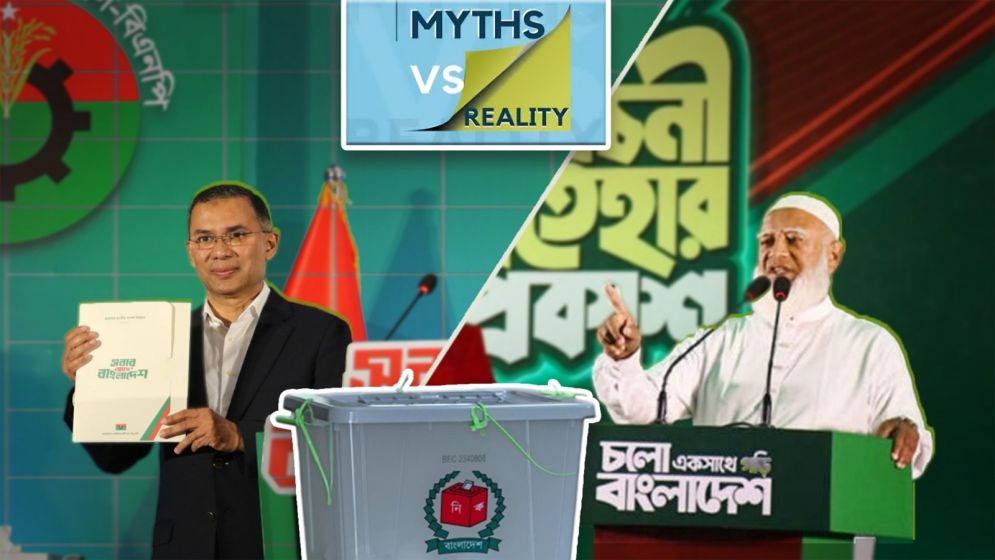
As Bangladesh heads toward the much coveted general election tomorrow, two starkly different visions for the country’s future have been articulated by the major contesting coalitions.
The Bangladesh Nationalist Party (BNP) released a comprehensive and measurable manifesto focused on economic recovery, social stability, and institutional reform, which economic expert Dr Rashed Al Mahmud Titumir describes as “actionable” and grounded in current national conditions.
In contrast, Jamaat-e-Islami’s manifesto, explained by AKM Waresul Karim as having moved rhetorically from its traditional positions, remains burdened by unrealistic targets and structural contradictions that make its implementation deeply problematic.
The contrast between these blueprints is technical: one outlines achievable steps, while the other promises lofty goals detached from economic and administrative realities.
Dr Titumir, a development studies professor, sees BNP’s manifesto as a response to the lived hardships of ordinary Bangladeshis after years of governance failures by the previous administration.
According to him, the manifesto does not merely offer broad slogans, but delineates specific strategies, timelines, and mechanisms for implementation. The plan enumerates reforms across constitutional, administrative, judicial, and economic structures, and anchors these in measurable targets.
For example, the party aims to transform the economy into a trillion-dollar economy by 2034—a goal consistent with projections by international agencies—and sets realistic fiscal targets such as increasing the tax-to-GDP ratio to 15% by 2035, with detailed paths to achieve intermediate milestones without raising tax rates indiscriminately.
This level of specificity is central to why BNP’s approach is more implementable. Rather than leaving the public guessing about what will be done, the manifesto identifies concrete pressures facing the population—rising inflation, stagnant wages, and unemployment—and proposes actionable remedies.
Implementable plans vs rhetoric
These include waiving agricultural loans up to 10,000 taka with interest for farmers, fishermen, and livestock keepers, repaying one year’s installments on microloans, enhancing skill development for overseas manpower, and adjusting wages in line with the cost of living.
It also outlines sector-specific interventions such as reopening closed industries, rationalizing interest rates, and bolstering small and medium enterprises, which together could stimulate production and bring down consumer prices.
Beyond economic measures, the BNP manifesto emphasizes institutional reform. Dr Titumir highlights proposals to restructure the public administration, judiciary, and law enforcement to strengthen accountability, merit-based governance, and transparency.
Given Bangladesh’s history of political polarization and governance challenges, such reforms are essential to reduce corruption and improve public service delivery.
The manifesto also recognizes regional imbalances in development and proposes strategic infrastructure projects—including river and canal conservation, agricultural value-chain expansion in northern districts, and positioning Chattogram as a commercial hub—which could catalyze employment outside Dhaka and break long-standing regional bottlenecks.
In contrast, Jamaat-e-Islami’s manifesto, although presented as inclusive, contains targets that defy empirical economic logic. Prof Waresul Karim points out a glaring example: the party’s pledge to build a $2 trillion economy by 2040 while targeting a steady 7% growth rate.
In reality, sustained growth at that rate would not double the size of the economy in a decade; it would take approximately 20–25 years to quadruple. This mismatch between ambition and mathematical feasibility undermines the credibility of Jamaat’s economic framework.
It reflects a broader pattern where aspirations are not anchored in analytical projections or plausible modeling.
Karim however critiques Jamaat’s ambitious target of attracting $15 billion in foreign direct investment (FDI) by 2030, a significant sum for an economy already struggling with investor confidence amid political uncertainty.
According to him, FDI follows from stability, security of capital, and predictability in governance—conditions that are not convincingly guaranteed in the party’s broader political narrative.
Domestic investors themselves remain cautious due to prevailing uncertainties; without addressing these foundational issues, pledges of substantial FDI inflows risk remaining wishful.
Another problematic aspect in Jamaat’s economic policy is the simultaneous promise to significantly reduce tax and interest rates while increasing public expenditure and growth.
This creates a fiscal contradiction: lower tax rates typically reduce government revenue unless offset by drastic expansions of the tax base or extraordinary economic performance—neither of which is sufficiently detailed in the manifesto.
Prof Karim points out this paradox explicitly, noting that no economist would confidently back such a dual mandate without clear mechanisms for balancing the books.

Electoral ambitions and reality
On social issues, Jamaat’s manifesto speaks of creating a safe and participatory state for women, yet the party did not nominate a single woman candidate, and its leader’s controversial remarks about women’s leadership rights signal a disconnect between policy language and political practice.
Prof Karim also identifies this gap as a strategic mistake that weakens trust in Jamaat’s commitments. In contrast, the BNP manifesto integrates social security measures like family cards, expanded social protection for vulnerable groups, and explicit support for women, children, and the elderly—areas where actionable policy can translate into measurable improvements in quality of life.
The difference in realism also extends to governance priorities. BNP’s blueprint lays out steps for reducing regional disparities, formalizing labor market improvements, and enhancing digital infrastructure to improve public service delivery.
These are not merely aspirational goals; they are tied to quantifiable indicators and policy tools that can be tracked and evaluated. This contrasts with Jamaat’s approach, where many commitments remain high-level and lack corresponding operational frameworks, raising legitimate questions about how these policies would be administered on the ground.
From an electoral standpoint, this contrast is significant. Bangladesh’s economy suffers from structural challenges: youth unemployment, inflationary pressures, and widespread underemployment continue to weigh on households.
The public’s demand is not for ideological declarations but for practical solutions that reduce costs, create jobs, and stabilize livelihoods. BNP’s manifesto speaks directly to these demands with measurable, phased proposals that can be monitored and adjusted based on performance metrics.
Jamaat’s, by comparison, remains rooted in broad goals requiring further definition and operational clarity.
Ultimately, the 2026 election presents voters with a clear choice between a policy platform grounded in implementable economic and institutional reforms and one that, despite softer rhetoric on inclusion, offers ambitious but mathematically and administratively unsupported aims.
BNP’s manifesto, as articulated by Dr Titumir, reflects an understanding of Bangladesh’s current conditions and proposes realistic pathways for progress.
Jamaat’s vision, articulated by Waresul Karim, contains promising elements but lacks the analytic rigor and operational detail necessary for effective implementation.
—