

The world is cracking….and ‘surprisingly’ Bangladesh is in a position to cash in

Sagor Hasnath
Publish: 04 Apr 2026, 04:22 PM
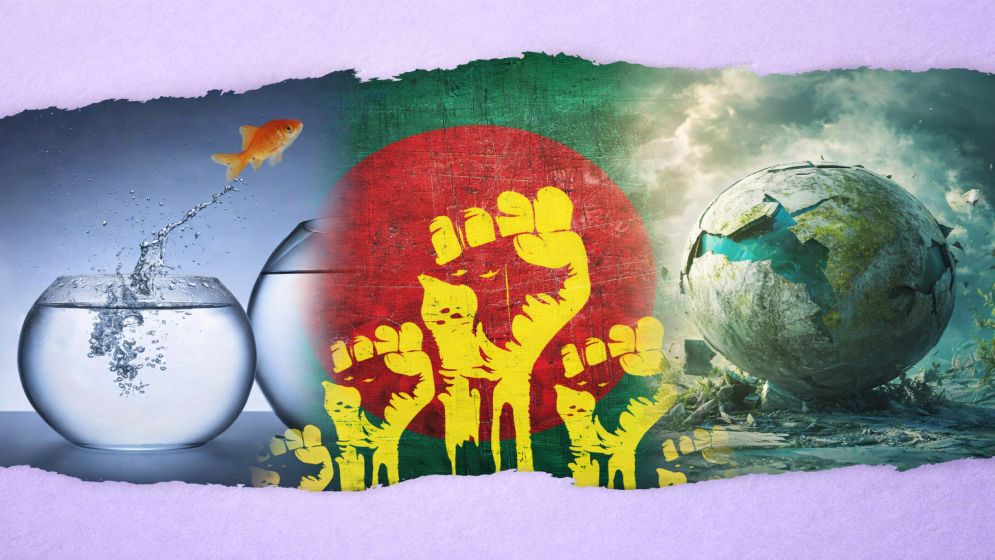
The modern global economy is a vast, inflated marketplace where the unnecessary is not only consumed but exalted. Entire industries derive their value from perception and speculative belief.
Products and services with little grounding in human necessity are traded at valuations reaching into the billions, even trillions.
We have seen this story before. The dot-com bubble of the early 2000s promised a digital utopia before collapsing under its own excess. It was followed by the housing bubble, built on equally fragile assumptions.
More recently, the startup ecosystem — once celebrated as the engine of innovation — has shown clear signs of deflation. Now, the world turns its gaze toward what may be the next fault line: artificial intelligence, an industry booming with promise…but not immune to overvaluation.
History suggests a brutal corrective mechanism: crisis. War, in particular, has a way of stripping illusions. It forces societies to confront what is essential and what is merely decorative.
Under such pressure, economies recalibrate, often violently, around necessity.
Today, the warning signs are difficult to ignore. The global economy appears to be inching toward another significant recession. Even in the unlikely event that ongoing conflicts were to cease immediately, the aftershocks would linger for years.
Damaged infrastructure, disrupted energy supplies, and fractured supply chains are not repaired overnight. Recovery, under optimistic assumptions, would take at least half a decade…more likely longer.
In every downturn, commerce is the first to feel the strain. Businesses serve as both the frontline and the buffer of economic stress. Yet recession does not distribute pain evenly.
While many sectors contract, others expand, particularly those tied to basic human needs.
This is where the narrative becomes less pessimistic and more instructive. In times of economic hardship, consumption patterns shift dramatically. Luxury gives way to necessity; aspiration yields to affordability.
The global financial crisis of 2009–10 offered a clear example. As consumers abandoned high-end brands, demand surged for more accessible alternatives.
Bangladesh’s ready-made garment sector was a beneficiary of this shift. While some predicted decline, the opposite occurred.
As global consumers traded down from premium labels to mid-tier retailers, Bangladesh, a key supplier for those markets, saw its apparel exports strengthen. The crisis did not weaken the industry; it repositioned it advantageously.
Bangladesh’s resilience
The same logic applies more broadly. In recessionary periods, businesses tied to fundamental needs—food, clothing, and medicine—often thrive. These are not discretionary purchases. They are the baseline of human existence.
And here lies an underappreciated reality: Bangladesh holds a strong position across all three sectors. Despite the often pessimistic national discourse, the country’s capacity in agriculture, textiles, and pharmaceuticals places it in a structurally resilient position in the face of global contraction.
In agriculture, Bangladesh occupies a far stronger global position than it is often given credit for. It ranks as the world’s third-largest producer of rice, trailing only China and India, and remains largely self-sufficient, resorting only to occasional imports to stabilize supply.
Its fisheries sector is equally formidable, placing between third and fifth globally and standing as a world leader in aquaculture, particularly in freshwater production.
Beyond staples, the country has built strength across a wide range of crops: potatoes, where it ranks between seventh and tenth with surplus output that supports exports; mangoes, where it holds a position just behind the global leaders; and vegetables, which benefit from year-round cultivation and consistent domestic sufficiency.
Even jute—long known as the “golden fiber”—continues to anchor Bangladesh near the top of global production, reinforcing its export profile.
Livestock production, particularly cattle and beef, is expanding but remains only partially self-sufficient, meeting seasonal demand peaks such as during Eid-ul-Adha. Poultry, by contrast, has grown rapidly and now largely meets domestic needs, ranking within the top tier globally.
Other areas reveal lingering gaps: onion and chilli production, despite ranking within the top 10 to 15 worldwide, still fall short of full self-sufficiency due to supply chain and value chain limitations.
Bananas, however, offer a steadier picture, with year-round production ensuring consistent availability. Taken together, the picture is neither one of scarcity nor excess, but of a complex agricultural system that is broadly resilient, increasingly productive, and still evolving toward greater balance.
In the global apparel trade, the country meanwhile is not merely competitive; in several categories, it leads. Within the European Union, Bangladesh ranks first in specific segments of clothing exports.

Foundational weakness
If clothing represents industrial strength, pharmaceuticals reveal something even more consequential: resilience. After food and garments, medicine is the third pillar of any functioning society, and here Bangladesh has built an unexpectedly formidable position.
Nearly all of its domestic demand—roughly 98 percent—is met through local production, an achievement that places it among a small group of countries approaching pharmaceutical self-sufficiency.
Beyond its borders, Bangladeshi medicines travel far, reaching more than 150 countries, including some of the most tightly regulated markets in the world such as the United States, the United Kingdom, Europe, Canada and Australia. This is not simply export activity; it is a signal of regulatory credibility and manufacturing competence.
And yet, beneath this strength lies a structural vulnerability that cannot be ignored. Bangladesh’s success across agriculture, textiles and pharmaceuticals rests on a foundation that is still, in critical ways, externally dependent.
The country grows its food but relies heavily on imported fertilizers—phosphate, potash and complex blends like NPK—to sustain that productivity. Its farmers increasingly depend on high-yield seed varieties sourced from abroad, along with pesticides produced by foreign companies.
The textile sector, despite its global dominance in finished garments, remains almost entirely reliant on imported cotton, without which yarn—and therefore clothing—cannot be produced.
Industrial machinery, from spinning and weaving equipment to irrigation and packaging systems, arrives from overseas. Even in pharmaceuticals, where the finished products are locally manufactured, key inputs such as active pharmaceutical ingredients and specialized equipment are still largely imported.
This duality, strength in output, dependence in input, defines Bangladesh’s economic reality. It is both a producer and a participant in a deeply interconnected global supply chain, benefiting from it in times of stability but exposed to it in times of disruption.
And disruption, increasingly, appears to be the defining condition of the coming decade.
Against such a backdrop, traditional trade patterns could give way to more pragmatic arrangements, including bilateral exchanges and even forms of barter, particularly among countries seeking to secure essential goods without overreliance on volatile financial systems.
In that world, Bangladesh’s position becomes more complex but also more strategic.
Areas of strength
Bangladesh’s ability to produce food at scale—from rice and fish to vegetables and jute —places it among a relatively small group of countries with agricultural depth.
Its dominance in ready-made garments ensures continued relevance in global consumption, especially as demand shifts toward affordability. And its growing pharmaceutical capacity offers a critical layer of domestic security while opening doors to international leverage.
The question, then, is not whether Bangladesh can withstand a global downturn. It is whether it can reduce the external dependencies that shadow its strengths….and in doing so, transform resilience into true economic sovereignty.
If the argument so far is that crises reorder the global economy around necessity, then the next question is who is already living in that future.
One plausible answer is Iran. Barring a catastrophic escalation, it is positioned to emerge from current tensions with a hardened, adaptive economic model—one built on constraint instead of abundances.
Years of sanctions have forced Iran to operate outside conventional financial systems, quietly eroding the once-unquestioned dominance of the Petrodollar. In its place, Iran has refined a parallel approach: an “emergency economy” grounded in direct exchange, where oil is traded—sometimes discreetly—for essential goods with partners such as China and Russia.
It began as a workaround but soon resembled a template.
In a fractured global order, where financial systems are increasingly politicized and supply chains unstable, barter-like arrangements are no longer relics of the past but previews of what comes next.
Countries rich in raw materials—oil, gas, fertilizers, seeds, cotton—often lack the industrial ecosystems needed to convert those inputs into finished goods.
Others, like Bangladesh, possess the inverse strength: a robust capacity to produce food, garments and pharmaceuticals, but with a persistent dependence on imported inputs.
That asymmetry is not merely a vulnerability….rather it is an opportunity.
 New form of economic opportunity
This is because a more transactional, necessity-driven global economy opens the door to pragmatic exchanges.
With blocs such as the Gulf Cooperation Council, Bangladesh could deepen a model of reciprocal trade—exporting essentials like food, clothing and medicine in exchange for energy resources and agricultural inputs.
It is a shift away from abstract financial flows toward tangible value, measured not in speculation but in survival.
There is another dimension to this equation, one less discussed but equally consequential: labor. Post-conflict reconstruction across the Gulf will demand an enormous workforce, and Bangladesh has long been one of the world’s most significant exporters of human capital.
Ranked among the top global sources of migrant labor, it supplies millions of workers—skilled, semi-skilled and unskilled—whose remittances form a critical pillar of the national economy.
Nearly ten million Bangladeshis abroad send earnings home, placing the country among the leading recipients of remittance income worldwide.
Taken together, these dynamics suggest a counterintuitive possibility. War, while destructive, also redistributes economic advantage. Bangladesh, like all nations, would face immediate strain—particularly in energy security—but its structural strengths align closely with the demands of a contracting world.
If it can plan with foresight, maintain balanced diplomacy, protect its core industries and continue shifting toward production rather than consumption, it may not simply endure the next global downturn.
It could emerge as one of its quieter beneficiaries, positioned at the center of recovery instead of the margins of crisis.
For Bangladesh, the moment ahead is as unforgiving as it is consequential.
The new government now confronts a scale of challenge that few could have fully anticipated before taking office—a convergence of global instability, economic recalibration and domestic vulnerability.
Yet history suggests that periods of maximum strain often carry within them the outlines of opportunity.

Silver linings
So, now the question is not whether difficulty lies ahead, but whether it will be recognized early enough to be shaped into advantage.
There is, faint but visible, a path forward. It requires more than optimism. It demands policymaking that is deliberate rather than reactive, grounded not in political instinct but in technical expertise.
Precision will matter. So will restraint. Decisions made in haste or driven by short-term pressures risk compounding fragility, while those guided by careful planning, institutional discipline and a measure of empathy may allow the country to navigate turbulence without losing direction.
War, by its nature, destroys. It fractures economies, disrupts supply chains and leaves behind physical and financial ruin.
But its consequences are not evenly distributed. In every era of upheaval, there are those who, by design or by circumstance, position themselves not merely to endure the shock but to shape what follows.
They invest when others retreat. They build when others hesitate.
Bangladesh now stands at precisely such a threshold. The capacity to convert global disorder into national gain is neither guaranteed nor accidental; it is constructed through choices made in real time.
The country’s existing strengths—in production, labor and essential goods—provide a foundation. What remains uncertain is whether those strengths will be strategically deployed or gradually eroded under pressure.
The difference will rest, to a large extent, with those in power. Opportunity, in moments like this, rarely announces itself plainly. It appears instead as risk, as instability, as disruption.
Recognizing it—and acting with clarity before it passes—is what separates those who inherit the future from those who watch it take shape elsewhere.
—
Sagor Hasnath is a former government employee turned-entrepreneur. He is the CEO of Ahlan Agro