

Indian press pushes Dhaka to reciprocate after Trivedi appointment

Staff Reporter
Publish: 29 Apr 2026, 08:49 PM
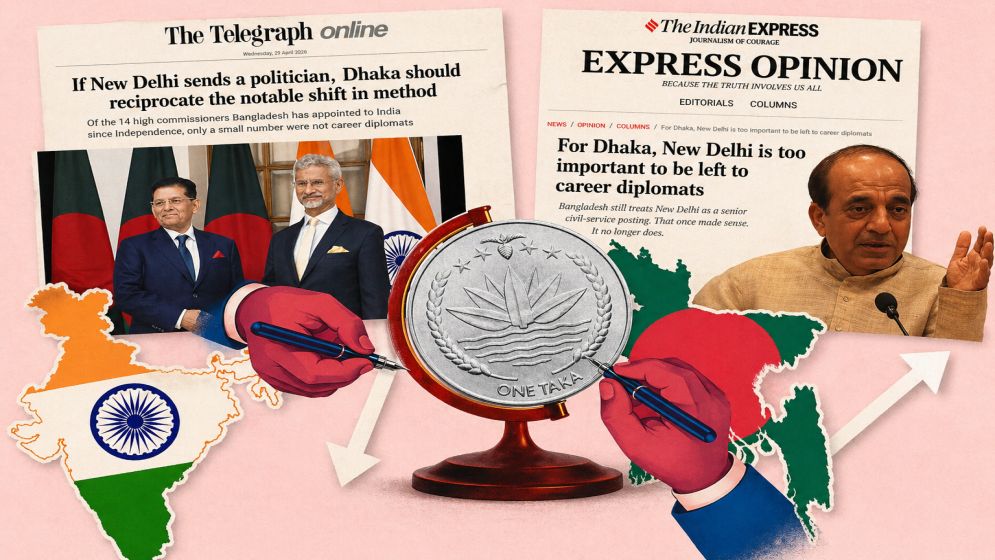
Two of India’s most influential national newspapers on Wednesday carried sharply argued commentaries urging Bangladesh to respond in kind after New Delhi’s decision to appoint a political heavyweight rather than a career diplomat as its next envoy to Dhaka, signalling what both papers described as a significant shift in the management of bilateral ties.
The simultaneous interventions by The Indian Express and The Telegraph came days after India named former Union minister and veteran politician Dinesh Trivedi as its next High Commissioner to Bangladesh—an unusual choice for one of New Delhi’s most sensitive neighbourhood postings, traditionally reserved for senior Indian Foreign Service officers.
Reuters reported earlier this week that the move was seen as part of an effort to rebuild ties and inject political weight into the relationship.
In a column published on Wednesday afternoon, The Indian Express said Bangladesh should recognise the message behind the appointment and answer with a comparable envoy of its own.
“New Delhi appears to have decided that relations with Dhaka can no longer be managed by diplomatic process alone,” the paper wrote. “They now require political management. Bangladesh should take the hint and reciprocate.”
The newspaper argued that the older framework of relying primarily on bureaucratic channels had become outdated amid rising sensitivities and political volatility on both sides of the border.
It said issues such as trade disputes, visa restrictions, border killings, water-sharing tensions and strategic mistrust had moved beyond routine diplomatic handling and were now deeply embedded in domestic politics.
The paper also suggested that Bangladesh’s own political transition had altered the nature of decision-making in Dhaka, making political access more valuable than formal protocol.
It said authority under the current government was more concentrated and overtly political, requiring envoys capable of operating quickly through trust networks and informal channels.
Explaining why Trivedi’s appointment mattered, The Indian Express wrote that his “value lies in political utility,” noting his familiarity with cabinet systems, party networks and media signalling. It said such experience could allow him to reach key decision-makers, read unofficial signals and communicate with the credibility of someone who had held power himself.
The newspaper framed the move not as ceremonial experimentation but as a strategic recalibration by India. In that context, it argued Bangladesh should consider sending to New Delhi “a politician of stature, or at minimum a figure with cabinet rank and direct access to Prime Minister Tarique Rahman.”
Earlier in the day, The Telegraph struck a similar note, saying India’s decision to appoint “a politician rather than a career diplomat” marked “a notable shift in method” and that Dhaka should reach the same conclusion.
The Kolkata-based daily said Bangladesh ought to appoint to New Delhi “a political envoy, or at least a figure of state-ministerial rank” who had direct access to Prime Minister Tarique Rahman and authority to speak for the government in urgent matters.
It stressed that such a step would not be symbolic vanity but a recognition of changed geopolitical and domestic realities.
According to The Telegraph, India and Bangladesh no longer deal mainly in technical matters handled through bureaucratic channels.
While border management, water-sharing, market access and transit remain important, the paper said those issues now sit within “a more overtly political context,” with regional competition sharper and public opinion in both countries more volatile.
The newspaper pointed to Bangladesh’s own diplomatic history with India, noting that of the 14 high commissioners Dhaka had appointed to New Delhi since independence, only a handful were not career diplomats.
That tradition, it said, had value in terms of professionalism and institutional memory, but traditions only work when circumstances remain constant—and circumstances had changed.
In a pointed line, The Telegraph described India as Bangladesh’s “most consequential bilateral relationship,” citing its status as immediate neighbour, major trading partner, energy link, transit route and unavoidable security actor.
It questioned whether Dhaka could still afford to treat New Delhi merely as a senior diplomatic posting rather than a strategic political one.
The convergence of editorial opinion in two leading Indian newspapers is notable because it reflects a wider reading within sections of India’s policy establishment that ties with Bangladesh now require a more politically managed framework after a turbulent recent period.
Relations were strained after the upheaval in Bangladesh in 2024 and subsequent shifts in regional alignments, before showing signs of stabilisation this year.
Neither paper directly criticised Bangladesh’s current envoy, but both questioned whether a traditional diplomatic profile was sufficient at a time when decisions in both capitals increasingly hinge on top-level political trust, rapid signalling and crisis management.
—