

Bangladesh’s lethal measles resurgence remains poorly explained, demanding a rigorous and impartial investigation

Irfan Sheikh
Publish: 03 May 2026, 04:36 PM
Measles, once thought a vanquished foe, is staging an unnerving global return. Across continents, cases are climbing and deaths are rising at an alarming pace. Yet among the many countries grappling with this resurgence, Bangladesh stands out for the wrong reason: it now sits near the top of the mortality charts.
The proximate cause appears deceptively simple—a shortage of vaccines. The deeper causes are anything but.
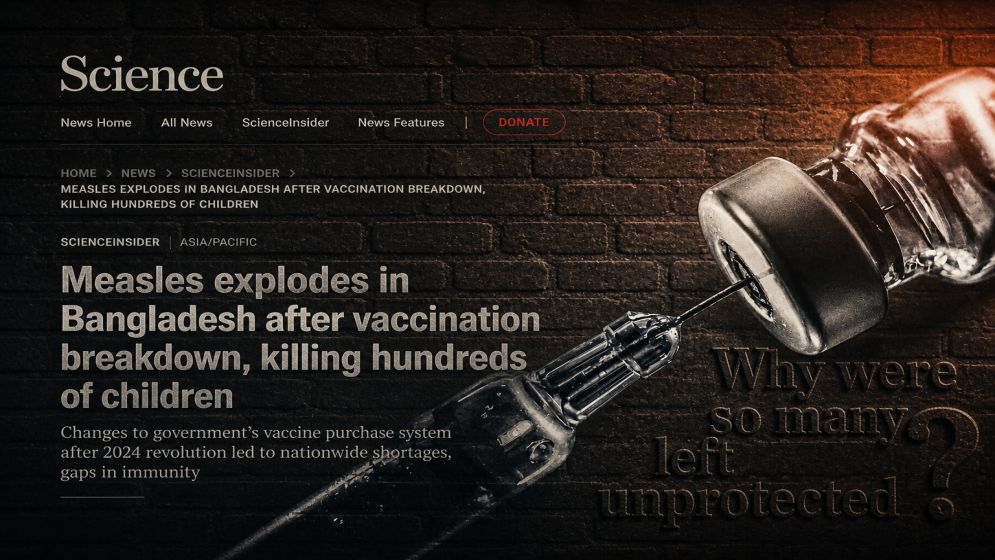
To begin with, the information ecosystem surrounding the outbreak is itself compromised. Reports attributed to the US based Science magazine and The Daily Star newspaper in Bangladesh have circulated widely, but key claims within them have been challenged by both the government and officials from UNICEF.
What was presented as authoritative and solid reporting from the Science magazine turns out, in part, to have been published in the blog rather than the peer-reviewed research publication that the magazine is known for.
Quotations attributed in the Science magazine piece have been disputed. The result is a fog of half-truths in which public understanding is shaped less by evidence than by assertion.
Within that fog, a particularly potent narrative has taken hold: that an interim administration simply “forgot” to procure vaccines in 2025, leading to a surge of preventable deaths in 2026.
It is an appealingly tidy explanation, but an implausible one. Vaccine procurement in modern bureaucracies is not akin to buying condiments at a grocery store. It is a structured, multi-year process involving budgeting, international coordination and supply-chain commitments.
By official accounts, the administration in question purchased vaccines worth over 10 billion taka, following established procedures. The idea of institutional amnesia on this scale strains credulity.
Yet rejecting that narrative does not resolve the puzzle. A more convincing explanation lies in the interaction of several overlapping disruptions. Vaccination cycles for measles are not annual; they depend on periodic coverage.
In 2020, as the world reeled from the covid-19 pandemic, routine immunisation campaigns were widely interrupted. Bangladesh was no exception. Children who missed their scheduled doses then are now reaching ages at which vulnerability translates into mortality.
The same pattern is visible globally, lending weight to the argument that today’s crisis is partly the delayed echo of yesterday’s pandemic.
Domestic upheaval has compounded the problem. In 2024, Bangladesh experienced a breakdown in governance that observers describe as the most severe since its independence. Administrative paralysis was accompanied by prolonged strikes among health workers.
Routine services, including vaccination drives, were suspended for months. Even a well-stocked system cannot deliver vaccines if its frontline workforce is absent. The result was not merely a temporary pause but a widening gap in population immunity.
Overlaying these structural failures is a subtler but equally corrosive shift in public attitudes. Prior to 2020, organised opposition to vaccines in Bangladesh was marginal. In recent years, however, influential religious figures have begun to voice skepticism. Some, commanding audiences of millions, have openly discouraged vaccination.
In a society where such figures often enjoy greater trust than officialdom or international agencies, their words carry weight. At the same time, government communication campaigns have lost intensity.
The once ingrained parental instinct—treating vaccination as a non-negotiable duty—has weakened. Cultural norms, it turns out, are as critical as clinical supply.
If the causes are complex, the public response has been further muddled by poor communication from those in authority of the both interim administration and the. Key officials have failed to engage transparently with inquiries.
Questions from journalists have gone unanswered or have been met with dense legalistic statements ill-suited to public comprehension. In an age of instant information, silence and opacity are not neutral; they invite speculation.
A straightforward press briefing, laying out procurement figures, distribution data and coverage rates, might have dispelled much of the confusion. Instead, the absence of clear data has allowed conjecture to flourish.
The government’s reluctance to provide detailed figures is particularly striking. Without hard numbers—how many doses were purchased, how many administered, and where gaps remain—neither experts nor citizens can form a coherent picture.
This vacuum has political consequences. With blame already drifting toward a previous administration, there is little incentive for current officials to clarify matters. Deflection becomes a strategy; ambiguity, a shield.
Journalism, which might have pierced this veil, has largely fallen short. Investigative efforts have been limited, and few outlets have systematically pursued data through formal channels such as freedom-of-information requests.
A rigorous, fact-based account—identifying not just what went wrong but who, if anyone, bears responsibility—remains absent. In its place is a patchwork of partial narratives that illuminate little and inflame much.
One interpretation, admittedly speculative but not implausible, is that there is no single point of failure. Bangladesh’s public systems often exhibit a peculiar kind of dysfunction: outcomes that are clearly suboptimal, yet traceable to no discrete decision or actor. Traffic jams materialise without obvious cause; administrative processes stall
inexplicably; shortages occur despite apparent abundance. In such a system, inertia and misalignment can be as lethal as overt negligence. Thousands may suffer not because of a dramatic breakdown, but because of a slow, pervasive drift.
Seen in this light, the measles outbreak is less an anomaly than a symptom. It reflects a broader institutional malaise in which systems are too sluggish, too fragmented and too unresponsive to prevent avoidable harm.
Vaccines may exist in warehouses, funds may be allocated on paper, and policies may be sound in theory. But if the machinery that connects these elements is unreliable, the outcome is indistinguishable from scarcity.
It is easier to blame a missed purchase or a misguided official than to confront systemic inertia. Yet without deeper reform—particularly of public administration—such crises will recur, whether in health, transport or energy.
—
Irfan Sheikh is a writer and analyst. He graduated in International Relations from Jahangirnagar University