

Kaarina's death reveals Awami League wants "war". Not reconciliation

Masum Billah
Publish: 17 May 2026, 06:24 PM
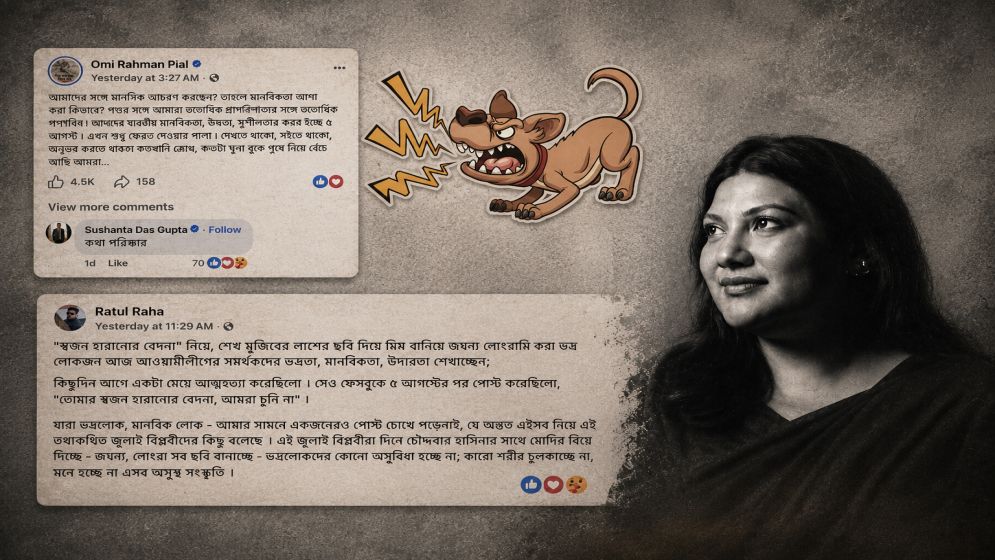
The death of Kaarina Kaisar, the only daughter of Bangladesh football legend Kaisar Hamid and granddaughter of celebrated chess player Rani Hamid, was met with an outpouring of national grief.
But among a section of supporters of the Awami League, her death sparked something else: celebration.
Kaarina, a prominent social media influencer, had joined the July 2024 uprising that ended the 15-year rule of ousted prime minister Sheikh Hasina.
She made no secret of her support for the youth-led movement and voiced her disapproval of the Hasina regime’s killing of more than a thousand men, women and children who took part in the protests – or, in some cases, were simply watching from what they believed to be the safety of their homes.
For this “crime” of speaking out, Kaarina became a target of Awami League supporters on social media. Soon after news emerged that she had fallen critically ill, been placed on life support and flown to India for treatment, public posts about her condition were hit by a coordinated wave of mocking “haha” reactions and celebratory comments.
After news of her death in India was confirmed, Awami League activist Sushanta Das Gupta, who now lives in Europe, posted a one-word message on Facebook: “Gone.”
He later wrote that supporters should feel no shame in rejoicing when a “July terrorist” dies, adding that they are at “a war” and that “enemies” should be made to understand how much their suffering delights them.
Dilip Sarker agreed that “she has been punished for her sins”.
Md Babul Akter doubled down: “On the battlefield, conceding even an inch to the enemy is to invite defeat. We will meet again in the march of victory and liberation. Joy Bangla, Joy Bangabandhu.”
For those hoping Bangladesh can move beyond the deep trauma inflicted by the ousted regime’s crackdown on citizens, the episode was sobering.

Any real chance of reconciliation?
Ever since the uprising, many from civil society and analysts have stressed the need for national healing and reconciliation. The argument is compelling.
Bangladesh cannot remain trapped forever in a cycle of vengeance. At some point, the country must find a way to acknowledge the crimes of the past, ensure accountability and allow ordinary supporters of the former ruling party to re-enter national life as citizens rather than permanent enemies
History offers important examples.
In South Africa, the Truth and Reconciliation Commission provided a framework for confronting the abuses of apartheid while helping prevent a descent into retaliatory violence.
In Rwanda, community-based justice mechanisms helped rebuild social trust after genocide. In Chile and Argentina, democratic transitions combined accountability with efforts to restore civic life.
These examples show that reconciliation is not amnesia. It does not mean pretending that mass abuses never happened. It requires truth-telling, remorse and a willingness to accept responsibility.
That is the stumbling block in Bangladesh.
Nearly two years after losing power, many Awami League leadership and activists appear unable to move beyond the second stage of grief: anger.
The five-stage model of grief – denial, anger, bargaining, depression and acceptance – is not a perfect fit for politics.
But as a metaphor, it works.
We saw for months how supporters continued to claim Sheikh Hasina was the rightful ruler notwithstanding she resigned and fled to India. Many first- and second-tier leaders fled the country in the face of public outrage.
Now they seem consumed by anger against a nation that said no to them and ousted them after deciding it had had enough.
AL’s stubborn refusal of decency
The online celebration of Kaarina Kaisar’s death is one example. There have been others.
Some pro-Awami League activists were seen to mock the outbreaks of measles for example, suggesting that Bangladeshis were getting what they deserved.
The message essentially is that there is still little empathy, and even less remorse.
Without remorse, reconciliation becomes impossible.
Ordinary Awami League supporters are not personally responsible for every crime committed under the previous government. Many joined the party out of ideology, loyalty to history or a belief that it best represented their values.
In any future settlement, they should not be treated as untouchables.
But reintegration requires a basic acceptance that grave wrongs were committed and that celebrating the suffering of others only deepens national wounds.
For now, that recognition appears distant.
As Sushanta Das Gupta wrote, this remains “a war.” As long as politics is viewed through that lens, opponents will continue to be seen not as fellow citizens, but as enemies whose deaths are occasions for applause.
That mindset serves no one except the leaders who fled abroad and now live comfortably, often beyond the reach of the anger they helped cultivate. It is ordinary supporters who remain trapped – socially isolated, politically marginalised and unable to move on.
Kaarina Kaisar’s death was a tragedy. The jubilant reaction it triggered among some Awami League loyalists was a reminder that the country’s deeper healing has yet to begin.
Until anger gives way to remorse and acceptance, reconciliation will remain a distant aspiration rather than a national reality.
—
Masum Billah is a Dhaka based journalist