


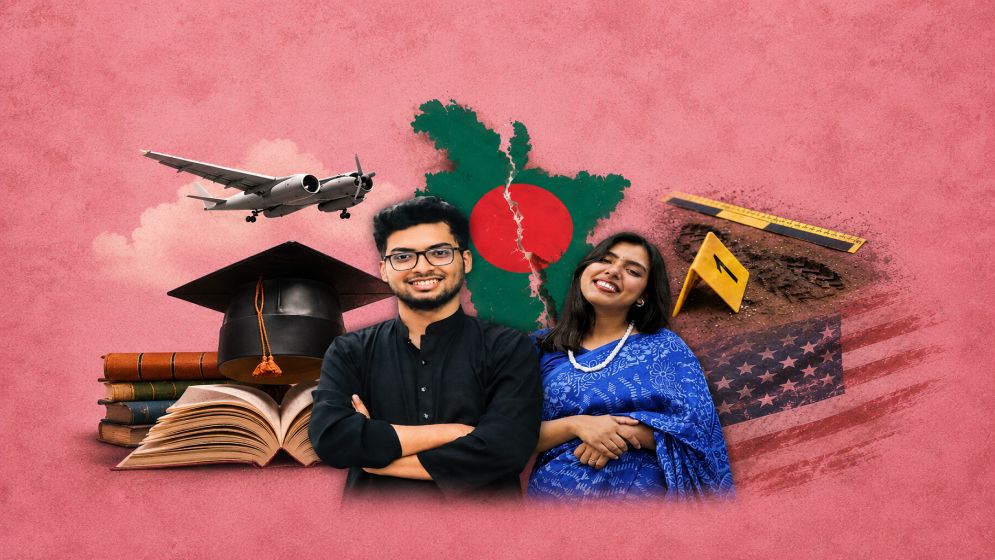
The last confirmed movements of Zamil Limon and Nahida Bristy followed a pattern so ordinary that, in hindsight, it barely reads like a prelude to catastrophe.
On April 16, friends were still in contact with them through the day, exchanging messages and brief calls, until…without warning…the communication stopped.
By evening, Bristy had missed a planned meeting, and both had effectively vanished. Within hours, what seemed like routine absence hardened into unease.
To those who knew them, the disappearance was especially jarring because of how grounded their lives had seemed. Both 27, they were part of a growing cohort of Bangladeshi graduate students in the United States, pursuing advanced degrees in demanding fields.
Limon studied geography and environmental science; Bristy was a doctoral candidate in chemical engineering, immersed in research that friends said she approached with “quiet intensity.”
They had come to the United States, as one report put it, with “dreams of a brighter future.” Those dreams were not abstract. Friends said they spoke often about careers, about supporting their families back in Bangladesh, and according to a report published by The Guardian, about a future together, with plans to marry.
Their lives in Florida reflected the rhythms familiar to many international students: long hours on campus, shared apartments, and tight-knit friendships built out of necessity as much as affinity. Within that circle, they were seen as anchors.
“They were like family away from home,” a friend told NBC News, describing a bond forged in a place far from the familiarity of Bangladesh. When they stopped responding, that same community became the first line of alarm—calling and retracing steps.
Eventually, law enforcement was notified, and the things that began as welfare checks quickly escalated into a missing persons investigation.
Investigators would later describe April 16 as the pivot point in a case that has since drawn international scrutiny.
The two students had last been in contact with friends earlier that day.
By evening, their digital silence had become conspicuous. Some rapid assembly of clues—phone records and location data as well as surveillance footage—began to suggest something more than a voluntary disappearance.
Suspect and his modus operandi
Then within days, attention turned to a man known to them: Hisham Abugharbieh, 26, Limon’s roommate.
His proximity to the victims and shifting statements placed him at the center of the investigation. Court records would later reveal a pattern of behavior that prosecutors argue points to planning.
Among the most striking elements were a series of questions the suspect allegedly posed to an artificial intelligence chatbot in the days before the killings.
According to prosecutors, on April 13—three days before the students were last seen—Abugharbieh asked: “What happens if a human is put in a black garbage bag and thrown in a dumpster”.
When the chatbot responded with concern, he followed up: “How would they find out”. Those exchanges, preserved in court filings, have become central to the prosecution’s argument that the killings were not spontaneous.
Another account, cited by The Washington Post, noted that “days before the two students were last seen,” the suspect asked what would happen if “a human body was put in a garbage bag and thrown in a dumpster.”
Investigators say the queries form part of a broader pattern of preparation.
Additional details emerging from court filings and forensic briefings have added a darker dimension to investigators’ reconstruction of events.
Authorities allege that the suspect’s preparations extended beyond online searches. Prosecutors say purchases made in the days leading up to April 16 included cleaning products, trash bags, and other household materials later considered relevant to the disposal of evidence.
Surveillance footage and digital location data reportedly allowed investigators to map movements between the apartment complex, nearby dumpsters, and the waterfront area where the remains were eventually recovered.
Investigators also believe the killings were carried out inside or near the apartment shared by Limon and the suspect. According to sheriff’s officials cited in multiple US media reports, forensic teams detected blood evidence inside the residence and in the suspect’s vehicle, despite signs that both locations had recently been cleaned.
Prosecutors allege the suspect attempted to conceal evidence by disposing of belongings connected to the victims, including clothing, phones, and personal effects.
The timeline assembled by prosecutors stretches backward from April 16. On April 7 and 11, the suspect made online purchases. On April 13 came the chatbot conversation.
Then, on the night the students disappeared, movements captured through digital and physical evidence began to align.
Location data placed Limon traveling from campus toward Clearwater around 7:43 pm, with the suspect’s vehicle appearing in the same area minutes later, as reported by the CBS news.
Through the night, their movements appeared to converge. By 10:30 pm, an order placed from the suspect’s phone brought trash bags and cleaning supplies to the apartment complex.
A roommate later reported seeing him moving boxes toward a dumpster. The next day, April 17, the two students were officially reported missing.
Around that same time, investigators say, the suspect conducted another search: “are cars checked at the Hillsborough River state park,” reported The Washington Post.
Prosecutors argue that the query reflects concern about detection, reinforcing their claim of premeditation. By then, physical evidence had begun to accumulate.
Finding the bodies
A search of a dumpster uncovered personal belongings belonging to both victims, including a wallet, phone case, and blood-stained clothing. Investigators also noted to CBS news that the suspect’s car appeared to have been “recently been cleaned.”
His statements to authorities shifted over time, from denying any travel to Clearwater to offering conflicting explanations.
As investigators continued piecing together the sequence of events, more details emerged about the condition in which the bodies were recovered.
Authorities said Limon’s remains were found inside a black trash bag near the Howard Frankland Bridge, with his hands and ankles bound.
Officials later stated that he had suffered multiple stab wounds, findings that prosecutors say are consistent with a deliberate and sustained attack rather than a sudden confrontation.
The sheriff’s office has not publicly released the full autopsy findings, but investigators have repeatedly described the crime as “premeditated” and unusually methodical.
The search for Bristy extended for days after Limon’s body was discovered, intensifying fears that she too had been killed. The breakthrough came when a kayaker and fisherman navigating mangroves near Tampa Bay reported a strong odor after a fishing line became snagged near debris along the shoreline.
Inside a partially opened plastic bag, authorities discovered human remains later identified through DNA testing, dental records, and clothing as belonging to Bristy.
Her remains were recovered not far from where Limon’s body had earlier been found, reinforcing investigators’ belief that the same disposal method had been used in both killings.
Sheriff Chad Chronister later said investigators believe the suspect transported the bodies during the early morning hours after the killings.
Detectives reportedly relied on bridge surveillance footage, cellphone records, vehicle tracking data, and receipts from late-night purchases to reconstruct those movements.
Prosecutors now argue that the alleged effort to move and conceal the bodies forms a critical part of the modus operandi: an attempt not only to kill, but to delay discovery long enough to obscure evidence and complicate the investigation.

Murders in numbers
The case has reverberated far beyond Florida.
In Bangladesh, grief quickly turned into public demand for accountability. “We want justice. We cannot accept this death,” one victim’s father said.
“We demand punishment for those responsible and the return of her body,” reported by The Daily Star in Bangladesh.
For many in Bangladesh, however, the shock has been compounded by a broader and more troubling pattern. The killings of Limon and Bristy have renewed concern over the safety of Bangladeshi students abroad.
A review of publicly reported cases indicates that at least six Bangladeshi students or recent Bangladeshi international students have been killed in the United States over the past two decades.
Because there is no official US database categorizing homicide victims by nationality and student status, the actual number may be higher. Earlier cases span a range of circumstances, from violent crime to police encounters.
In 2023, Sayed Faisal, a Bangladeshi student in Massachusetts, was fatally shot by police after a mental health-related emergency call—an incident that sparked protests within the diaspora.
That same year, Yazuddin Romim Uddin Ahmed, 22, was shot and killed in Missouri while confronting individuals attempting to break into his car; authorities later identified a suspect in what they described as a robbery-related killing.
Other cases stretch further back. In 2017, M Hasan Rahman Badhon was shot dead in Kansas, though public records leave questions about whether the case was fully resolved.
Mohammad Ali Hasan, another Bangladeshi student, was reportedly murdered in New York City in a robbery-related incident in 2000, a case that received limited international attention at the time. Of the six documented cases over roughly two decades, about four appear to have led to arrests or legal closure, while others remain unresolved.
Education consultants and diaspora organizations say such incidents underscore structural vulnerabilities faced by international students. Many live off campus, manage financial pressures, and lack immediate family support networks.
These risks are compounded by cultural isolation and unfamiliarity with local systems, particularly in moments of crisis. At the same time, the United States remains one of the most sought-after destinations for Bangladeshi students, especially in science, engineering, and technology fields.
Recent data indicates that approximately 24,000 Bangladeshi students are enrolled in U.S. institutions each year, reflecting both the scale of opportunity and the number of individuals potentially exposed to such risks.
Within the University of South Florida community, the loss of Limon and Bristy has been deeply felt. Friends described them not only as dedicated students but as sources of stability for others navigating life abroad.
Their deaths have left what one account described as a void among those who relied on them as “family away from home.”
Moral question about tech usage
As investigators continued to build their case, another dimension began to take shape, one that extends beyond the immediate facts of the killings.
The suspect’s use of an AI chatbot has prompted scrutiny from policymakers. Florida’s attorney general has expanded a probe into the role of such technology, following revelations that the suspect used ChatGPT “to seek advice on disposing of a body.”
The broader debate is not about causation—authorities have been clear that responsibility lies with the accused—but about the role of digital tools in shaping or facilitating harmful intent.
Legal experts note that internet searches have long been used to establish intent. What distinguishes this case is the interactive nature of the tool involved. Unlike static search engines, an AI chatbot can engage in a dialogue, potentially influencing the direction of inquiry.
For prosecutors, the chatbot queries are one piece of a larger evidentiary mosaic. They sit alongside surveillance footage, phone data, forensic findings, and witness testimony, all aimed at establishing a coherent narrative of planning, execution, and concealment.
For the defense, those same elements are likely to be contested, particularly the interpretation of digital evidence. Meanwhile, the families of the victims are navigating a process that is both legal and deeply personal.
They have called for the “highest possible punishment” while seeking the return of their children’s remains for burial, reported NPR. Their grief is compounded by distance, as they follow developments in a foreign legal system thousands of miles away.
At the University of South Florida, vigils have been held, counseling services expanded, and faculty urged to support affected students.
Yet the sense of vulnerability remains…an awareness that even within spaces defined by learning and aspiration, violence can intrude.
The investigation, still unfolding, is an exercise in reconstruction—assembling a sequence of events from fragments of data and testimony.
It is also an attempt to understand how ordinary interactions—shared housing and casual acquaintance—can give way to irreversible violence.
–