

Why tobacco giant BAT’s Bangladesh operations are facing fresh scrutiny from the country’s corruption watchdog?

Faisal Mahmud
Publish: 24 May 2026, 09:58 PM
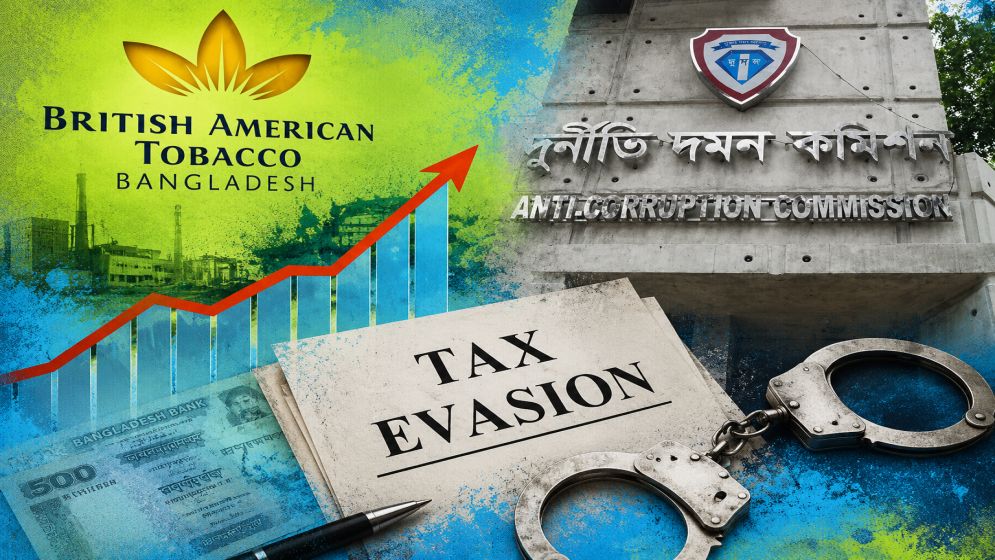
The investigation launched by the Anti-Corruption Commission into alleged fraud and money laundering involving British American Tobacco Bangladesh has triggered fresh scrutiny of the tobacco giant’s financial practices in Bangladesh.
The probe centres on allegations that the company may have used complex financial structures and regulatory loopholes to move large sums of money out of the country.
But the controversy extends far beyond a single investigation.
At its core lies a broader question about whether multinational corporations operating in heavily regulated industries are quietly extracting enormous value from one of the world’s largest tobacco markets while simultaneously presenting themselves as model taxpayers and corporate citizens.
The ACC’s inquiry is pinning down on allegations that BAT siphoned between $20bn and $30bn out of Bangladesh over several decades through manipulation and financial irregularities.
The allegations are ‘sweeping’ and yet to be proven. Yet the instinctive corporate defence mounted by BAT’s ‘supporters’—that such sums are mathematically impossible because tobacco taxes consume most cigarette revenue—reveals how misunderstood the mechanics of multinational profit extraction remain in Bangladesh.
The defence rests on a superficially appealing but fundamentally flawed premise.
Since around 83% of cigarette retail prices in Bangladesh go to the government in excise duties and VAT, the argument goes, BAT retains only a tiny fraction of sales revenue after taxes.
Therefore, it supposedly lacks the financial capacity to move vast sums abroad.
This line of reasoning conflates tax collection with economic value capture. Cigarette taxes are embedded within the retail price paid by consumers; the company merely acts as a collector and remitter.
So the thing that matters is not the final tax-inclusive retail price but the pricing architecture underneath it: procurement contracts, transfer pricing, royalty arrangements, intercompany payments, inventory valuation and intra-group financial engineering.
Indeed, the company’s defenders inadvertently acknowledge this reality when they concede that multinational firms commonly use transfer pricing mechanisms to shift profits internationally.
Transfer pricing is one of the principal ways multinational corporations legally or illegally move value across jurisdictions while suppressing taxable profits locally. Once that fact is admitted, the simplistic “only 14% remains” argument collapses.

Tobacco industry’s layered strategy
The tobacco industry’s global history suggests precisely why regulators are paying renewed attention these days.
BAT has repeatedly faced allegations in multiple countries involving tax discrepancies, opaque revenue accounting and aggressive pricing practices.
In Kenya, investigative reports uncovered discrepancies of nearly $93m between revenue figures reported by BAT Kenya and financial data appearing elsewhere within the group structure, prompting concerns about whether taxable income had been understated.
Similar questions have surfaced in South Africa and other developing markets where tobacco multinationals operate through deeply integrated cross-border supply chains.
In the Netherlands, one of BAT’s major European operational hubs, investigators and tax justice advocates have long scrutinised the role of Dutch financial structures in facilitating multinational tax minimisation strategies.
Dutch holding entities have historically served as conduits for royalty routing, intellectual property transfers and intra-company financing arrangements that allow profits generated in high-consumption countries to appear in low-tax jurisdictions.
BAT has consistently denied wrongdoing in these matters.
Yet the broader international pattern demonstrates that tobacco multinationals possess both the technical sophistication and institutional experience required to move profits across borders while remaining formally compliant with fragmented national tax systems.
Bangladesh’s tax authorities, meanwhile, have repeatedly uncovered evidence suggesting that BAT’s local tax conduct deserves scrutiny far beyond ordinary compliance disputes.
Over the past several years, the National Board of Revenue has accused BAT Bangladesh of evading thousands of crores in VAT and supplementary duties through various pricing and inventory strategies.
One investigation by the NBR’s Large Taxpayers Unit found that BAT allegedly evaded Tk 379 crore in VAT across four fiscal years by exploiting the annual tobacco price adjustment mechanism.
The method was strikingly simple. Before new budgets took effect, BAT reportedly transferred enormous quantities of cigarettes from factories to warehouses while paying tax at the lower outgoing rates.
After the budget raised retail prices and tax rates, those same cigarettes were sold at higher prices without corresponding additional tax payments.
To consumers, cigarettes became more expensive immediately after the budget. But according to tax investigators, the government did not receive the full benefit of those higher taxes because the inventory had already exited the factory under the previous fiscal structure.
The scale was hardly trivial. NBR investigators later alleged Tk1.69bn in VAT evasion for FY24 alone, alongside hundreds of crores more across FY21-FY23.
An even larger dispute dates back to allegations that BAT evaded Tk2,054 crore in VAT and supplementary duty in 2016 by concealing information related to cigarette pricing and sales declarations.
That case remains entangled in legal proceedings years later.

BAT’s ‘checkered’ legacy
Separately, BAT Bangladesh has also faced scrutiny over allegations involving withholding VAT on tobacco leaf purchases.
Tax auditors accused the company of failing to pay VAT obligations on billions of taka worth of locally purchased tobacco leaves while offering implausible explanations about millions of kilograms of tobacco allegedly destroyed or “blown away” during processing. Investigators estimated unpaid liabilities exceeding Tk2.5bn.
Taken individually, these cases might appear as technical tax disputes common in large industries. Taken together, they reveal something more systematic…that of a corporate culture deeply comfortable operating at the edge of regulatory interpretation in one of Bangladesh’s most politically sensitive sectors.
That matters because tobacco occupies a unique place in Bangladesh’s fiscal system. BAT is among the country’s largest taxpayers and one of its most politically connected multinational firms.
Governments become financially dependent on tobacco revenues even as public health costs spiral.
This creates an unusual regulatory equilibrium in which aggressive enforcement risks destabilising revenue collection while weak enforcement encourages increasingly sophisticated forms of tax avoidance.
There is a group of people who always warn that aggressive investigations against companies like BAT could damage Bangladesh’s investment climate. This argument has become a familiar refrain whenever large multinationals face scrutiny in developing economies.
Yet mature investment climates are not built by insulating corporations from investigation. They are built through predictable enforcement and equal application of law.
Investors are rarely frightened by the existence of investigations; they are frightened by arbitrary systems where politically connected firms appear immune from scrutiny.
Nor is it convincing to argue that only the NBR—not the ACC—should investigate BAT. Tax authorities investigate compliance. Anti-corruption agencies investigate fraud, illicit enrichment and potentially criminal financial conduct.
In many jurisdictions, complex financial investigations involve coordinated work between tax offices, anti-money laundering units and anti-corruption agencies precisely because sophisticated corporate structures blur the boundaries between tax avoidance, aggressive accounting and illicit financial flows.
The fact is tobacco companies no longer operate as straightforward manufacturers selling cigarettes within national borders. They function as globally integrated financial networks in which trademarks, procurement contracts, distribution rights and financing structures are dispersed across jurisdictions designed to optimise tax outcomes.
Bangladesh’s regulators have historically struggled to keep pace with such structures. Transfer pricing units remain under-resourced. Corporate disclosures are limited. Cross-border beneficial ownership chains remain opaque.
Legal proceedings move slowly enough to turn enforcement into a negotiating tactic rather than a deterrent.
Against that backdrop, the ACC investigation becomes more significant because the question is not whether BAT physically carried sacks of cash out of Bangladesh.
The question is whether decades of pricing strategies, tax structures, transfer arrangements and regulatory arbitrage allowed enormous value generated from Bangladeshi consumers to escape meaningful domestic taxation while public institutions lacked the tools or will to respond.
—