

Customs investigators unable to account for thousands of tons of duty-free imports at prominent garment manufacturer

Zulkarnain Saer
Publish: 13 Jun 2026, 04:42 PM
-6a2d33fcb0181.png)
When a team of customs intelligence officials arrived at a garment factory in Tejgaon in July last year, they were not looking for hidden compartments or secret warehouses.
Their task was far more routine that involved inspecting bonded warehouse stocks and reconciling imports with exports.
What they encountered instead has now become the subject of a widening customs investigation involving one of the country's export-oriented apparel manufacturers and a prominent figure in Bangladesh's garment sector.
According to a series of official reports prepared by the Customs Intelligence and Investigation Directorate (CIID), copies of which were obtained by Bangla Outlook, investigators have been examining the import and utilization of duty-free fabrics brought into the country by Anannya Socks & Inners Industries Ltd. under Bangladesh's bonded warehouse system.
The reports, prepared in coordination with the National Board of Revenue's Central Intelligence Cell (CIC) and the Customs Bond Commissionerate, state that investigators have so far been unable to establish the whereabouts of a substantial volume of those imported materials through warehouse inventories, export records or supporting documentation.
The company, located at 45/2 Tejgaon Industrial Area in Dhaka, operates as a bonded manufacturer, a status that allows export-oriented factories to import raw materials without paying customs duties and taxes.
The arrangement is one of the cornerstones of Bangladesh's export model, enabling manufacturers to compete internationally by lowering production costs.
In return, companies are required to maintain detailed records demonstrating how imported materials are used and to ensure that the duty-free goods are ultimately linked to export production.
The customs investigation began after authorities received intelligence reports alleging irregularities involving bonded imports at the factory.
-6a2d3342d74ff.png)
Investigators
subsequently reviewed import records, warehouse inventories, production
information and export data relating to the company.
According to customs documents, Anannya Socks & Inners Industries imported approximately 3,670 metric tons of fabrics and raw materials under bonded warehouse facilities.
During the same period, customs records indicate exports totaling approximately 786 metric tons.
The difference between those figures became a central focus of the inquiry.
Under bonded warehouse regulations, materials imported without payment of duties and taxes must either remain in bonded inventory, be consumed in export production, or be transferred through approved and documented procedures.
Investigators therefore sought to determine whether records existed to account for the remaining imported materials.
A multi-agency customs team visited the factory on 15 July 2025 to conduct physical verification and document review.
The inspection formed part of an investigation initiated following intelligence reports alleging that imported fabrics may have been diverted from their intended purpose.
According to the preliminary investigation report, customs officials requested warehouse stock books, inventory registers, utilization records, import documents, production records and export-related documentation.
-6a2d33640dd8f.png)
These
records are ordinarily used to establish a traceable link between imported raw
materials and exported finished products.
The report states that investigators were unable to obtain records sufficient to verify the utilization of imported fabrics.
Company representatives informed investigators that inventory information was maintained through stock books and internal systems. Customs officials noted, however, that they were unable to verify those records during the inspection.
Investigators further reported that warehouse registers and other supporting documents necessary for tracing imported materials through production were either unavailable or could not be examined in a manner that allowed independent verification.
The inquiry then moved from paperwork to physical inventory.
Customs officials examined nineteen Bills of Entry covering imports made between 27 May and 3 July 2025. The consignments included polyester fabrics, polyester-spandex fabrics, fleece knit fabrics and other textile materials commonly used in garment manufacturing.
According to customs calculations, those nineteen consignments alone accounted for approximately 256.525 metric tons of imported fabrics with a declared value exceeding Tk 11.86 crore.
Investigators attempted to determine whether those imports could be located in warehouse inventory or linked to production and exports.
The report states that they could not.
Although
customs officials identified fabrics inside the warehouse during their
inspection, they reported being unable to determine which import consignments
those materials belonged to.
Investigators documented approximately 44.1 metric tons of fabrics physically present in the facility. However, because supporting documentation was unavailable, they could not establish whether the inventory corresponded to the imports under examination.
According to the report, customs officials found approximately 15.5 metric tons of polyester fabrics, 8.4 metric tons of polyester-spandex fabrics and a further 20.2 metric tons associated with a separate import registration.
Yet the absence of traceable inventory records meant investigators could not reconcile the materials with specific Bills of Entry.
The inability to match warehouse inventory with customs declarations became the main finding in the investigation.
Officials also examined whether imported fabrics had been transferred to other factories.
During discussions with investigators, company representatives reportedly stated that imported fabrics had been supplied to other entities for production purposes, officials involved in the investigations told Bangla Outlook.
Customs officials subsequently requested documentary evidence supporting those transfers, including delivery records, transport documents and records demonstrating receipt of materials by third parties.
-6a2d33a868209.png)
The
report states that investigators were unable to verify those claims because
supporting records were not produced.
A separate section of the inquiry focused on materials imported under Free of Cost, or FOC, facilities.
Customs records reviewed by investigators showed that approximately 26.07 metric tons of goods entered the country under FOC arrangements between June 2024 and July 2025.
Investigators requested records relating to the receipt, storage and utilization of those imports. According to the report, documentation explaining those transactions was not made available during the inspection.
The investigation also documented manufacturing activity observed inside the factory.
During the warehouse visit, customs officials observed production associated with the domestic apparel brand Gentle Park. Investigators subsequently requested purchase orders and supporting records relating to the manufacturing activity.
According to the report, company representatives were unable to provide purchase orders or documentation establishing the basis of the production arrangement.
The observation drew attention because customs investigators were attempting to determine how imported bonded materials were being utilized and whether all manufacturing activities taking place at the facility were properly documented.
As the inquiry progressed, investigators encountered additional obstacles.
-6a2d33cb0a0a4.png)
Customs
records indicate that inspection teams attempted on multiple occasions to
conduct physical verification of bonded inventory. Officials reported that
these efforts were repeatedly disrupted, preventing completion of certain
verification activities.
Internal reports describe situations in which investigators were unable to conduct inventory assessments in the manner originally planned, an official told Bangla Outlook.
Documents included in the investigation file provide additional context to that period.
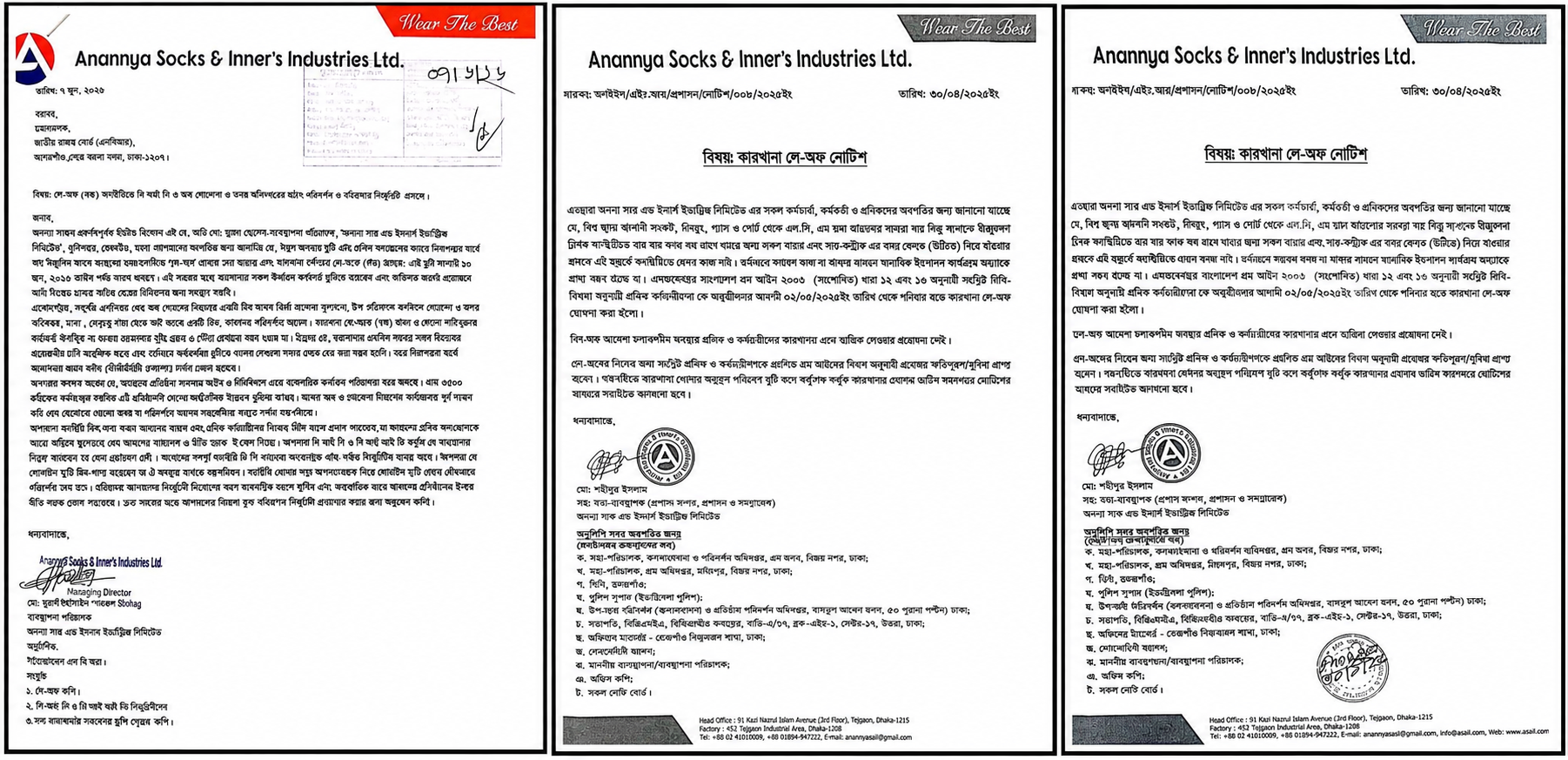
Among them are layoff notices issued by the company on 30 April 2025. The notices cited gas shortages, electricity shortages and operational difficulties affecting factory operations. The notices informed workers that production activities would be suspended because of those conditions.
The timing of the layoffs, subsequent inspection attempts and the disruptions encountered by investigators are all documented within the customs investigation file.
Corporate and tax records identify Md. Murad Hossain Shohag as the Managing Director and authorized representative of Anannya Socks & Inners Industries Ltd. Company records list its address at Kazi Nazrul Islam Avenue in Tejgaon, Dhaka.
Investigators also noted the existence of earlier customs proceedings involving the company.
According to officials familiar with the matter, two separate customs cases alleging duty and tax liabilities of approximately Tk 30 crore and Tk 8.64 crore respectively had already been initiated before the latest investigation began.
Bangla Outlook tried to reach Murad Hossain but couldn’t get his comment on the ongoing investigation.
—