

The daughter, the prisoner, the poet: Zeb-un-Nissa’s forgotten legacy

Sabiha Nahla
Publish: 14 Sep 2025, 09:51 PM
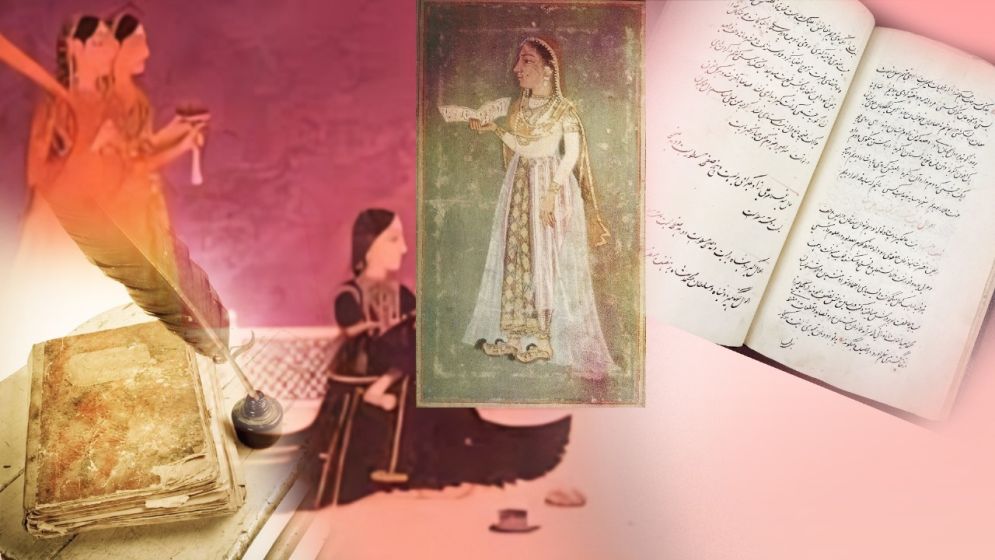
“I wish my longing might pour out,
my grief turn to hymns,
my pain resound in psalms,
like David of Israel once sang.”
So wrote Princess Zeb-un-Nissa, the eldest daughter of the Mughal emperor Aurangzeb, in verses that now read less like courtly ornament and more like the confession of a soul weighed down by sorrow.
Born in Delhi on February 15, 1638, to Aurangzeb’s chief consort, Dilras Banu Begum of the Safavid dynasty–a poet in her own right–Zeb-un-Nissa inherited both privilege and burden.
Her life was a study in contradictions. By seven, she had memorized the Quran, earning the title of hafiza. By adolescence, she had mastered philosophy, mathematics, astronomy, and literature, often holding her own against the scholars of her time.
She composed over 500 poems, many in Persian, and made music that blended devotion with melancholy. She funded annual pilgrimages to Mecca, planted gardens, gave in charity, and yet dressed with the austere simplicity of white robes and bare ornament.
Her beauty, chroniclers say, was striking–tall, slender, fair-skinned, with black eyes and hair so dark it seemed to absorb the light. A portrait of her still hangs in Lahore Museum, gazing back at us across centuries.
But what truly distinguished her was her intellect. She built a library more expansive than any private collection of her age, filled with treatises on law, history, theology, and literature. She employed scholars, commissioned manuscripts, and served as critic and patron to writers across the empire.
Aurangzeb, remembered for his orthodoxy and political ruthlessness, nevertheless recognized his daughter’s gifts. At 21, Zeb-un-Nissa was more than a poet-princess; she was a trusted confidante, privy to the intricacies of imperial politics.
He called her his “fountain of wisdom.” She presided over her own court, dispensing salaries to poets and thinkers, a Mughal-era salon in an age when women were expected to remain in the shadows.
And yet, despite her brilliance, her legacy is cloaked in silence. History remembers Aurangzeb as the stern emperor, Shah Jahan as the patron of the Taj Mahal, but Zeb-un-Nissa is too often reduced to a footnote. She was neither merely her father’s favorite child nor simply a tragic poetess. She was an intellectual force, a custodian of culture, and one of the most remarkable women of the Mughal world.
In her verse, the ache of longing is unmistakable. But beneath that sorrow is also defiance–the voice of a woman who refused to be confined by the limits of her era, and who still, across the centuries, demands to be heard.
-68c6e448bea73.png)
Hiding behind a veil of words
“You with the dark, curling hair and those devastating eyes,
your glance cuts and then retreats,
like a blood-stained sword,
your lashes, sharp as daggers.”
These lines belong to Zeb-un-Nissa, yet they were never meant to appear under her own name. Despite being one of the most accomplished poets of her time, she signed her verses Makhfi, meaning “the hidden one.”
It was not modesty but necessity. In a world where women’s voices were seldom allowed in the literary canon, her brilliance had to be disguised.
From a young age she wrote, first in Arabic, only to be dismissed by a scholar who told her: “The verses are wise, but their idioms are Indian.” She pressed on, nonetheless. Aurangzeb himself–orthodox though he was–recognized her gift.
He surrounded her with poets from Delhi, Persia, and Kashmir, ensuring she had a circle worthy of her mind.
Her influences were clear–Hafez of Shiraz, the mystical master of Persian verse, left his fingerprints on her style. And yet, Zeb-un-Nissa carved her own path. In the crowded constellation of Mughal-era poets, she shone brightly enough to keep her significance.
Over her lifetime, she composed not hundreds but thousands of poems—some accounts say 5,000, others 15,000–written mostly in the ghazal and rubai forms.
But she was not only a poet of love and longing. Zeb-un-Nissa was a scholar who left behind works of deep intellectual weight: Monis al-Ruh (The Companion of the Soul), Zeb al-Monsha’at (her literary compositions), and most strikingly, Zeb al-Tafasir–the first and only Quranic commentary ever written by a woman in the Islamic tradition.
That alone should have secured her a monumental place in history.
She encouraged translations, sponsored compilations, and cultivated a literary culture that extended beyond her own pen. Her work was both a refuge and a rebellion–a voice that refused erasure, even when cloaked in the anonymity of Makhfi.
Zeb-un-Nissa’s verses still read like daggers–precise, piercing, unforgettable. But it is her audacity, her insistence on speaking even when hidden, that makes her one of the most radical poets of her age.
-68c6e4657b360.jpeg)
Inside the walls of Salimgarh
All of Zeb-un-Nissa’s verses–said to number 5,000–were eventually gathered into a volume known as Deewan-e-Makhfi, the “Book of the Hidden One.”
But the very name captures the tragedy of her life: a poet forced into concealment, a voice confined not only by pen name but by prison walls.
Her fate turned dark in middle age. Accounts differ: some say she was punished for a forbidden love affair, others that her crime was her closeness to her brother Akbar, who rebelled against Aurangzeb.
Whatever the reason, the emperor who once called her his confidante condemned her to twenty years of confinement in Delhi’s Salimgarh Fort. There, behind the thick Mughal stone, she continued to write.
“In my longing for thee,” one verse laments, “I have become as the dust wandering from the earth.”
She died in captivity in 1701 at the age of fifty. Her tomb, first placed in the gardens of Tees Hazari, became a quiet memorial for a woman who once commanded salons of poets and scholars.
Her words, however, refused to be buried. In 1724, her surviving verses were gathered into another Diwan-e-Makhfi, though this version contained just 421 poems—a fraction of what she is believed to have written.
In 1913, her first 50 ghazals appeared in English in the “Wisdom of the East” series, translated in London by Magan Lal and Jessie Duncan Westbrook. Later, her work was printed in Delhi in 1929 and again in Tehran in 2001.
Today, her manuscripts rest in the National Library of Paris and the British Museum, their fragile pages still whispering her defiance.
Readers of great aspiration, from Delhi to Tehran to London, have continued to find solace in her lines. The irony is inescapable: a woman silenced by her own father became, through the endurance of her poetry, one of the most enduring voices of the Mughal age.
—
Sabiha Nahla is an aspiring painter