

The rebel pen that made Bengal's Muslims dare to dream

Arefin Al Imran
Publish: 17 Sep 2025, 02:07 PM
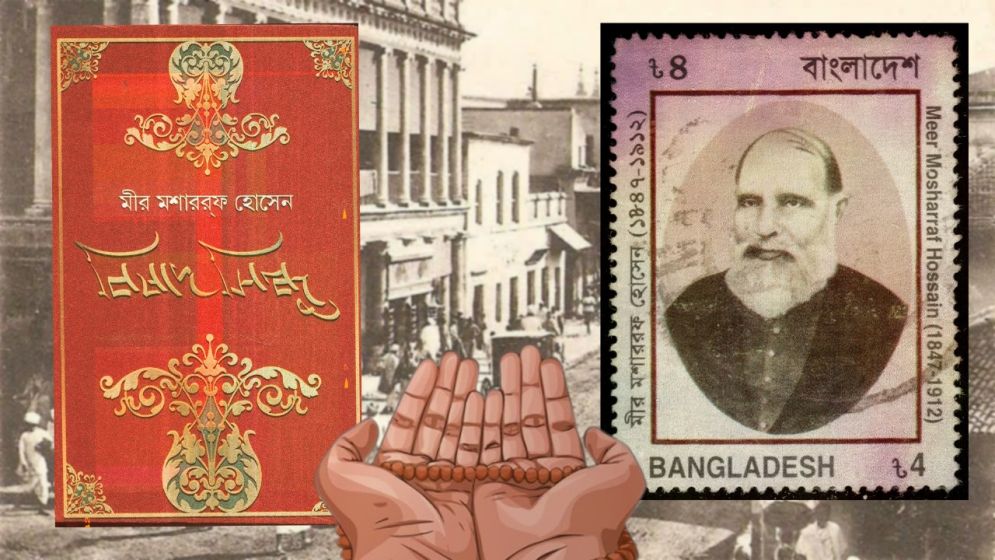
When Mir Mosharraf Hossain picked up his pen, Bengal was suffocating under British colonial rule.
For Muslims, the landscape was bleak. Education was scarce, power had all but vanished after the Sepoy Mutiny, and poverty was deepened by the tyranny of landlords and indigo planters.
At such a moment of despair, Hossain’s literary voice carried a weight far beyond the page.
Born in 1847 in Lahinipara, Kushtia, and later rooted in Podmadi, Syed Mir Mosharraf Hossain was a product of both rural Bengal and the currents of colonial modernity. His education took him through Kushtia, Faridpur, and Krishnanagar, and his professional life was tied to the Nawab Estate in Faridpur, with an important interlude in Calcutta.
But wherever he lived, he carried an unusual gift: the ability to write across genres–novels, plays, farces, poetry, essays–and to speak directly to the condition of his community.
Hossain reshaped the Muslim imagination in Bengal. His originality, his instinctive command of Bangla, and his grounding in both Islamic thought and historical awareness opened a door for a community trapped in intellectual stagnation.
He stood against the narrow world of Puthis and Maktubs, offering instead a literary tradition that was both modern and Muslim, both rooted and ambitious.
As a craftsman of pure literature, he produced works of striking beauty–Ratnabati, Jamidar Darpan, Udasin Pathiker Moner Katha, and Prem Parijat–novels that remain aesthetically vibrant.
Yet his pen was equally committed to the Islamic moral universe, producing works such as Maulud Sharif, Hazrat Omarer Dharmma-Jiban Labh, Madinar Gaurav, Eslam-er Joy, and Moslem Biratva.
In them, one can sense his determination to re-anchor a dispossessed Muslim community in dignity and pride.
And then there was Bishad Sindhu–his magnum opus. Drawing on the tragedy of Karbala and the martyrdom of Imam Hussain (R.A.), the work transformed Bengali Muslim consciousness.
For generations, it was read with the reverence of scripture, its cadences echoing across villages as both elegy and political allegory. It is no exaggeration to say that Bishad Sindhu ignited a cultural revolution in rural Bengal, binding memory, faith, and resistance into a single, unforgettable narrative.
In Mir Mosharraf Hossain we find an architect of cultural survival–someone who, in the darkest hour, used literature to carve out a space for dignity, imagination, and hope.

Reimaging history
Like any great artist, Mir Mosharraf Hossain was not without controversy.
Critics accused him of bending history, indulging in sentimentality, and inventing details for characters who belonged to the sacred canon of Islam.
The backlash was fierce: in 1889, a fatwa was issued against his essay Go-Jiban (The Life of a Cow). Even Bishad Sindhu, his most celebrated work, was faulted for privileging emotion over accuracy.
Yet here lies the paradox–what his critics called distortion was also the very source of his power.
Across world literature, historical fiction has never been bound by strict fidelity to fact. Writers from Tolstoy to Hilary Mantel have taken liberties, inventing dialogue, reshaping motives, and sharpening events to serve a narrative truth rather than a literal one.
History itself is notoriously contested terrain; Thomas Carlyle once dismissed it as little more than “the biography of great men.” Against this backdrop, Mosharraf’s imaginative flourishes seem less like heresies than hallmarks of the genre.
To demand that he surrender creativity at the altar of accuracy would have drained his work of its vitality.
But the tension is real. When a writer embellishes the lives of figures such as Imam Hassan (R.A.) and Imam Hussain (R.A.), he inevitably raises questions of religious propriety. Where does art end and misrepresentation begin?
Islamic rules regarding culture and depiction cast a long shadow over this debate, and in Mosharraf’s case, the line was often contested.
Still, to focus solely on these controversies is to miss the historical moment. In the late nineteenth century, Bengal’s Muslim community was devastated–educationally, economically, politically.
While Bankim Chandra, Michael Madhusudan, Ishwar Chandra Vidyasagar, Ram Mohan Roy, the Tagores, and others were forging a Bengali cultural renaissance, Muslims were largely absent from the stage. Into that void stepped Mosharraf.
His task was monumental: to offer a battered community dignity, pride, and a cultural voice. He did so not with manifestos or treatises but with literature that blended history and imagination, fact and feeling.

Swimming against the
tide
It was, in its own way, an act of defiance.
To reframe tragedy as epic, to retell the martyrdom of Karbala as both memory and myth, to give a defeated people a sense of cultural continuity–this was not distortion but reconstruction.
In doing so, Mir Mosharraf Hossain rearmed a community with the tools of imagination. And if future generations of Muslim writers in Bengal found the courage to pick up the pen, it was in no small part because he had first carved out the space.
Until Kazi Nazrul Islam burst onto the scene, Mir Mosharraf Hossain and Ismail Hossain Siraji stood almost alone as pioneers of Muslim literary expression in Bengal.
Nazrul, of course, transformed the landscape altogether. With his genius, he gave the community a new idiom of resistance and renewal, and–most strikingly–he drew clear boundaries between history, fantasy, and mythology.
That clarity remains one of his greatest contributions, though it is astonishing how little serious scholarship has been devoted to this subject.
Mir Mosharraf Hossain, by contrast, must be judged within the world he inherited. He was not writing in an age of cultural confidence but in one of collapse.
For a community crushed politically, economically, and intellectually, his works offered a much-needed scaffolding–a way to see dignity and continuity where despair reigned. In that sense, he did not fail his moment; he fulfilled it.
Today, there is room–indeed, a responsibility–to revisit his portrayals of Islamic history and the lives of the Companions with critical distance.
To separate what was imaginative license from what was historical record is not to diminish him but to better understand him. What remains beyond debate is his extraordinary talent and his singular role in filling a cultural void when few others could.
For that, Mir Mosharraf Hossain deserves not just remembrance but recognition as a writer who carried a battered community across one of its darkest hours.
—
Arefin Al Imran is a music director, producer and sound designer