

Dhaka University’s manuscripts are a hidden treasure trove..

Sabiha Nahla
Publish: 26 Sep 2025, 08:45 PM
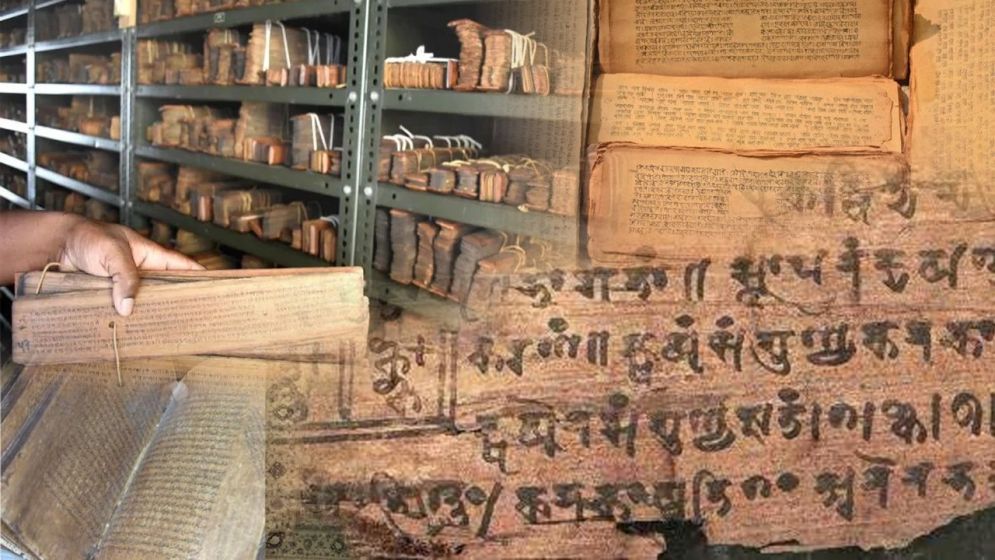
Manuscripts are not mere relics; they are time itself, pressed onto palm leaves, tree bark, cotton paper, banana fronds.
Each script is a fossil of thought, a declaration of when and how human history was recorded.
At Dhaka University Library, there is a room that feels less like an archive and more like a passageway into centuries gone by. Its rows of wooden shelves are lined with over 30,000 manuscripts, each one a fragile time capsule.
To enter this section is to walk into a museum of words, a repository that rivals any in South Asia for both rarity and richness.
The range is staggering. More than 12,000 texts are in Old Bangla and Devanagari; over 1,000 in Urdu and Persian. The languages–Ancient Bangla, Sanskrit, Persian, Urdu, Arabic, Maithili–tell the story of a region shaped by shifting empires, religions, and intellectual traditions.
Some of the manuscripts date back more than a millennium. The oldest preserved Bangla text, Sharadatilak, written on tree bark in 640 AD, sits alongside Bishnupuran, penned in 659 AD.
Others are monumental in scale: the Padmapuran, with its 2,799 pages and 39 hand-painted illustrations, looms behind protective glass like a giant from another age.
The Persian and Urdu collection is no less remarkable. Works range from Tarikhe Azadi America–a chronicle of America’s independence–to Mir Ammar’s Bagh o Bahar and Muhammad Baker “Agha’s” Hasht Bihisht, a poetic account of the Prophet Muhammad’s life in Dakhani Urdu.
There are romances like Sadiq Khan’s Masnavi Sarapasoz, rhetorical handbooks such as Talkhusil Miftah, and philosophical treatises like Fiqhul Lugat wa Siratul Arabia.
One of the oldest Arabic manuscripts here, Taftajani’s Al Mukhtasar, has survived centuries of handling, war, and climate.
And yet, despite this richness, many of the texts remain unidentified–hidden in plain sight, waiting for scholars to excavate them from obscurity.
-68d6a6b92db9c.jpg)
Forming of a formidable
collections
The story of how Dhaka University amassed its extraordinary manuscript collection begins almost a century ago. In September 1925, a high-level committee was formed, led by Dr. Sushil Kumar De, head of the Sanskrit and Bengali Department, and Nalinikanta Bhattasali, curator of the Dhaka Museum.
Within a single academic year, they collected more than 13,000 manuscripts in Sanskrit and Bengali, an astonishing intellectual harvest.
The effort soon widened. Agents were dispatched across undivided India to scour villages, temples, and estates. In 1933, Bhattasali went further, issuing a public call for manuscripts.
The response was overwhelming: nearly 17,000 more manuscripts poured in from Assam, Nadia, Medinipur, Hooghly, Dhaka, Sylhet, Faridpur and Barisal.
The university’s ambitions expanded again in 1928, with a new committee dedicated to acquiring Urdu, Persian and Arabic manuscripts. Within two years, another 300 rare works were secured.
Not all came through purchase or collection. Some were gifts of extraordinary generosity. Khan Bahadur Chowdhury Kazimuddin Ahmed Siddiqui of the Boliyadi Zamindar family, and Hakim Habibur Rahman, a towering public intellectual of his time, donated entire collections.
Later, in 1952, Abdul Karim Sahitya Bisharad, arguably the most formidable literary historian of Bengal, contributed 585 manuscripts, including the largest known assemblage of medieval Muslim poets and writers in the subcontinent.
Piece by piece, donation by donation, Dhaka University became one of South Asia’s most important centers for manuscripts.
Yet alongside this grand history, there is lore. Staff whisper about a hidden chamber in the library where a copy of the Shahnama and the deeds of Nawab Siraj ud-Daulah are said to lie, items so politically and culturally charged that they remain almost mythical, guarded by silence more than locks.
-68d6a6d048a1e.jpg)
Left in the lurch
The present-day reality is more sobering. Preservation efforts are rudimentary at best. The temperature is fixed at 22 to 23 degrees Celsius, humidity checked by a handful of dehumidifiers.
The manuscripts are wrapped in blue cloth, a practice based less on science than on the belief that insects avoid the color.
The librarian admits what is obvious: the budget for conservation is grossly insufficient.
What was once a project of ambition and vision now risks sliding into neglect. For nearly a century, Dhaka University has collected the words of civilizations past. Whether it can protect them for the future remains an open question.
However, Dhaka University Library is trying to pull its treasures into the modern age. The manuscript section now offers digital access to Bengali, Persian, Urdu, Arabic and Sanskrit texts through its online catalog.
Most of the collection has been microfilmed and digitized. There are indexes on the website, annual scholarships for students willing to take on the painstaking work of decoding, and workshops designed to train a new generation of researchers.
And yet, the gulf remains. Thousands of rare manuscripts sit unread, untouched, and essentially invisible to scholarship.
Digitization has given them a second life, but not necessarily a future. Without systematic research, they remain files in a database, their significance still locked in languages and scripts few today can parse.
That neglect is not just academic. Manuscripts are more than dusty relics; they are the raw materials of history itself.
They capture how cultures evolved, how languages intertwined, how empires justified themselves, how poets and mystics made sense of their world.
They are both evidence and art, their pages marked by calligraphy, miniature paintings, and craftsmanship that turn preservation into a moral duty.
–
Sabiha Nahla is an aspiring painter