

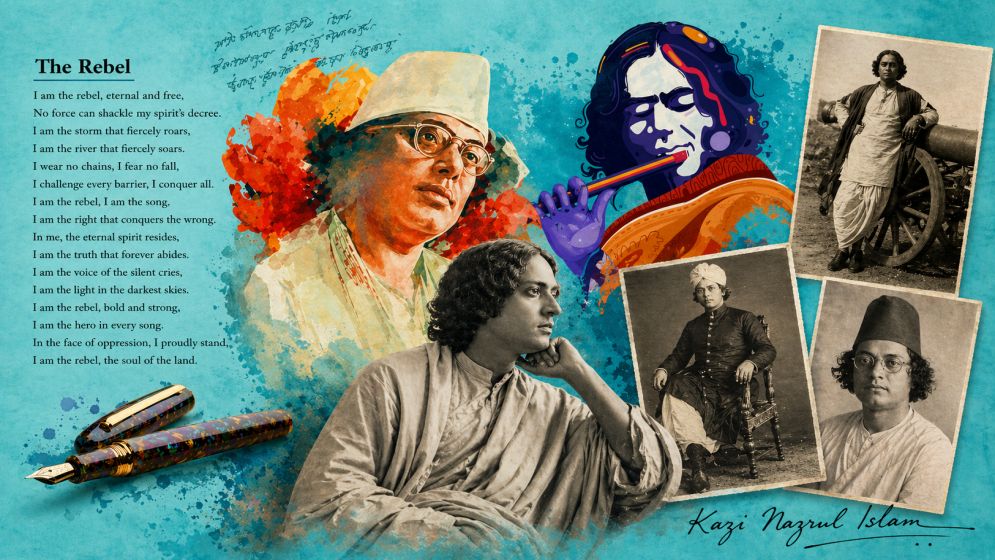
To speak of Kazi Nazrul Islam is almost always to speak of fire…of rebellion, of poetry that refused to kneel, of songs that braided together devotion and dissent.
History has flattened him into a figure of urgency: the “Rebel Poet,” the soldier-turned-writer who emerged from the British Indian Army and went on to produce thousands of songs and poems that challenged empire and orthodoxy alike.
Yet in the archive of his photographs, something quieter persists—an aesthetic intelligence that rarely announces itself but is impossible to miss once seen.
Nazrul’s legacy has been canonized in words, but his image…his posture, his dress, the careful choreography of his presence…offers another kind of text. It is less declamatory than “Bidrohi,” less overtly political, and yet no less revealing.
The man who wrote of upheaval seems, in these images, to have understood something about stillness: how to inhabit it, how to shape it, how to let it speak.
He was, by most accounts, striking. Contemporary descriptions often note a well-built physique, bright eyes, and a voice that carried with it both warmth and authority. These were not incidental traits in an age when photography was becoming a tool of self-fashioning as much as documentation.
Nazrul appears to have recognized the camera not merely as witness but as collaborator. His poses are rarely accidental; they suggest rehearsal, or at least intention.
In early photographs taken after his return from World War I—he had enlisted in 1917 and served until the war’s end —Nazrul appears with cropped, middle-parted hair, dressed in khadi.
The fabric itself carries meaning: handspun, anti-colonial, aligned with the politics of self-reliance. But the image is not austere. A shawl is draped with a kind of casual precision, and his eyes, often lined with kajal, soften the severity of the ensemble.
It is a look that holds tension—between discipline and ornament, between soldier and artist.
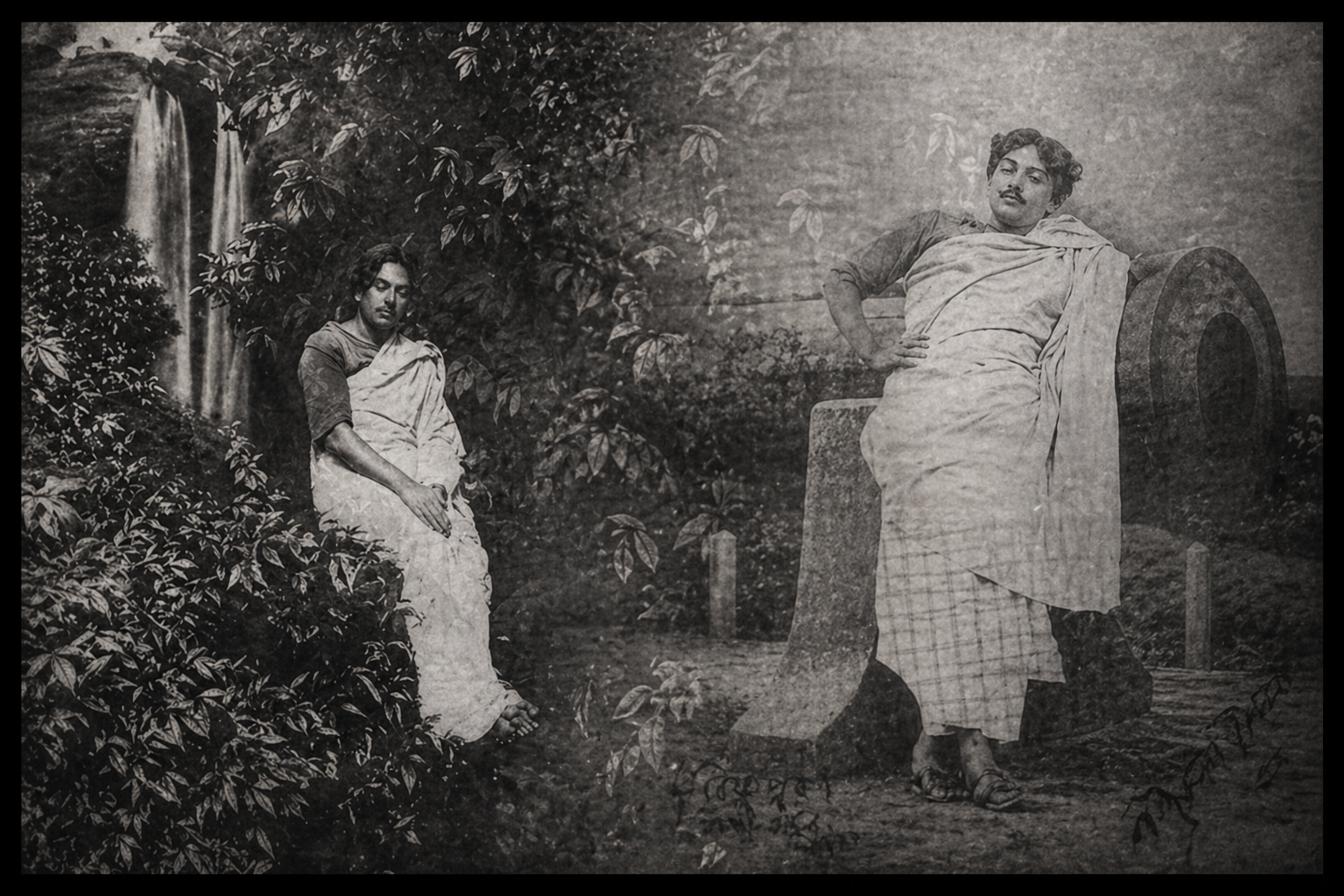
Distinctive attire and style
Elsewhere, the same man seems to loosen. His hair grows longer, falling into soft waves; the kurta remains simple, but the posture changes. In one oft-cited image, he sits with his chin resting lightly on his hand, gaze angled away from the viewer.
It is an almost cinematic moment, a refusal of direct address that paradoxically draws the eye closer. One begins to suspect that Nazrul understood something fundamental about modern visibility: that allure often lies in what is withheld.
The evolution of his style mirrors the restlessness of his career. After the war, in Calcutta, he became a journalist and a cultural force, writing fiercely against colonial rule and social injustice.
Around this time—and later, during his association with the Gramophone Company—his appearance shifts again. The hair grows fuller, sometimes described as “babri,” the curls framing his face with deliberate softness.
Accessories enter the frame: round spectacles, the kisti cap, occasionally a fez. These are not flamboyant additions, but they are unmistakably expressive. They suggest a man experimenting not only with literary form but with the grammar of self-presentation.
There is, too, a sense of play. One photograph captures him leaning against a cannon, dressed in dhuti and kurta, shawl draped just so, shoes polished. The pose is theatrical—almost defiantly so—and it became iconic enough to be imitated by young men of the time. It is tempting to read this as vanity, but that would miss the point.
Nazrul’s theatricality is not narcissistic…rather it is communicative. It translates charisma into image, turning the body into an extension of the voice that had already electrified Bengal.
Even in more formal attire—a sherwani paired with Aligarhi trousers, a pagri completing the silhouette—Nazrul resists stiffness. The clothing signals refinement, perhaps even conformity, but the man inside it refuses to disappear. His posture remains relaxed, his gaze alive.
The effect is one of controlled contradiction: elegance without rigidity, tradition without submission.
What emerges across these images is not a fixed style but a sensibility. Nazrul did not dress to belong to a single aesthetic category.
He moved between them—rural and urban, traditional and modern, restrained and expressive—much as his writing moved between genres and registers.
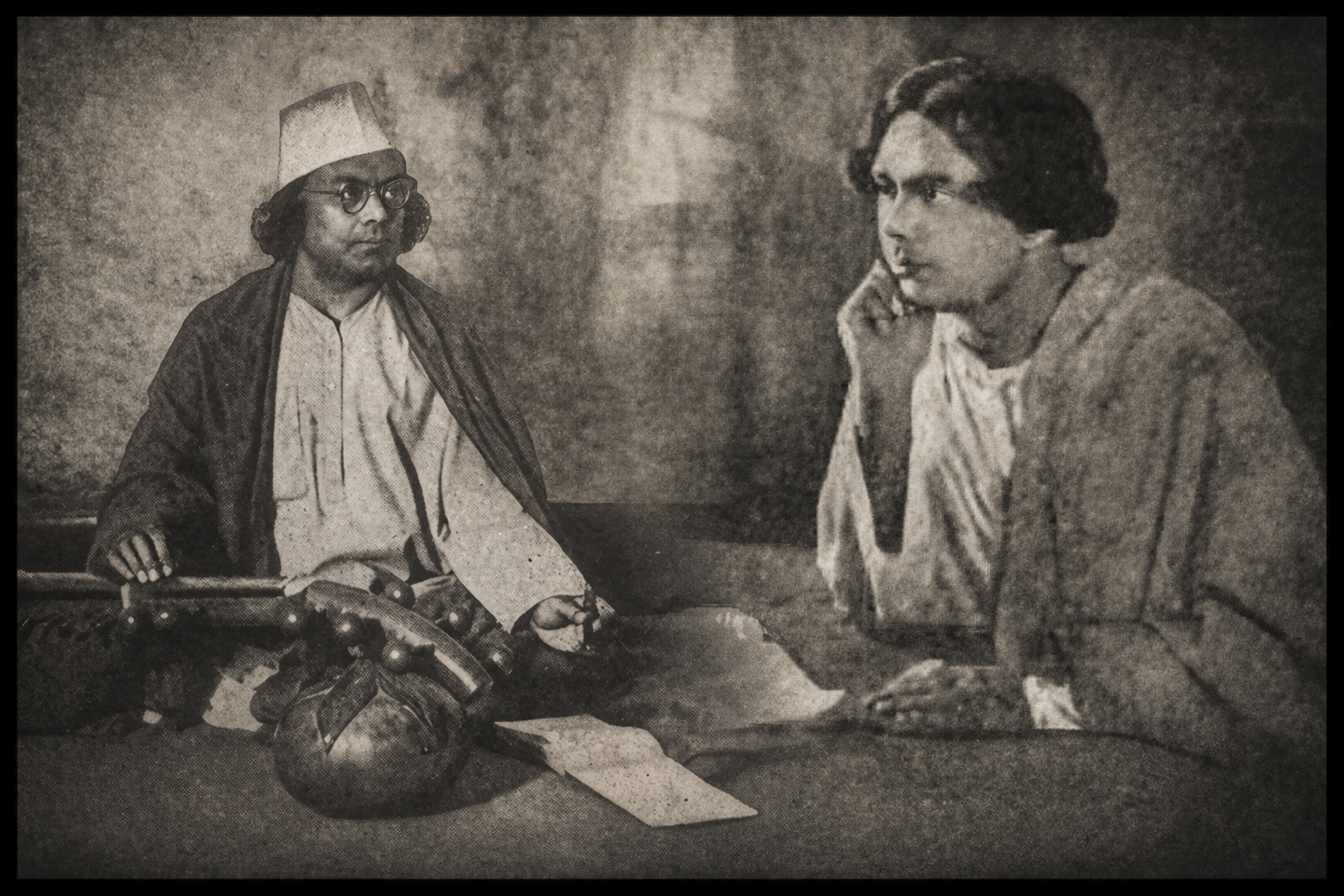
Wardrobe reflecting the artworks
His music alone spans thousands of compositions, blending folk, classical, and devotional forms into something distinctly his own.
It is difficult not to see his wardrobe as part of the same project: an ongoing negotiation between influences and moods.
At home, the simplicity returns. Accounts suggest that he preferred a dhuti and genji after bathing—a look that strips away performance in favor of comfort.
Yet even here, the choice feels intentional. Nazrul’s simplicity is never careless; it is curated minimalism, a refusal of excess rather than an absence of thought.
And then there are the moments of brightness. He is said to have favored colorful attire at public functions, reportedly remarking that it helped him stand out in a crowd.
The statement is pragmatic, almost playful, but it also hints at an acute awareness of visibility—of the politics of being seen. For a man whose work insisted on recognition for the marginalized, this awareness carries weight.
To stand out is not merely to be noticed; it is to claim space.
In the end, Nazrul’s fashion sense does not exist apart from his larger legacy. It is not an eccentric footnote to a literary life; it is another expression of the same restless, boundary-crossing spirit.
The man who refused to accept imposed limits in poetry and politics seems equally unwilling to be confined by a single way of appearing.
To look at his photographs now is to encounter a presence…composed and quietly magnetic. The rebellion is still there, but it has been distilled into posture, into fabric, into the angle of a glance.
It is less loud than his verse, perhaps, but no less enduring.
—
Sabiha Nahla is an aspiring painter