



Beyond his brilliant sleuthing, Feluda’s endurance is fueled by his ability to soothe the collective cultural nerves of his readers and audience.
That may sound excessive for a fictional detective created by Satyajit Ray in 1965, but excess is built into the idea of the very “phenomenon.”
Feluda—Prodosh C. Mitter to the formal world—has long slipped beyond the boundaries of character into something closer to a shared habit of thought.
The word itself invites trouble. Immanuel Kant would have preferred a narrower definition. That the phenomenon is that which appears to the senses, that which can be known. But language rarely obeys philosophy.
A phenomenon now describes both what is clearly seen and what is half-believed—charisma and myth with a sprinkle of spectacle. Joan Baez once used it to describe Bob Dylan, capturing that moment when a figure exceeds the sum of his parts. Feluda has crossed that threshold.
He is, in all good senses, no longer just written; he is inhabited.
Part of the explanation lies in timing. The Feluda stories belong to a Kolkata that feels what writer Indrajit Hazra described as almost archival now. "Slower, less cluttered, pre-liberalisation, before the economic rupture of the 1990s", as he wrote.
They depict “an unhurried pace” of middle-class life, with limited consumption and largely domestic travel. This is not nostalgia in the sentimental sense. This is more likely a structural nostalgia, Hazra pointed out.
The stories reconstruct a world where knowledge mattered more than access, where deduction had to compete with neither Google nor speed.
Feluda thrives in that space because he is designed for it. He is not merely intelligent; he is demonstratively so. A “renaissance man,” as writer Jash Sen puts it—well-read, intuitive, argumentative without being verbose .
His weapon, famously, is the “magajastra,” the brain. He reads before he travels, notices before he speaks, and connects before others even recognise the need for connection. In an age of information overload, this curated intelligence has become even more aspirational.
But Feluda’s endurance is not only about intellect. It is also about texture. The stories are dense with digressions—geometry, telepathy, local customs, fingerprinting, peacock behaviour—threads that appear incidental but accumulate into a worldview .
They expand curiosity, along with solving crimes. You do not finish a Feluda story with closure alone; you finish with residue.
And yet, this is only half the story. The other half is discomfort.
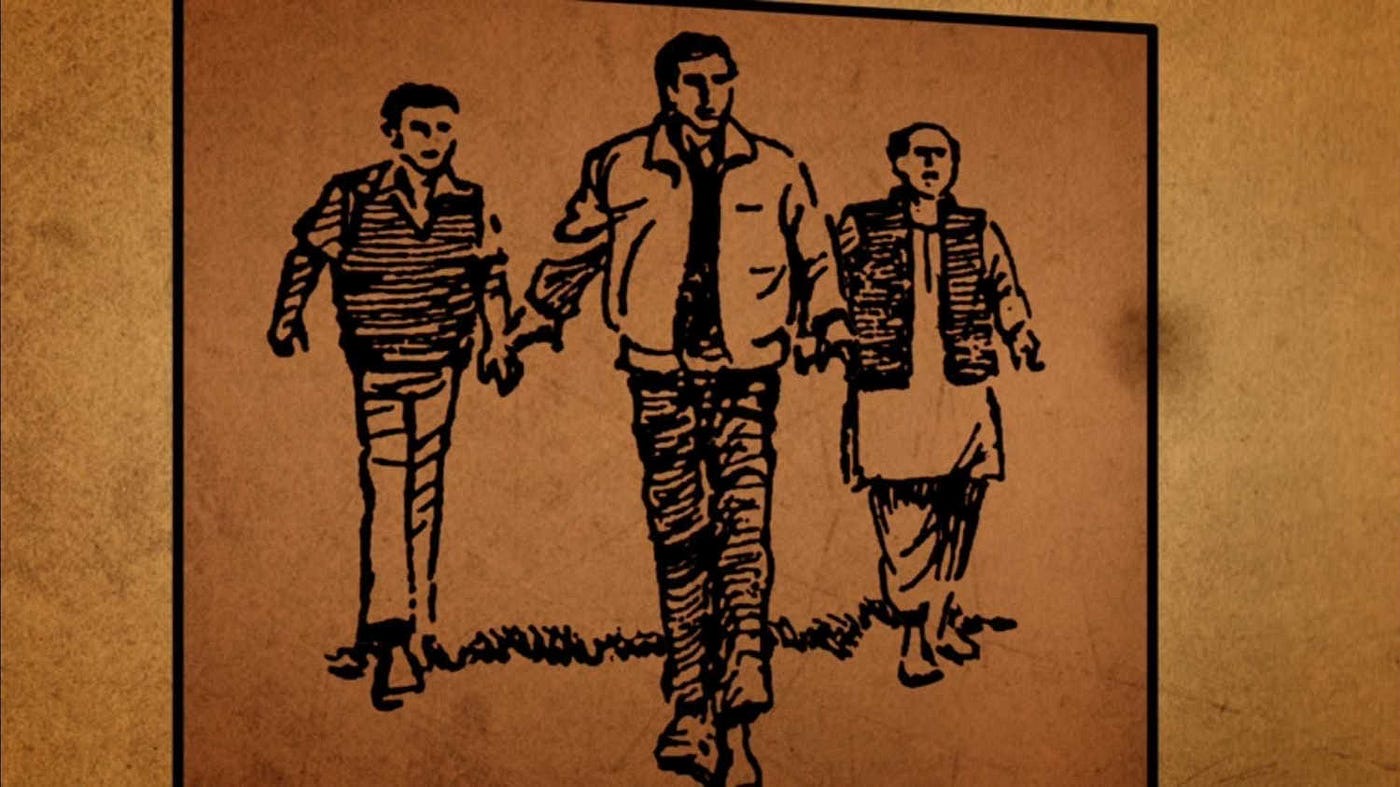
Alter ego, and the anchor
Feluda has often been read as Ray’s alter ego, a projection of his intellectual and moral preferences into fiction, writer Shurid Sankar Chattopadhay said. The resemblance is not accidental. As Chattopadhyay's interpretation suggests, “Feluda was Ray, Ray was Feluda” .
The detective’s tastes, his habits, his disdain for vulgarity, his love for books and music—all mirror the creator. But if Feluda is Ray’s ideal self, then the world he inhabits is one that requires constant correction.
This becomes clearer when one considers the city around him. Kolkata, in Ray’s later years, was more than a setting; it was a problem, as writer Indrajit Hazra pointed out. Feluda’s method—order imposed on chaos, clarity extracted from confusion—reads as a form of coping.
The mysteries are not just external puzzles; they are ways of restoring coherence to a fraying environment.
Which is why Feluda rarely feels like a professional detective. He is selective, almost aloof. He chooses cases that interest him, not those that pay. This lack of overt ambition is not incidental.
It aligns with a deeply embedded “bhadralok” ethic—the suspicion of material success, the preference for intellectual over economic capital, as Hazra said. Feluda’s refusal to be driven by money is as important as his ability to solve crimes.
But ideals require anchors. And in Feluda’s universe, that anchor is not the detective himself. It is an unlikely character: Lalmohan Ganguly—Jatayu.
Jatayu is not brilliant. He is not composed. He is not particularly observant. He is, instead, recognisable. Curious but often wrong, enthusiastic but easily frightened, he embodies the middle-class Bengali far more accurately than Feluda ever could.
If Feluda is aspiration, Jatayu is admission.
This is why adaptations that misjudge Jatayu falter. Reduce him to buffoonery, and the audience loses its reflection. Elevate him too much, and the balance collapses. The Feluda stories—and especially Ray’s own films—understood this equilibrium.
The humour was never separate from the structure; it was integral to it.
The newer iterations often miss this. They aim for fidelity—faithful retellings, updated visuals—but fidelity to plot is not fidelity to tone. Ray’s films were not literal. They relied on pauses, on suggestion, on the rhythm of dialogue that carried cultural nuance.
The newer versions tend to explain more and imply less. The result is a thinning of texture.
And yet, the thing that Hazra dubbed as “Felumenon” continues.

Enduring appeal and the restraint
It continues because it has detached itself from the necessity of excellence.
Like a ritual, it sustains itself through repetition. Each new adaptation—television, film, streaming—adds another layer, another point of comparison. Viewers return for the act of revisiting.
There is also the matter of scale. Feluda operates within a distinctly local framework of West Bengal—language and social codes—that resists easy translation. This limits global reach but deepens local attachment.
The dialogues, especially, carry a flavour that often evaporates outside Bengali. What remains, then, is not exportable spectacle, but internal resonance.
At the same time, Feluda participates in a broader detective tradition. He draws from figures like Sherlock Holmes and Hercule Poirot, yet remains distinctly situated within Indian—and specifically Bengali—modernity.
His cases are rarely grand conspiracies. They are grounded, often domestic, occasionally historical. Violence is present but rarely excessive. The emphasis is on resolution…not shock.
This restraint is crucial. It allows Feluda to function across generations. A child encounters adventure. An adult encounters structure. An older reader encounters memory. The stories do not age in a linear way; they accumulate meanings.
Which brings us back to the idea of the phenomenon.
Feluda is observable. He exists in texts, films, performances. But he is also something less tangible: a habit of mind, a cultural reflex. He represents a way of engaging with the world—through curiosity, through deduction, through a certain measured distance.
At the same time, he exposes a contradiction. The audience that venerates Feluda does not necessarily resemble him. The gap between admiration and imitation remains.
Feluda is not meant to be replicated; he is meant to be contemplated.
And perhaps that is the secret of his endurance. Not that he solves mysteries, but that he leaves one unresolved. Why does a culture return, again and again, to a figure who is so clearly beyond it?
The answer, like most things in the Feluda universe, is not stated outright. It is inferred.
—