


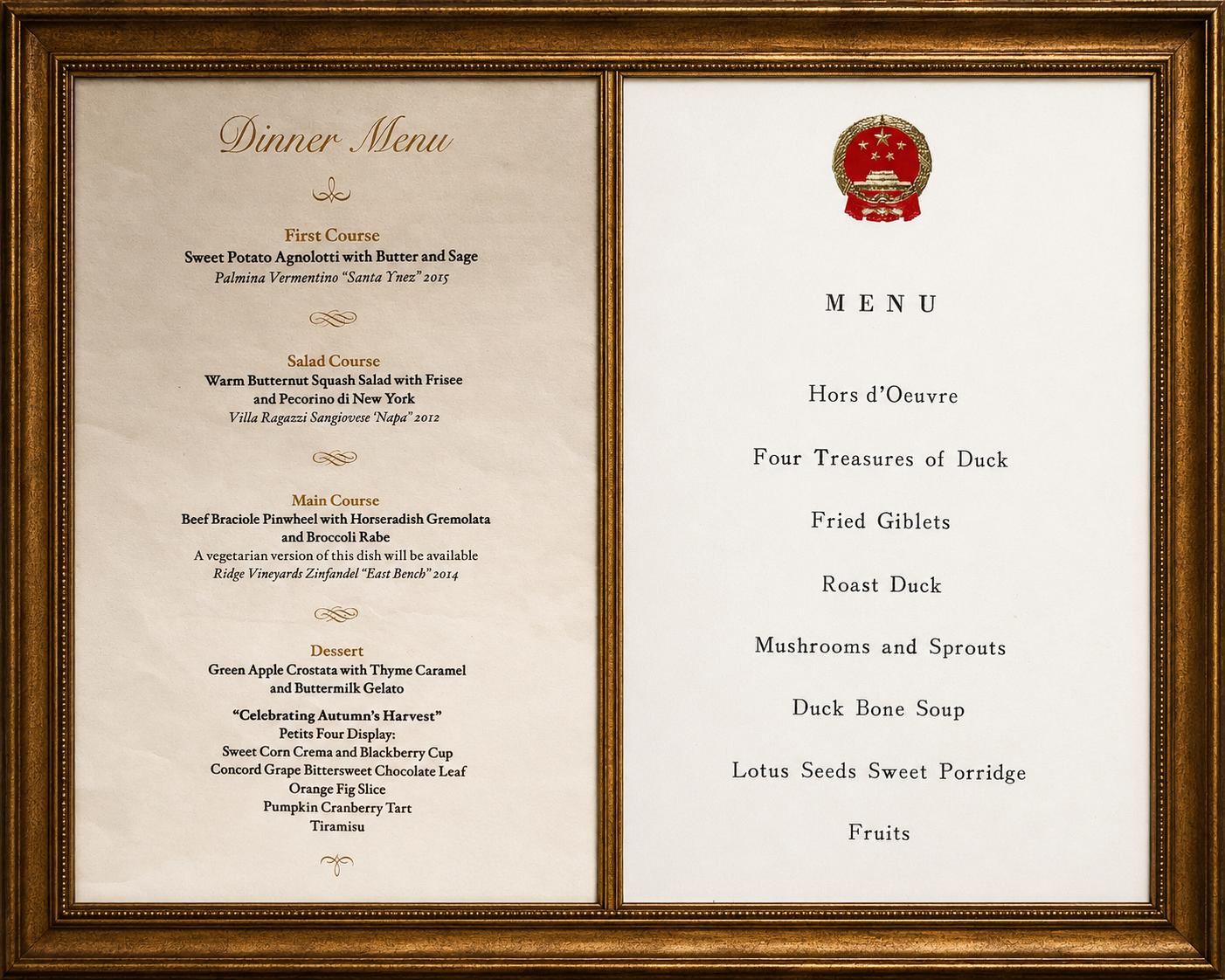
In the Great Hall of the People in Beijing on Thursday, beneath the grand chandeliers, US President Donald Trump sat down to a state banquet hosted by President Xi Jinping.
The meal was calibrated with the precision of a trade negotiation and the theatricality of an opera.
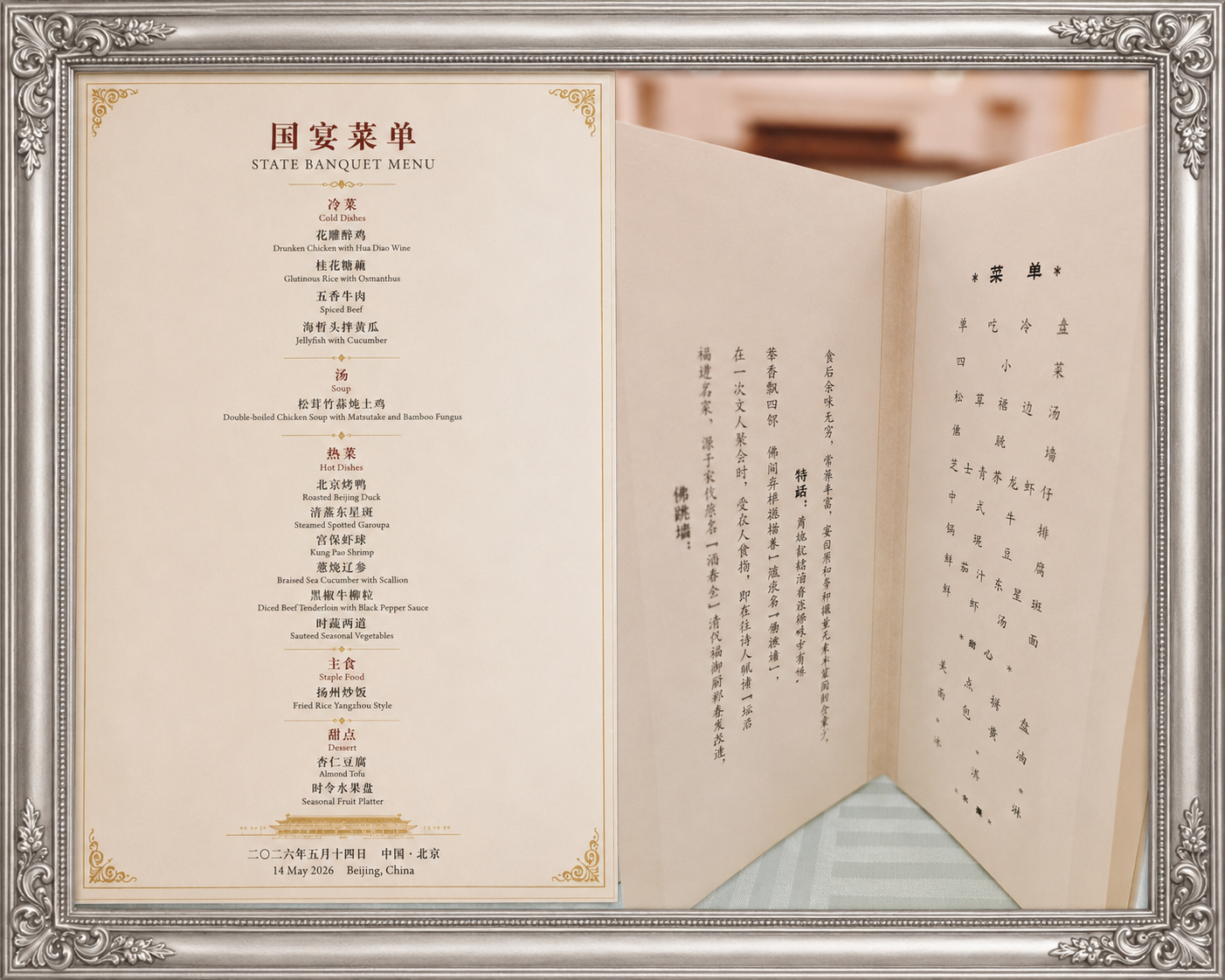
There were crispy beef ribs—a diplomatic nod to Trump’s famously carnivorous tastes—alongside Beijing roast duck lacquered to a mahogany sheen.
The two center dishes were complemented with lobster in tomato soup, pan-fried pork buns, mustard-glazed salmon, and a parade of desserts that included tiramisu, ice cream, and a trumpet-shell pastry that looked as “though Bernini had designed it after a sugar rush,” reported the New York Times.
A military orchestra played “YMCA,” Elton John, and “We Are the World,” because, as said The Washington Post, that even geopolitical rivalry now arrives with “a curated playlist.”
The dinner was of course a choreography. Huaiyang cuisine, with its subtle flavors and knife-work so meticulous it borders on neurosis, has long been the preferred language of Chinese state hospitality.
The cuisine signals refinement without ostentation, sophistication without aggression.
“Safe,” as one chef told Reuters, in the sense that no guest leaves offended, bewildered, or sweating through Sichuan peppercorns. The menu functioned as edible diplomacy.
It was Chinese enough to project civilizational confidence, Western enough to flatter American palates, luxurious enough to suggest abundance, and restrained enough to imply discipline.
This
is the strange genius of the state dinner.
Nations negotiate through tariffs, aircraft carriers, sanctions, and treaties; but they seduce through soup or biriyanis. Long before ambassadors draft communiques, cooks are drafting emotional atmospheres.
State dinners are where geopolitics slips off its tie and attempts charm.
Every garnish carries coded meaning. Every drink pairing whispers ideology. The seating chart matters nearly as much as the menu. If diplomacy is the management of tension, then the state banquet is its soft-focus close-up.
No ritual better reveals how power wishes to be seen. Empires announce themselves through architecture and military parades; governments announce their aspirations through what they feed guests.
Food, unlike speeches, enters the body. It is memory.
Modern diplomatic gastronomy may have reached its most theatrical refinement in the twentieth century, but rulers have always understood the political utility of abundance.
Louis XIV turned Versailles into a monument of edible spectacle. Ottoman sultans measured prestige by the extravagance of palace kitchens. Mughal emperors transformed Persian and Central Asian culinary traditions into feasts that doubled as declarations of imperial sophistication.
Even today, when leaders gather around polished mahogany tables beneath elaborate floral arrangements, they are participating in a ritual older than modern states themselves.
The
White House understood this early in the modern world. One of the most famous
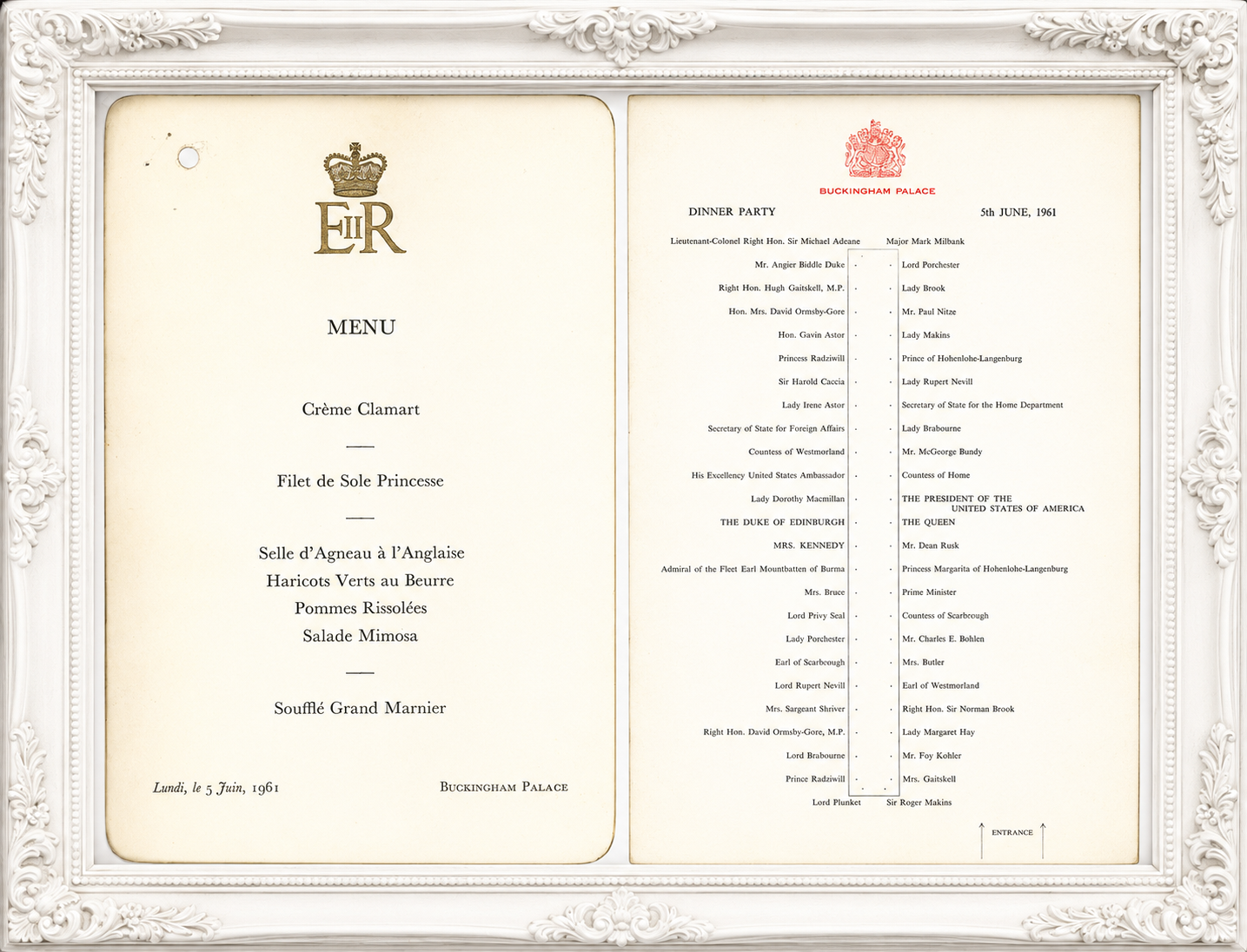
American state dinners came in 1961, when President John F Kennedy and
Jacqueline Kennedy Onassis hosted Pakistan’s President Ayub Khan.
Jackie Kennedy recognized instinctively that diplomacy was partly aesthetic theater.
French chefs, candlelight, and carefully curated glamour became extensions of American soft power during the Cold War. Washington was selling sophistication while also subtly presenting its military might.
The Kennedys also transformed the state dinner into televised mythology. Guests, along with eating, participated in an idea of America—cultured and confident.
This was diplomacy as lifestyle branding decades before Instagram discovered plating.
Even Richard Nixon’s historic opening to China in 1972 carried culinary symbolism. When Richard Nixon dined with Premier Zhou Enlai in Beijing, the banquet became part of the geopolitical thaw itself.
Americans watching television saw dishes they could barely identify and chopsticks wielded with varying levels of embarrassment.
But the dinner mattered because it domesticated the unimaginable. China ceased, briefly, to be an abstraction and became a table covered with lacquered duck and Maotai toasts.
Henry Kissinger once remarked that control over food and protocol often shaped the emotional climate of negotiations more effectively than formal sessions.
He understood that state dinners create psychological weather. A guest who feels honored becomes more pliable. A guest subtly insulted remembers forever.
India,
perhaps more than any democracy, has elevated the state banquet into a
civilizational performance.
The Indian diplomatic table carries an impossible burden: representing a nation with hundreds of cuisines, religions, languages, climates, and culinary philosophies while simultaneously satisfying foreign dignitaries unused to complexity.
Yet India repeatedly turns this challenge into spectacle.
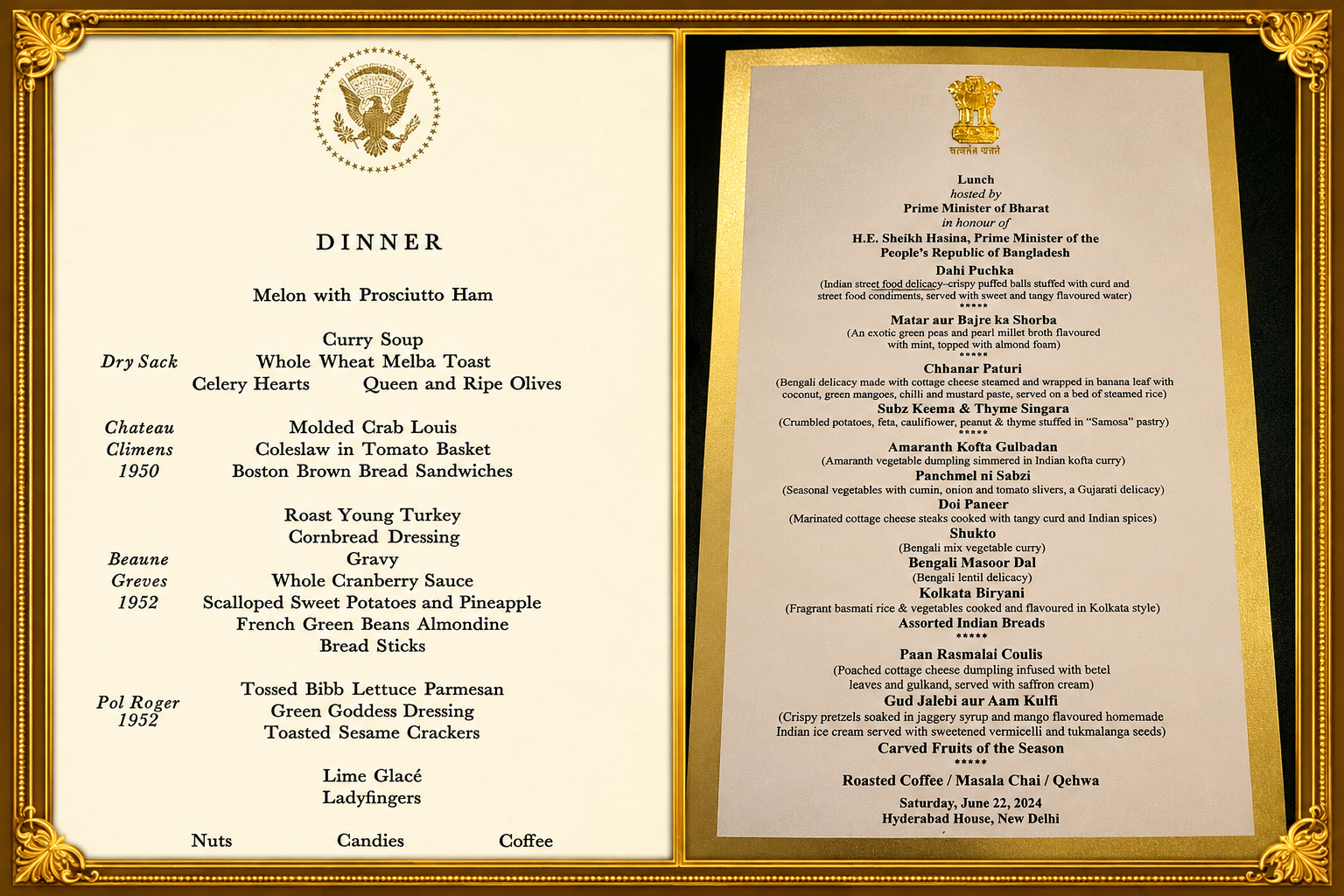
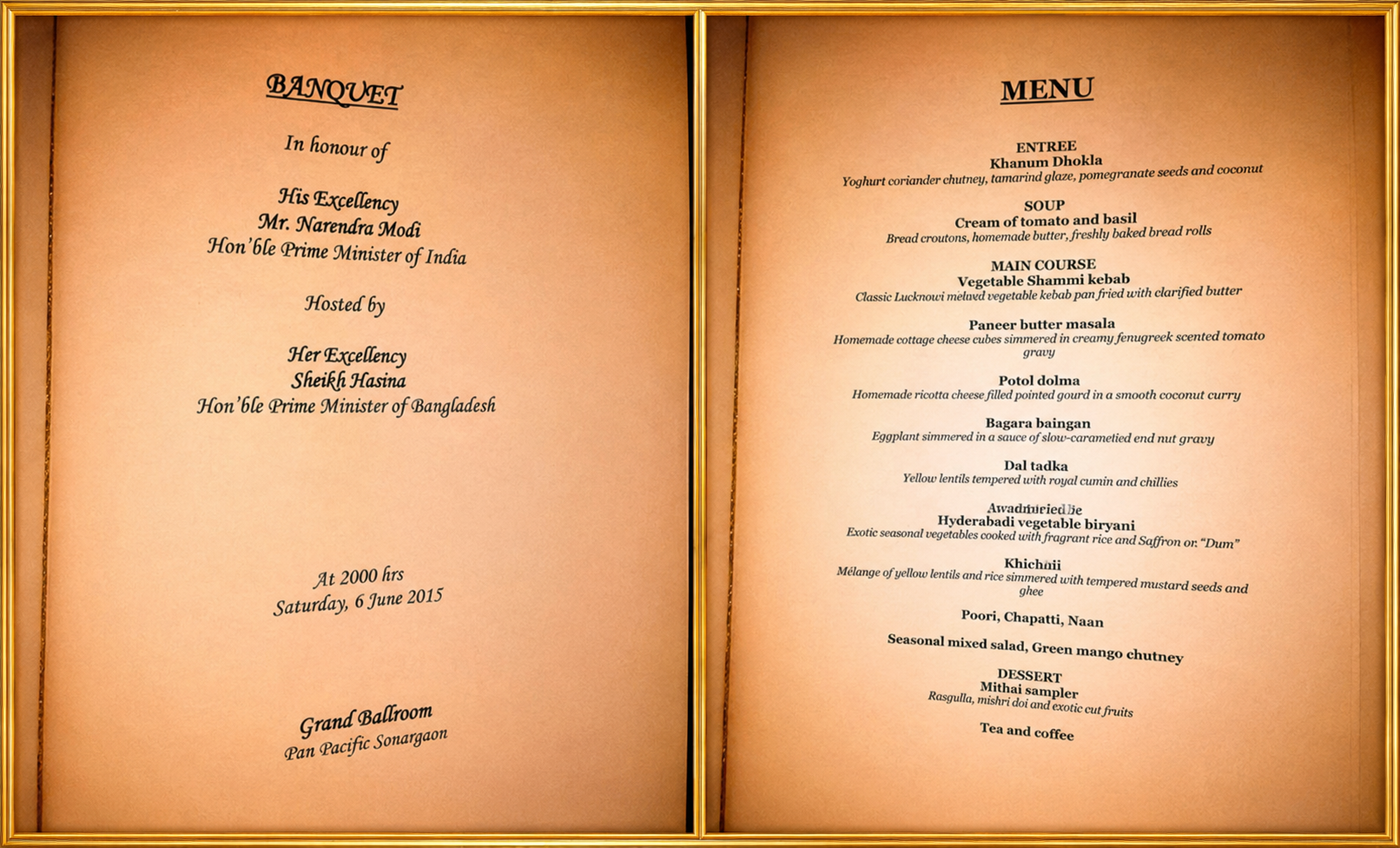
When Prime Minister Narendra Modi hosted Russian President Vladimir Putin in 2025, the menu reportedly moved through a carefully choreographed sequence of regional flavors.
The banquet table had jhol momo from the Himalayas, achaari baingan rich with North Indian spice traditions, venison preparations, and desserts that balanced royal Mughal decadence with contemporary presentation.
Putin, who projects the image of a stern strategic operator, was offered a meal designed to communicate India’s layered abundance rather than simple luxury.
India’s state hospitality often attempts something difficult—democratic grandeur. Unlike monarchies, which can lean on inherited opulence, India’s diplomatic feasts try to present pluralism itself as grandeur.
One dinner may feature Kashmiri saffron, Kerala coconut, Rajasthani game meats, Bengali sweets, and tribal millet traditions in succession.
The implicit message is always the same: India is not a country but a continent pretending to be one nation.
When
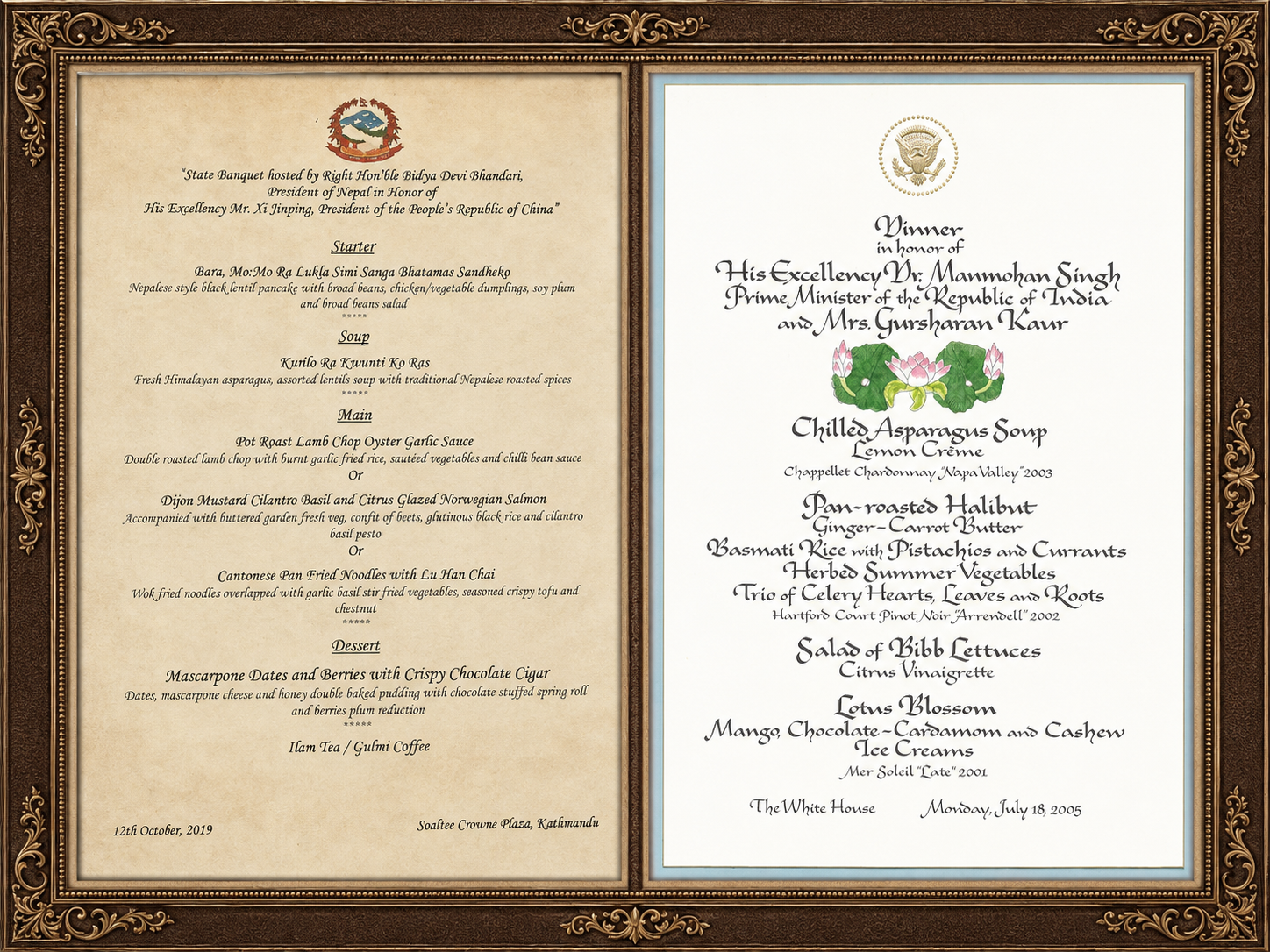
Modi visited the White House during Barack Obama’s presidency in 2021, the menu
included mango crème brûlée—a French dessert infused with Indian memory.
The symbolism was almost embarrassingly perfect: globalization sweetened with nostalgia.
American diplomatic cuisine often works this way, blending cosmopolitan technique with local ingredients in order to suggest a nation simultaneously rooted and universal.
The Obama White House excelled at this culinary messaging. Michelle Obama understood food politically and culturally, not merely ceremonially.
Menus during their administration frequently emphasized American agriculture, regional produce, immigrant culinary traditions, and healthier preparation.
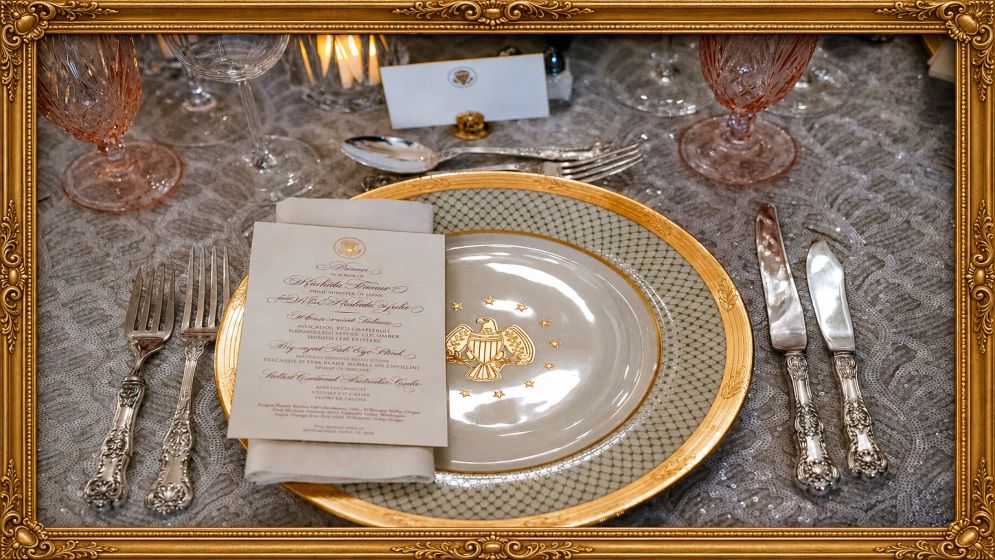
Consider the 2024 state dinner hosted by President Joe Biden for Japanese Prime Minister Fumio Kishida. The menu included house-cured salmon, dry-aged ribeye, and salted caramel pistachio cake, all presented with the polished confidence of contemporary American fine dining.
Yet beneath the elegance was strategic reassurance. Japan is America’s most important Asian ally; the dinner sought intimacy rather than awe.
Even the floral arrangements reportedly incorporated symbolic references to cherry blossoms and spring renewal.
That is why state dinners are often negotiations conducted through centerpieces.
Japan
itself practices a quieter, more minimalist diplomacy at table. Japanese state
hospitality tends toward precision over extravagance.
When Trump visited Tokyo during Shinzo Abe’s tenure, he was served hamburgers made with premium American beef and Japanese technique—a meal that seemed almost comically straightforward until one realized its brilliance.
It reassured Trump through familiarity while showcasing Japanese perfectionism. Abe understood that flattery is most effective when disguised as simplicity.
France, meanwhile, treats the state dinner as a branch of civilization itself. French diplomatic cuisine is unapologetically hierarchical.
Sauces are political philosophy. Cheese courses are declarations of cultural supremacy.
At Elysee Palace banquets, one senses that France is not merely feeding guests but reminding them, gently and continuously, that gastronomy is one of the few global languages in which Paris still considers itself unquestionably fluent.
No country weaponizes culinary prestige quite like France because no country has more aggressively linked cuisine with national identity. To dine formally in Paris is to enter an argument about history, refinement, and intellectual order.
Even wine pairings carry historical subtext. Burgundy and Bordeaux are essentially geopolitical artifacts.
Britain
approaches state dining differently. The British banquet remains inseparable
from monarchy, ritual, silverware, and inherited pageantry.
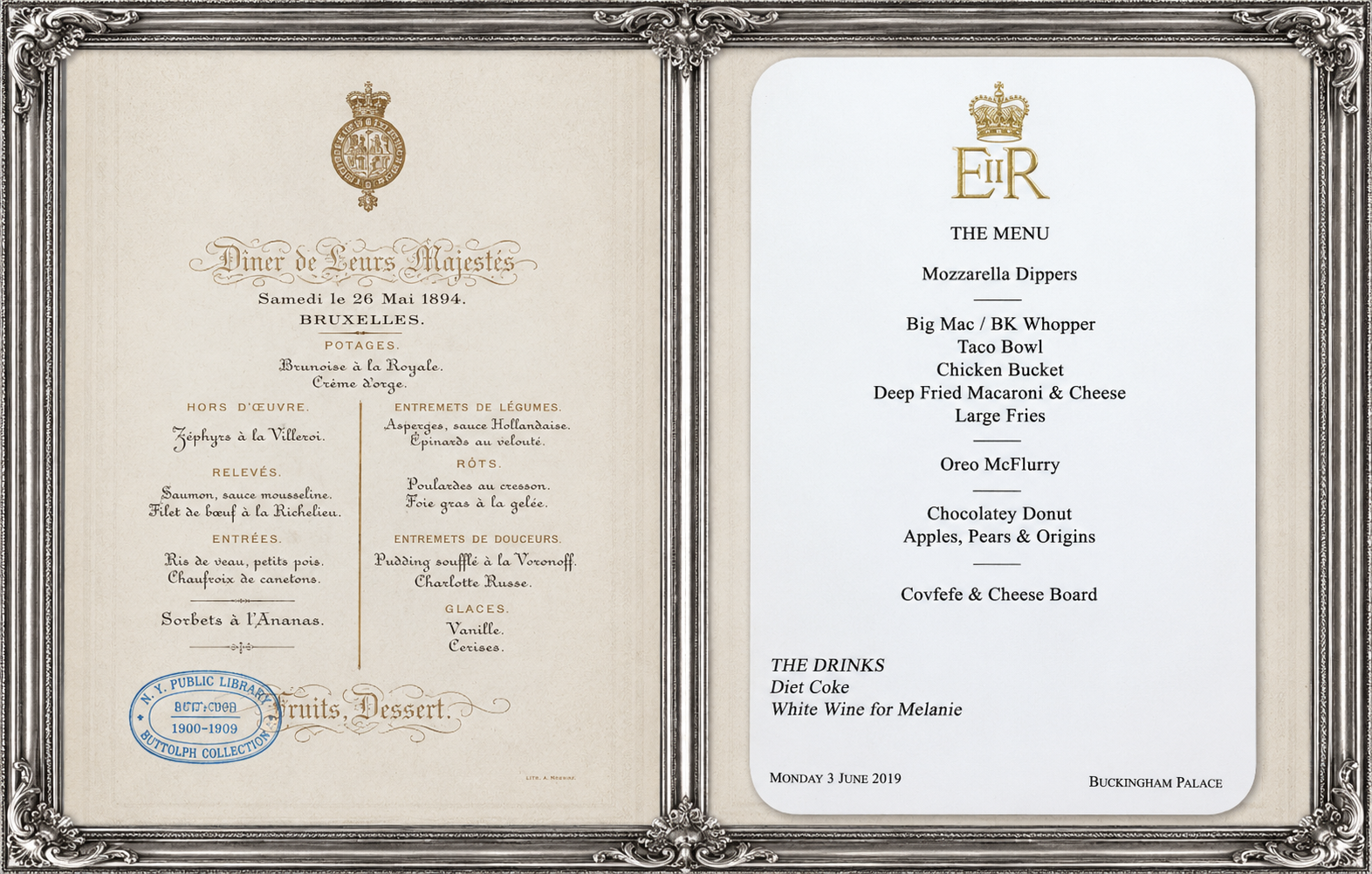
When Trump attended a lavish banquet hosted by King Charles III in 2025, the menu reportedly featured watercress panna cotta, organic Norfolk chicken ballotine, and bombe glacee with Kentish raspberry sorbet, paired with wines selected to project both heritage and modern British viticulture.
Britain’s diplomatic meals communicate continuity. The message is less “look how innovative we are” than “observe how effortlessly old we remain.”
Royal banquets however excel at transforming nostalgia into soft power. Guests dine amid portraits, tapestries, and chandeliers that quietly imply Britain survived every geopolitical catastrophe imaginable and still found time to perfect dessert service.
The Gulf monarchies have mastered another variation: abundance as geopolitical theater.
In Riyadh, Abu Dhabi, and Doha, diplomatic hospitality often reaches near-mythic levels of opulence. Gold leaf appears where restraint would suffice. Lamb arrives with enough ceremonial gravity to resemble a coronation ritual.
The point is not merely generosity but sovereign confidence. Oil wealth has enabled these states to turn hospitality into architecture, and architecture into diplomacy.
Turkey, positioned historically between Europe and Asia, frequently deploys Ottoman culinary memory during diplomatic visits.
Baklava, lamb stews, sherbets, and elaborate mezze spreads invoke imperial inheritance without explicitly mentioning empire.
Balkan states similarly use hospitality to narrate national identity through cuisine: pastries, yogurt dishes, slow-cooked meats, and layered desserts functioning as edible maps of centuries of migration and conquest.
South
Asian diplomacy often relies especially heavily on food because cuisine there
carries emotional force that transcends protocol.
When Indian Prime Minister Modi met Sheikh Hasina in Dhaka in 2021, reports focused not merely on agreements or street clashes but on the lunch itself: fish preparations, sweets, and carefully calibrated hospitality designed to emphasize cultural familiarity between neighbors.
In South Asia, feeding someone remains inseparable from honoring them.
This is why diplomatic meals are remembered long after policy statements vanish into archives. Few people recall the precise wording of summit communiques.
Many remember that Zhou Enlai served Nixon shark fin soup, that Obama offered mango creme brulee to Modi, or that Xi Jinping’s chefs fed Trump tiramisu beneath crystal chandeliers while military musicians played disco anthems.
Food survives because it humanizes abstraction.
The irony, of course, is that many leaders themselves eat terribly. Trump’s affection for fast food is practically folklore. Putin reportedly prefers simpler Russian fare outside ceremonial settings. Winston Churchill survived on champagne, roast meats, and cigar smoke with alarming efficiency.
Yet state dinners ask leaders temporarily to perform refinement for one another. They become actors in a civilizational pageant where nobody can admit they would secretly prefer fries.
The diplomatic banquet also reveals global anxieties about authenticity. Nations increasingly worry about appearing provincial or outdated. Menus now balance local identity with international recognizability.
A purely traditional meal risks alienating guests; an overly globalized menu risks seeming culturally insecure. Hence the modern diplomatic compromise–local ingredients prepared with internationally legible techniques.
A nation offers itself, but translated.
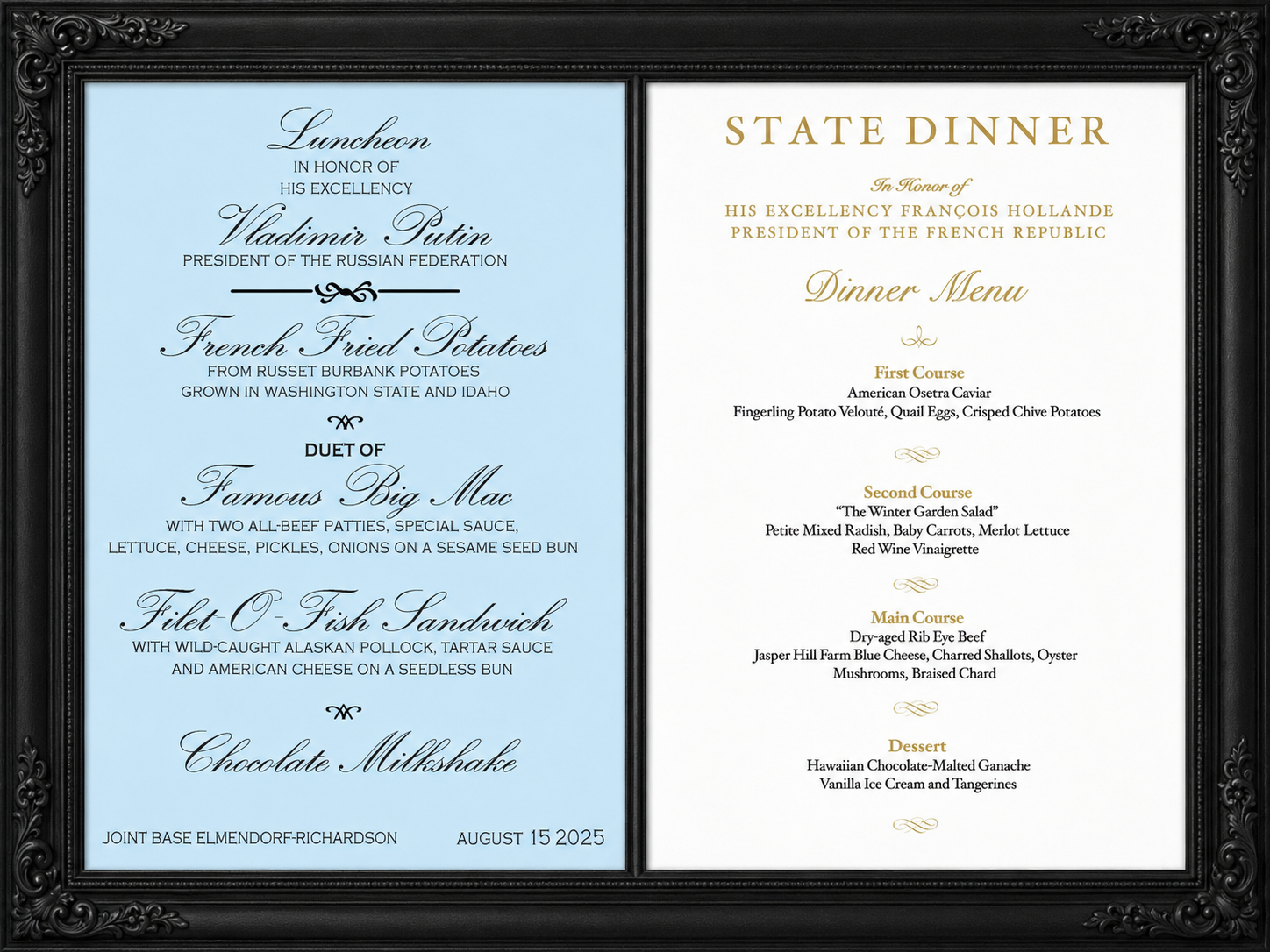
China’s
banquet for Trump embodied this perfectly. Peking duck announced Chinese
identity; tiramisu signaled cosmopolitan ease. Beef ribs nodded toward Trump’s
tastes without surrendering entirely to them.
The result was not authentic Chinese dining but diplomatic Chinese dining: cuisine optimized for symbolism rather than appetite.
And yet symbolism matters because diplomacy itself is symbolic theater backed by hard power. State dinners cannot prevent wars or resolve ideological conflict. But they can create atmospheres in which leaders imagine coexistence.
They can flatter egos sufficiently to reopen dialogue. They can project stability during moments of tension. They can reassure domestic audiences that their nation remains respected abroad.
Sometimes the meal itself becomes history. In 2017, Trump famously informed Xi Jinping over chocolate cake at Mar-a-Lago that the United States had launched missile strikes in Syria.
The juxtaposition felt grotesquely modern….that military escalation announced between dessert courses.
Diplomacy has always contained this contradiction. Fine china and geopolitical menace frequently occupy the same table.
There is also something revealingly human about the persistence of these rituals. In an age of drone warfare, cyber conflict, and algorithmic propaganda, governments still believe deeply in the persuasive power of a beautifully roasted bird.
Leaders who distrust one another enough to expand naval deployments nevertheless sit together discussing fish courses.
Perhaps this is because eating together remains one of the oldest technologies of trust.
—