

Inside Roid's endless, trance-like cycle

Shakhawat Hossen
Publish: 03 Jun 2026, 05:29 PM
-6a201004a33d5.png)
According to Genesis, God needed six days to make the world. Before creation, there was only darkness. So on the first day, He made light and separated it from the void.
Light, however, is not sunlight. For that, Genesis asks us to wait. Two full days pass before the sun appears. Only on the fourth day—after the creation of the heavens and the Earth—does God fashion the celestial bodies that illuminate them. It is this fourth day that gives Mejbaur Rahman Sumon's film its title—Roid.
The obvious question is what occupies those intervening days.
Genesis is surprisingly specific. On the second day, God creates the sky, carving out the atmosphere above. On the third, He gathers the waters and brings forth the Earth itself. Only then comes the sun.
Roid unfolds in that symbolic interval between illumination and understanding.
Its story is deeply entangled with the myth of the first man and woman. Primordial love, temptation, transgression, and consequence. Yet to describe the film merely as a biblical allegory would undersell its ambition.
There is a persistent misconception [among a group of audience] that Roid is somehow "storyless," and that this supposed absence of narrative constitutes its artistic achievement.
In fact, the opposite is true. The film possesses a remarkably intricate and carefully engineered narrative structure. Its foundation may be Adam and Eve, but woven through it are the six inner vices, Bengali folklore, Greek mythology, the paintings of SM Sultan, ideas of cyclical time, fate, karma, and, inevitably, Sumon's trademark ending.
If you have not seen the film, this is where you should stop reading. What follows contains major spoilers.
-6a200ed109e8b.png)
At
its most basic level, the plot is ‘deceptively’ simple.
Sadhu is a man shaped by poverty and hard labor. He has drifted beyond the age at which most men in his village marry. He works with near-animal endurance, and his diligence earns him the admiration of virtually everyone around him, especially his employer.
Eventually, through his employer's intervention, Sadhu finds a bride.
The marriage immediately unsettles expectations.
His wife appears mentally unstable. During communal television screenings, she abruptly breaks into dance when Hindi songs come on. She empties an entire sack of fish feed into the pond at once, preferring abundance in a single day to measured portions spread across many.
At first, these acts seem merely eccentric. Over time, they become intolerable to Sadhu.
One day, under the pretense of taking her to a fair, he leads her onto a boat, ferries her to a riverside forest, and abandons her there.
Time passes.
Then comes one of the film's pivotal images. Standing beneath a palm tree, Sadhu watches a ripe palm fruit fall to the ground. He picks it up. And almost immediately, his wife returns.
There is no confrontation. No accusation. No demand for explanation. She arrives without anger, without resentment, without even curiosity. She simply comes back, and life resumes.
Most stories move through a familiar architecture of beginning, middle, and end. What has been described above constitutes only the first movement of Roid. Its peculiar power lies in a sequence of events that feels simultaneously arbitrary and inevitable.
Sadhu's solitude, the arrival of the woman, her disappearance, the falling palm fruit, and then her return.
The film's second and third movements do not so much advance this narrative as circle back through it. Again and again, Roid folds onto itself, replaying variations of the same existential pattern.
It is this recursive design that leads many viewers to mistake the film for an extended exercise in visual poetry rather than a story. Because the opening movement resists conventional decoding, the repetitions that follow seem to reject conventional storytelling altogether.
But the film is not without narrative. It is without answers.
-6a200efacb659.png)
Most
stories are engines that generate questions and then satisfy them. Roid
asks questions and leaves them suspended.
How does the wife return? What exactly is the palm fruit?
The film never says. And it is in that refusal—less an absence of meaning than a withholding of it—that Roid locates its mystery.
To understand what follows, it helps to return to the story that hovers over Roid from beginning to end.
Adam, according to Genesis, was created first. Faced with his loneliness, God filled the world around him with living creatures. Animals, birds, and every manner of companionship appeared before him. None were enough.
Only when Eve was fashioned from Adam's rib did that loneliness subside. The pair were permitted to remain in Eden under a single condition: they must not eat the forbidden fruit. Tempted by Satan, they disobeyed. Knowledge arrived. Paradise ended.
The parallels in Roid are difficult to miss.
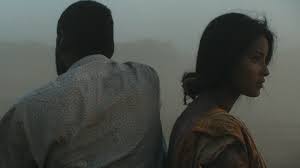
Sadhu exists in a state of profound solitude. He lives among animals and spends much of his life in their company. Marriage comes late. Then a woman enters his world. Together they inhabit a landscape so detached from social life that it resembles a private Eden.
Yet harmony never arrives. His wife cannot perform the roles expected of her. She struggles with ordinary domestic tasks, resists social norms, inhabits a reality largely inaccessible to everyone around her.
She names a goat Kulsum, converses with animals and fish, rejects physical intimacy, and moves through the world according to a logic that belongs entirely to herself.
Viewed through the film's symbolic framework, the casting becomes clear. Sadhu is Adam. The wife is Eve. And the Devil is not a horned tempter but society itself—a collective force that treats difference as pathology and demands conformity as a condition of acceptance.
Under that pressure comes the first true transgression.
Sadhu abandons his wife.
Time passes. A palm fruit falls from a tree. He picks it up. She returns.
The symbolism is hardly accidental. The palm fruit functions as Roid's equivalent of the forbidden fruit: an object that transforms desire into reality.
In Genesis, the fruit of the Tree of Knowledge promises expanded vision, a way of seeing beyond ordinary human limits. Adam and Eve eat because they desire what lies beyond the boundary imposed upon them.
Desire operates differently in Roid, but it is no less powerful.
-6a200f172ba88.png)
Sadhu
never articulates it aloud. Even after a brief and troubled marriage, he
discovers that he cannot bear his wife's absence. The longing remains after she
is gone. The moment he reaches for the fruit, that longing is answered.
From then on, a pattern emerges. Each time Sadhu possesses the fruit, the wife returns. And each return brings a subtle revision. She becomes less herself and more a reflection of what Sadhu wishes her to be.
The first return produces a more capable homemaker. The woman who once seemed incapable of managing a kitchen now prepares food with effortless mastery.
The second return delivers something closer to social acceptability. Sadhu's deepest wish has always been for her to become "normal"—to fit into the world that rejected her. Yet the more completely that wish is fulfilled, the more distorted Sadhu himself becomes.
This is what gives the film's final movement its unsettling force. By the time Roid approaches its climax, the transformation is no longer occurring in the wife alone. The corruption has migrated. Sadhu's pursuit of normalcy gradually strips away his own humanity.
The thing that remains is not a better version of himself but a stranger wearing his face.
The obvious question, of course, is where the wife goes when she disappears.
The film refuses to answer. But then mystery has always been one of literature's and film’s oldest tools. We never learn where the enigmatic boy in Humayun Ahmed's Dui Duari comes from.
We never understand why the stone moves in Haruki Murakami's "The Kidney-Shaped Stone That Moves Every Day." We never discover the crime at the center of Kafka's The Trial, nor the mechanism behind Rip Van Winkle's impossible sleep.
These mysteries endure because they are not problems awaiting solutions. They are structural absences, spaces deliberately left unfilled.
The same principle applies here.
Roid is ultimately Sadhu's story, just as Genesis is ultimately Adam's. Eve enters that narrative not as an independent protagonist but as an extension of Adam's experience, a figure whose existence is defined through his.
She has no separate mythology, no autonomous world beyond the one Adam inhabits.
In Roid, the wife occupies a similarly elusive position. We never see where she goes because, in a sense, there is nowhere for her to go. The film grants her no reality outside Sadhu's consciousness.
She exists as a manifestation of his desires, fears, guilt, and longing—a figure who appears whenever he needs her and vanishes whenever he fails to understand what she represents.
-6a200f363caa5.png)
And
yet even three cycles are not enough.
If Roid is indeed structured around the six days of Genesis, then what we witness on screen constitutes only half the journey.
The fourth day—the day of sunlight, the day from which the film takes its title—still lies ahead. The logic of the film suggests that Sadhu's repetitions are not approaching a conclusion but extending toward another beginning.
In many pagan traditions, the sun is less a symbol of illumination than of recurrence. It dies each evening only to return the next morning. Birth, death, rebirth: the cycle has no terminal point.
Sadhu becomes captive to precisely that rhythm.
The film repeatedly returns to the same underlying structure. A household is formed. A transgression follows. Separation arrives. Guilt festers. The fruit appears. The fruit is touched. The wife returns, altered by desires Sadhu barely understands himself.
The details change. The pattern does not. And the thing that evolves across these repetitions is not the wife but Sadhu. Or, more precisely, the extent to which he attempts to possess her.
The first time, he abandons her because her difference becomes intolerable. Her eccentricities exceed his capacity for acceptance. By the second cycle, his attachment has deepened. Even after she commits an act that horrifies the community, he does not cast her away. Instead, he chains her.
The thing that once appeared as rejection has become control. Only after the destruction of his home does he separate from her again.
By the third cycle, the transformation is complete. The man who once wanted distance now wants permanence at any cost. If preserving possession requires the destruction of her unborn child, he is willing to contemplate that as well.
This progression gives the film's climax its extraordinary force.
Bengali cinema has produced no shortage of tragic endings, but what happens here feels less like tragedy than metamorphosis. Sadhu does not merely make a terrible choice. He crosses a threshold from which return appears impossible.
The moment was especially devastating because of the film's unwavering formal discipline. From beginning to end, Roid sustains a remarkably consistent visual language and emotional tempo.
The rhythm rarely accelerates. The tone seldom breaks. Scenes unfold with a dreamlike patience that can initially seem detached from narrative urgency.
The strategy is deliberate.
Before the film can depict madness, it must first induce a kind of trance. Only then can the audience experience the full horror of what Sadhu becomes.
The
roots of that transformation are planted surprisingly early. After the first
cycle, Sadhu learns the film's central lesson. Loneliness is temporary. The
fruit will come again.
Crucially, he never attempts to understand why.
He asks no metaphysical questions. He seeks no explanation for the impossible events surrounding him. Curiosity is replaced by expectation. He simply waits for the next fruit to fall.
And when it does, he reaches for it.
This may be the most disturbing aspect of Roid. Sadhu knows the consequences. Every return eventually produces suffering. Every reunion leads to fresh transgressions. Every cycle leaves him morally diminished. Yet he continues waiting for the fruit with almost religious devotion.
The film painstakingly earns this obsession. Between Sadhu and his wife unfolds a relationship that resists easy categorization. At times it is tender. At times cruel. It contains wonder, frustration, dependence, curiosity, longing, resentment, and moments of genuine menace.
There are traces of romance, but also domination. Affection exists alongside violence. It is not an idealized love story but something far messier and therefore more recognizable…a compressed portrait of human attachment itself.
As the cycles progress, Sadhu's relationship to his wife continually shifts. Initially, he wants society to accept her. Later, he becomes suspicious of her. Eventually, he attempts to eliminate what stands between her and his possessive vision of domestic completeness.
Yet one element never changes. She always returns.
Why?
That question opens perhaps the richest interpretive territory in the film.
Those who describe Roid as "pure art cinema" often mean that it refuses definitive explanation. The film does not present symbols as equations waiting to be solved. Instead, it generates multiple, often contradictory readings.
One possibility is that the wife possesses no agency within the cycle at all.
A cryptic, unfinished exchange with a Baul singer inside the film gestures toward this interpretation. Once Sadhu takes hold of the fruit, he becomes trapped within its logic. The cycle is no longer something that happens to him; it becomes something he actively perpetuates.
The wife does not choose to return. Sadhu summons her back. More significantly, he summons back a version shaped by his own desires.
Each cycle becomes a prayer disguised as a wish. Every return is a revision.
He wants a better cook. She returns. He wants someone more socially acceptable. She returns. He wants stability, obedience, permanence. Again she returns.
But desire, the film suggests, has no natural endpoint. Fulfillment merely creates new deficiencies. Satisfaction generates new cravings. Even if the landscape were covered with palm fruits, Sadhu would continue searching for another.

This
is where a more provocative reading emerges…one that leads away from Eve and
toward Lilith.
According to the medieval text known as the Alphabet of Ben Sira, Adam's first companion was not Eve but Lilith, a woman who refused subservience and departed rather than submit. Eve came later, fashioned as a more compliant counterpart.
Viewed through that lens, Roid acquires an unsettling new dimension. Perhaps the woman who disappears after the first cycle never truly returns.
Perhaps the figure who reappears is not the same woman at all.
Perhaps each successive return produces another Eve: a version increasingly molded to Sadhu's expectations, increasingly stripped of the qualities that once made her irreducibly herself.
The woman who talks to animals, rejects convention, and exists outside society's categories gradually gives way to a sequence of replacements designed to satisfy his longing for order.
If so, the burning of Sadhu's house after her first return ceases to function merely as a narrative incident. It becomes symbolic expulsion. Paradise is lost. The original woman is gone.
So, there is an endless attempt to recreate what has already been destroyed—a doomed effort that echoes Genesis itself, where humanity spends the rest of history trying to recover a garden it can never re-enter.
It is in the climax that Roid reveals the full extent of its ambition.
The ending probably ranks among the most astonishing sequences in contemporary Bengali cinema….not because it resolves the film's mysteries, but because it deepens them.
Late in the film, Sadhu discovers that his wife's beloved goat has died while giving birth. His response is grotesque in both its simplicity and its symbolism…he cooks the animal and consumes it.
Not a portion of it. The entire creature.
Earlier, the film lingers on another seemingly incidental detail. Sadhu's wife prepares the rice cake that has become one of the recurring emotional motifs of their relationship. When Sadhu leaves it untouched, flies descend upon it.
The scene is unhurried. More importantly, the buzzing is impossible to ignore. The sound is foregrounded with unusual insistence.
The connection may be coincidental. It may not.
-6a200fac09456.png)
In
Catholic theology, gluttony is one of the Seven Deadly Sins. The demon
traditionally associated with it is Beelzebub…the Lord of the Flies, the Prince
of Demons.
Whether Sumon intended such a reference is impossible to say with certainty. Yet the film's fixation on flies, followed by Sadhu's startling act of consumption, makes the association difficult to dismiss entirely.
Whatever interpretation one prefers, the symbolism of the goat feels harder to escape.
If the goat functions as an extension of the wife—as so many animals in Roid seem to function as extensions of human desire—then Sadhu finally achieves what he has unconsciously pursued throughout the film. He consumes her.
Literally.
The woman he could never fully understand, never fully possess, and scarcely even touch becomes part of his own body. Love, loneliness, longing, guilt, obsession….everything collapses into a single act of consumption.
The boundary between self and other disappears. And with that disappearance comes escalation.
The palm fruits multiply.
Desire ceases to have limits. One fruit is no longer enough. Neither is a hundred. Sadhu stands surrounded by abundance yet remains unsatisfied, reaching compulsively for another fruit, another cycle, another version of the impossible fulfillment he has been chasing from the beginning.
The tragedy of Roid is not that Sadhu cannot obtain what he wants. It is that obtaining it changes nothing.
The performances are crucial to making such an abstract structure emotionally legible.
As the wife, Nazifa Tushi delivers what may well be the defining performance of her career. Following her remarkable work in Hawa and Pressure Cooker, she creates a character who remains mysterious without becoming symbolic shorthand, vulnerable without ever appearing weak.
The film depends on the audience believing that this woman is simultaneously real and mythic. Tushi accomplishes that difficult balancing act with extraordinary confidence.
Mostafizur Noor Imran faces an equally demanding task. Sadhu begins as an ordinary man and gradually mutates into something far more unsettling.
Imran charts that transformation with remarkable precision, allowing each cycle to leave an almost imperceptible scar until the cumulative damage becomes impossible to ignore.
The technical achievements are equally impressive. Rashid Sharif Shoaib's score reaches its fullest expression in the closing passages, where the music seems to drift somewhere between dream, memory, and nightmare.
The cinematography, sound design, and atmosphere work in concert to create a world that feels suspended outside ordinary time.
Every creative department appears to be pursuing the same objective, and the resulting coherence is one of the film's greatest strengths.
-6a200fc97a7e5.png)
The
screenplay's achievement is perhaps even more impressive.
Mejbaur Rahman Sumon, Siddiq Ahmed, Jahin Faruk Amin, Shukorno Shahed Dhiman, and Selina Banu Moni have created a narrative that invites interpretation without collapsing into obscurity.
Contrary to some early reactions, Roid is not an incomprehensible film. It is simply a film that refuses to stop thinking once the credits roll.
Its meanings continue multiplying in the viewer's mind.
Read one way, the palm fruit becomes fate, and the film begins to resemble a Greek tragedy in which escape is impossible because destiny itself is the trap.
Read another way, it is the forbidden fruit of Genesis, transforming the narrative into a meditation on desire, knowledge, and exile. Read it as a magical object from folklore and the film becomes a fable.
Read it as an endlessly recurring burden and echoes of Sisyphus begin to emerge.
None of these readings cancels the others.
In fact, the film becomes richer the more interpretive frameworks one brings to it.
Yet perhaps the most remarkable thing about Roid is that it does not require any of them. A viewer can trace its biblical echoes, decode its mythological references, examine its symbolism, and debate its metaphysics.
Or a viewer can simply surrender to the story itself—a strange, melancholy, beautiful tale about loneliness and longing. Either approach works.
That is the mark of a rare film.
Too often, ambitious cinema announces its significance through self-conscious symbolism and manufactured profundity. Roid does neither. Its imagery feels earned. Its mysteries arise organically. Not a single frame appears designed merely to impress.
The result is a work of unusual honesty….one that trusts its audience enough to leave room for uncertainty.
Films like this do not arrive every season. They do not even arrive every year.
When they do, they deserve all of our attention.
—
Shakhawat Hossen is a writer
(Translated from Bangla by Faisal Mahmud)