

Ex-Maltese Prime Minister and Balkan fixer linked to lobbying drive for Hasina’s return with S Alam’s money

Zulkarnain Saer
Publish: 14 Sep 2025, 03:39 PM
-68c68d3d5dd29.jpeg)
On August 27, Mirza Fakhrul Islam Alamgir, the secretary general of Bangladesh Nationalist Party (BNP), made a startling accusation at a Dhaka press conference that a business group–he named S Alam–had paid Tk 2,500 crore to convicted former Prime Minister Sheikh Hasina “on behalf of those who do not want elections in Bangladesh.”
Fakhrul cited a newspaper report, but no public account or document has yet confirmed the transfer.
The business conglomerate in question, S Alam, is already very controversial in Bangladesh, accused in various quarters of large-scale financial misdeeds–allegations of siphoning funds, and manipulating contracts..
Fakhrul’s charge, though, marks one of the first times he has tied those allegations directly to using money to interfere with elections.
Overseas media, especially in India, quickly picked up the story. But the coverage has been careful to emphasize that despite the gravity of the claims, no concrete evidence has yet been produced publicly to show S Alam made such payments.
A US–based agency’s intelligence memo, a copy of which is
obtained by Bangla Outlook, claims to lay out recent unregistered lobbying
efforts tied to former Bangladeshi officials as well. These efforts allegedly
include private meetings, contracts, financial transactions, and commitments
meant to influence U.S. policy.
According to the memo, the lobbying was pushed by a coalition
that includes actors in Indian intelligence, Sheikh Hasina herself, and allied
business tycoons.
Their purported goals are cleaning up Hasina’s international image, weakening sanctions or asset freezes against business figures close to her, portraying the current interim government as “Islamist fundamentalists,” and even laying groundwork for a possible overthrow of Bangladesh’s current administration.
Among those named in the document are two lobbyists said to have been hired to advance these aims internationally: former Maltese Prime Minister Joseph Muscat and a British-Bosnian fixer, Damir Fazlic.
The memo alleges high-level meetings were held in Malta, Dubai, and London, involving Indian intelligence operatives, Hasina’s emissaries, and legal/political players with U.S. access.
According to the memo, groups tied to former Bangladeshi officials, Indian operatives, and allied business tycoons are not only lobbying for Sheikh Hasina’s political rehabilitation–they are also attempting to manufacture evidence.
The memo alleges that these actors are preparing claims of financial ties between Bangladesh’s transitional government under Chief Adviser Muhammad Yunus and the Iranian regime, a narrative apparently designed to erode Yunus’s international credibility and lay diplomatic groundwork for a coup and Hasina’s potential return.
Bangla Outlook was unable to independently verify these claims. But a source in another U.S. agency confirmed that the individuals named as lobbyists in the memo –Joseph Muscat and Damir Fazlić–are themselves embroiled in a long trail of dubious dealings.
-68c6912e8dc0a.jpeg)
The Maltese connection
Muscat, who served as Malta’s prime minister from 2013 to 2020, resigned under the cloud of the journalist Daphne Caruana Galizia assassination scandal.
The investigative journalist had relentlessly exposed corruption within his administration before being killed in a car bombing in 2017.
In May 2024, Muscat and several of his former ministers were criminally charged with bribery, money laundering, and criminal conspiracy linked to controversial hospital concession deals–a scandal that further shredded Malta’s political credibility and cemented Muscat’s reputation as one of Europe’s most tarnished leaders.
One of Joseph Muscat’s closest associates, Yorgen Fenech–who now stands accused in the assassination of journalist Daphne Caruana Galizia–had forged business ties with Bangladeshi tycoon and political adviser Salman F. Rahman as early as 2015, according to Malta’s investigative outlet The Shift.
The outlet reported that Fenech facilitated a payment of $293,000 to Dutch energy consultancy Royal Haskoning DHV (RHDHV). Documents and sources reviewed by The Shift indicated that both Fenech and Rahman’s conglomerate, Beximco, had jointly engaged RHDHV to design an “Energy Hub” in Kutubdia, Cox’s Bazar.
The project was meant to house both a Liquefied Petroleum Gas facility–aligned with Beximco’s core business–and a Liquefied Natural Gas (LNG) plant modeled after Malta’s own.
Leaked emails obtained by The Shift showed Fenech discussing the Bangladesh LNG venture with Beximco executives, including Salman F. Rahman, as well as with RHDHV consultants in Dhaka and Dubai.
-68c691419c3a8.jpeg)
While Rahman’s unrivaled access to Bangladesh’s political
establishment appeared instrumental in securing a Memorandum of Understanding
(MoU), the investigation noted that it was unclear what value Fenech–who
expected to claim a 30% stake–contributed to the partnership.
The plan ultimately stalled. Petrobangla, the state-owned oil and gas corporation, abandoned the idea of floating LNG tankers due to Bangladesh’s extreme tides and unstable seabed, opting instead for land-based solutions.
By September 2017, payments from Fenech’s Dubai-based firms to RHDHV ceased abruptly.
Six months after The Shift published its findings, Salman F. Rahman’s office issued a statement rejecting the characterization of his role.
“Mr. Rahman was introduced to Yorgen Fenech because he was interested in building a power station in Bangladesh,” the statement read.
“He became aware that a very similar project was underway in Malta and was introduced to Mr. Fenech, who was leading that initiative alongside Siemens and Socar. The article inaccurately represents Mr. Rahman’s brief association with Yorgen Fenech.”
Bangla Outlook confirmed through multiple sources that, via French intermediaries, Muscat has established ties with close associates of Prime Minister Hasina and is now actively advancing their interests.
-68c6915702126.jpeg)
The Balkan fixer
Damir Fazlić remains a relatively obscure figure compared to others in his orbit, yet his record is no less checkered. The Bosnian-born British businessman has long operated in the murky overlap of politics, energy, and media across the Balkans and beyond.
His network extends into Washington. Fazlić sits on the board of the John F. Kennedy Center for the Performing Arts and is regarded in Republican fundraising circles as a discreet operator with access to high-level MAGA donors.
His wife, Amra Fazlić, is known to be a close associate of First Lady Melania Trump.
Fazlić’s career has repeatedly drawn scrutiny for allegations of financial misconduct and opaque ventures in the oil sector, raising persistent questions about both the origins of his wealth and the true reach of his influence.
Balkan Insight reported that prosecutors in Bosnia and Albania at different times opened probes into suspected fraud and tax evasion linked to his corporate dealings, though cases were hampered by lack of evidence and often ended without charges.
The same outlet noted his role in contentious real-estate acquisitions, particularly coastal land in Porto Romano near Durrës, Albania. The deals, tied in media reports to former Prime Minister Sali Berisha’s inner circle, fueled suspicions of preferential treatment and political favoritism.
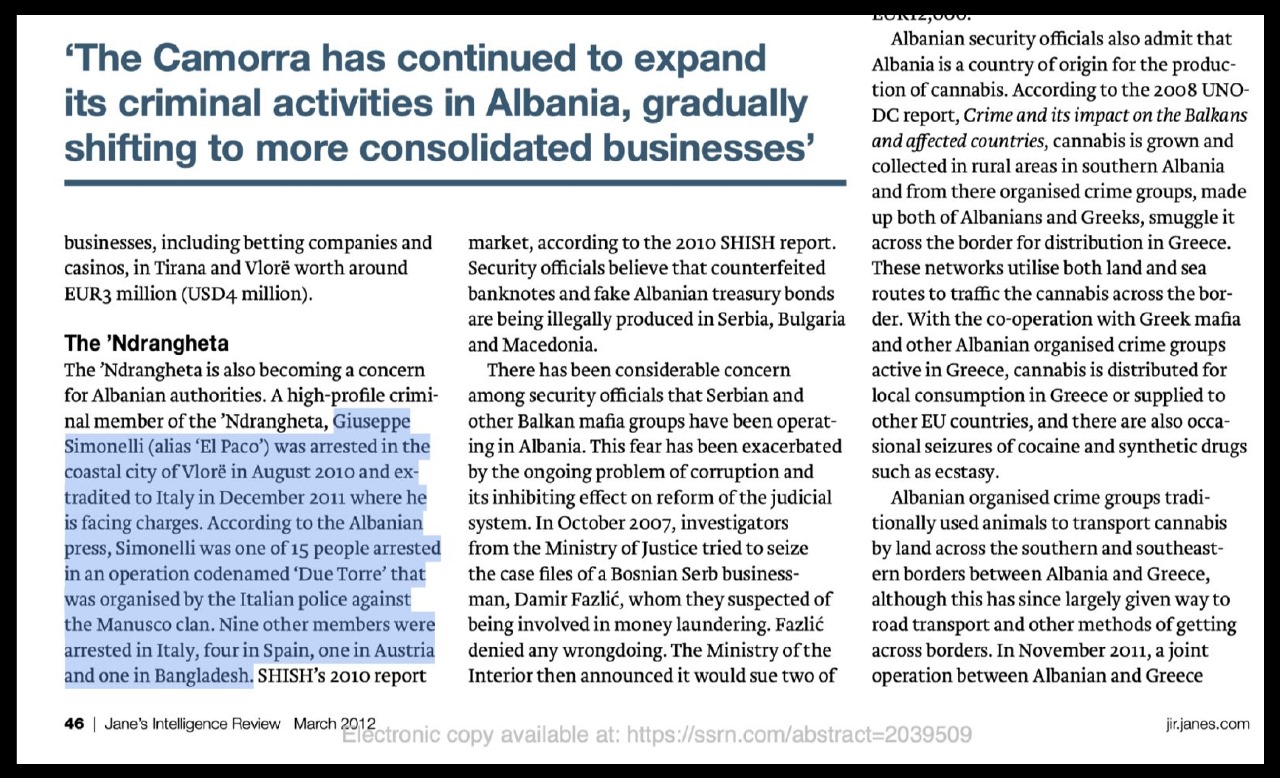
While Bangla Outlook found no direct evidence connecting Fazlić to Bangladesh, a Social Science Research Network (SSRN) study highlighted his proximity to Giuseppe Simonelli–alias El Paco–a documented criminal associate.
Simonelli was arrested in August 2010 in the Albanian port city of Vlorë during “Operation Due Torre,” a coordinated Italian police crackdown on his clan. Fifteen gang members were detained in Albania, while others were arrested across Italy, Spain, Austria—and one in Bangladesh.
Payments upfront
The intelligence memo alleges that the campaign to return Sheikh Hasina to power has already moved beyond rhetoric and into hard cash.
According to the document, a one-year agreement worth $2 million, with an extraordinary $20 million “success fee” tied to toppling Bangladesh’s interim government, has been finalized.
At least $600,000 has already been disbursed upfront, routed through multiple offshore accounts in Europe, the memo says.
In addition to the $20 million payout, the memo claims the deal includes commitments to unfreeze frozen assets of the foreign intermediaries and promises of lucrative business opportunities, particularly in the healthcare sector–a sector often ripe for opaque contracting and inflated profits.
The memo also names M Saiful Alam. The memo said, asserting that Alam, acting in concert with Bangladesh’s military intelligence directorate (DGFI), was complicit in siphoning as much as $10 billion from the country’s banking system during Sheikh Hasina’s tenure.
“Engagement and empowerment of actors who are driven by personal gain pose significant risk to regional stability and balance of power,” the memo warns.
“Facilitating business opportunities for these individuals, especially those under criminal investigation, exacerbates economic instability, undermines market integrity, and fuels civil unrest. Combined with a coup d’état, this creates a recipe for regional instability with far-reaching implications for neighboring countries and allies,” it added.
—