

The quiet architect of a cross-border War: Imran Haider and the making of the Indo-TTP pipeline from Bangladesh

Zulkarnain Saer
Publish: 12 Oct 2025, 11:09 PM
-68ebe0bf784ee.jpeg)
On
September 26 this year, the Pakistan Army launched a large-scale
counterterrorism operation against the outlawed Tehrik-i-Taliban Pakistan (TTP)
in the Karak district of Khyber Pakhtunkhwa, a restive region in northern
Pakistan long scarred by militancy.
The
raid ended with the deaths of 17 TTP operatives. Among those killed was a
22-year-old Bangladeshi national named Faisal Hossain.
Hossain,
who came from Chhotodudhkhali in Kalikapur Union of Madaripur Sadar, was
believed by his family to be working in Dubai. Only after his death did they
learn that he had instead crossed into Pakistan and joined the TTP’s ranks.
The
discovery was unprecedented. Never before had there been any confirmed record
of a Bangladeshi citizen fighting under the TTP banner. But Hossain’s death
shattered that assumption, lending weight to long-whispered fears that the
group’s recruitment network had quietly expanded into Bangladesh.
Investigators soon began tracing how such infiltration had taken place–and all paths seemed to lead back to a single name.
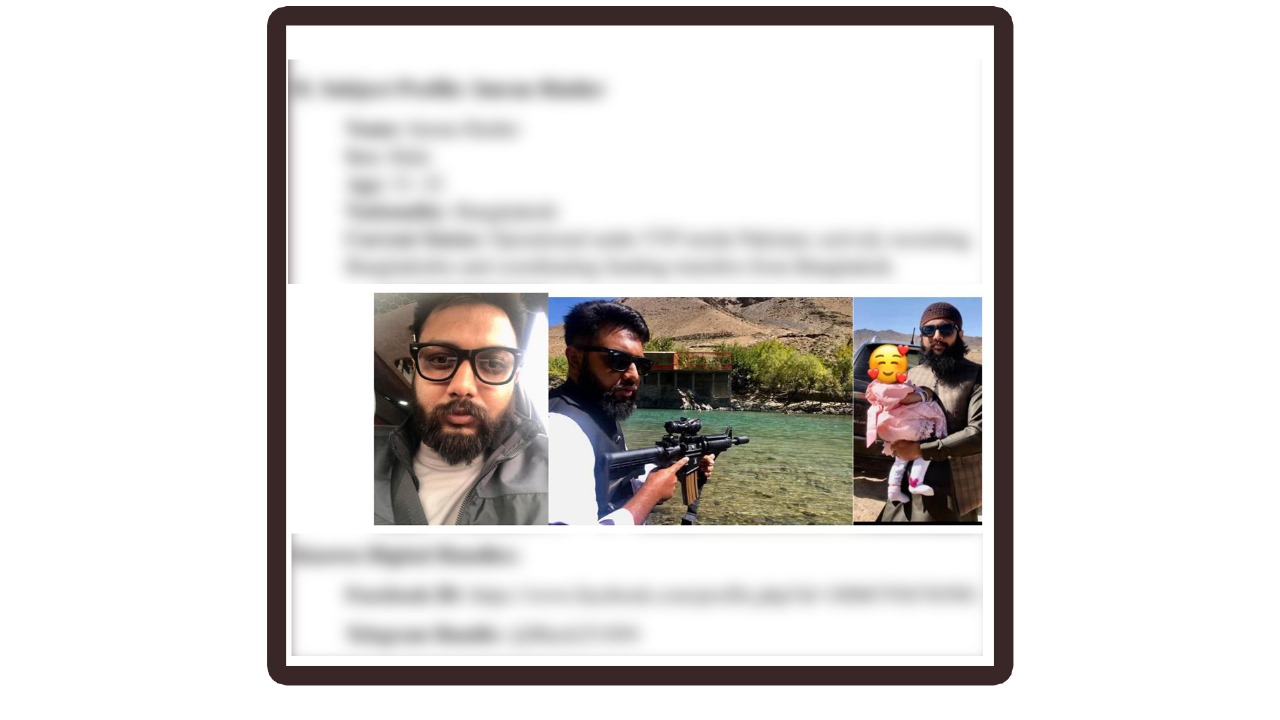
In
late 2022, a young Bangladeshi man named Imran Haider began cultivating what
appeared to be a small, obscure digital forum of disenchanted youths.
What
seemed like ordinary ideological debate online soon morphed into a sophisticated
recruitment and facilitation chain connecting Bangladesh to the TTP.
According
to multiple credible intelligence reports reviewed by Bangla Outlook, at least
nine Bangladeshi nationals have crossed borders under Haider’s coordination
since then, transiting through India before entering Pakistan to enlist with
the militant outfit.
Security
agencies now identify Haider as the operational architect of a new and
dangerous hybrid structure–one that blends ideological subversion, digital
radicalization, and clandestine cross-border movement into a single, tightly
managed system.
Within
this emerging Indo–TTP nexus, Haider has become both the recruiter and the
conduit.
At
the center of this network lies a model insiders call the Enemy Diversion
Program, or EDP. The term, drawn from internal intelligence classification,
refers to a psychological warfare framework designed to redirect anti-India
Islamic sentiment away from India itself and toward Pakistan’s militant
landscapes.
In
practical terms, it converts anger that might have destabilized one state into
manpower that benefits another.
For
Bangladesh, still navigating its own post-regime turbulence after August 5, the
implications are profound as the country’s fractured political environment has
become fertile ground for manipulation by foreign actors, who now see its
disillusioned youth as a resource to be harvested.
Haider,
now in his early thirties, is an unlikely architect of such a network. A
graduate in aeronautical engineering from a Bangladeshi institution, he
presents himself online as someone versed in “military science”--a claim that
has no basis in reality, since no civilian university in Bangladesh offers such
a program.
Investigators
believe this self-styled military identity is a deliberate performance, an
attempt to project authority and legitimacy among potential recruits.
His
social media footprints are sparse but traceable: a Facebook profile under his
real name, a Telegram account under the handle @Black251094, and a small
cluster of private messaging groups that function as ideological grooming
spaces.
Life before the militant turn
Before
his turn to militancy, Haider moved in the overlapping worlds of culture and
politics.
He
had ties to groups such as Udichi and Chhayanaut–both historically associated
with secular, left-leaning cultural movements–as well as regular contact with
the Indira Gandhi Cultural Center in Dhaka, a known outpost for Indian cultural
diplomacy.
He
also maintained connections with the Bangladesh Chhatra League, the student
wing of the ruling Awami League. These early affiliations suggest a young man
accustomed to navigating power structures, adept at passing through both
nationalist and religious spaces without drawing attention.
But
somewhere along that path, Haider changed course. According to intelligence
analysis and interviews with individuals who interacted with him, he underwent
a gradual ideological transformation under the influence of a local cleric he
referred to as his peer–his spiritual guide.
The
cleric’s identity remains uncertain, though investigators believe it may be a
man known in extremist circles as Mufti Uthman, or Abu Imran. Through this
mentorship, Haider’s worldview hardened, fusing religious romanticism with
strategic resentment.
His
online rhetoric began to focus on the supposed futility of jihad in Kashmir, a
narrative that analysts now see as calculated misdirection. He claimed that
Kashmir was no longer an accessible or legitimate front and that only the TTP,
based in Pakistan, offered a true avenue for religious struggle.
His
movements trace the evolution of this belief. In June 2022, Haider left
Bangladesh for Kolkata, traveling overland to Jammu by the Jammu Tawi Express
and then on to Srinagar.
He
reportedly sought to join Ansar Ghazwat-ul-Hind, a militant outfit operating in
Kashmir.
That
attempt failed, partly because of linguistic barriers and partly due to the
organization’s suspicion of outsiders. He lingered in Srinagar, staying with
sympathetic locals and briefly considering marriage or a business cover to
remain undetected.
Eventually,
his focus shifted westward, toward Pakistan and the TTP’s networks, where his
background as a foreign recruit made him useful in new ways.
By
early 2023, Haider had become a facilitator. Intelligence files indicate that
he helped at least nine Bangladeshis cross borders into Pakistan. The process
was methodical: digital indoctrination, logistical guidance, and financial
coordination through informal channels inside Bangladesh.
His
operation relied on quiet persuasion. Recruits were told that the traditional
battlefields were compromised, that their energy should serve a “purer”
struggle under TTP’s banner.
Behind
this ideological framework lay a larger strategic logic. The EDP–described by
analysts as an intelligence-engineered diversionary model–appears to exploit
post-regime instability in Dhaka to fracture regional Muslim unity.
By
redirecting young radicals toward Pakistan, it neutralizes potential anti-India
agitation within Bangladesh while simultaneously swelling the ranks of a group
that serves broader regional objectives.
In
effect, Bangladesh’s internal vulnerability has been weaponized against itself.
Deep into the ideological fabric
Intelligence
files and field interviews reveal that Imran Haider’s trajectory through South
Asia was a deliberate attempt to test and penetrate multiple militant
ecosystems.
He
first reached outward through digital overtures–contacting a GDI leader named
Abdul Wasiq on Twitter, exchanging secure numbers and even submitting a
curriculum vitae that proclaimed his readiness to join.
That
application produced no confirmed insertion, but it signaled the modus operandi
that would follow: an informal, cyber-mediated auditioning of militant doors
until one opened.
According
to intelligence reports, in early 2023 Haider’s travels took on a regional
dimension. He moved through Kazakhstan and then into Afghanistan, a corridor
the network would later exploit repeatedly.
Sources
say he married a woman who was, in the reporting available to investigators,
linked to ISIS; Afghan Taliban authorities soon placed him under a cloud of
suspicion because of that association. Under surveillance and fearing arrest,
Haider’s time in Afghanistan became untenable.
He
fled under pressure, and in the months that followed his path bent westward
into the Pakistan-centered orbit he would come to inhabit.
Telegram,
the encrypted platform so often used to stitch together distant networks,
proved decisive. Through a contact identified as Muhammad Khorasani–later known
publicly as a TTP spokesman–Haider secured the logistical and ideological
bridge he needed to enter TTP territory.
Investigators
record a personal meeting between Haider and the TTP amir, Mufti Noor Wali
Mehsud, on February 12, 2025; intelligence authorities describe that encounter
as the seal on his operational transition from itinerant aspirant to embedded
facilitator.
Once
embedded, Haider became an active node in the movement’s propaganda and
recruitment architecture, producing and amplifying narratives designed to
reshape jihadi priorities across borders.
His
messaging recast regional politics: rather than presenting India as the primary
object of grievance, Haider framed Pakistan itself as the treacherous
gatekeeper obstructing the so-called Ghazwatul Hind.
“The
real enemy of South Asian Muslims,” one of his declarations reads in the files,
“is not India– it is the treacherous state of Pakistan. The gate to Ghazwatul
Hind is Pakistan. Until this gate is destroyed, India, Bangladesh, and Burma
will never be liberated.”
This
line of argument denounces the Afghan Taliban as compromised and elevates TTP
as the only authentic jihadi vanguard, a rhetorical maneuver intended to
redirect frustrated Islamist energies away from anti-India agitation and toward
anti-Pakistan action.
Haider’s
propaganda did not float in a vacuum. It fed into carefully constructed
recruitment pathways.
During
2022–2023, the most routinely used corridor ran from Kazakhstan through
Afghanistan and into Pakistan. Recruits would obtain tourist visas to
Kazakhstan, travel legally, and then slip into Afghan contacts who could
shepherd them onward at an opportune moment into TTP zones.
In
2024, the network diversified: handlers in the United Arab Emirates provided
staging sites where recruits lingered for weeks before moving on, and a Qatar
cell–composed of a handful of Bengali nationals–served a similar function.
These routes combined legal cover with informal handlers and were designed expressly to minimize exposure to law enforcement.

The
facade began to crack in October 2024, when Emirati authorities arrested three
facilitators connected to the Gulf-based leg of the network. One of the
suspects, identified in open reporting as Abu Sumaiya, was detained at his
home; two others were intercepted attempting to flee the airport.
Those
arrests, investigators say, weakened the Dubai node but did not eliminate it.
The logistical architecture–staging houses, transiters, and encrypted
contacts–proved resilient, capable of rerouting when one channel closed.
Dangerous indoctrination
Tracing
Haider’s own movements provides a human thread through the network’s geography.
He
was last seen in Bangladesh on November 22, 2022, surfaced in Dushanbe,
Tajikistan, with a social post on April 12, 2023, and thereafter is assessed to
have settled inside Pakistan under TTP’s protection and operational command,
answering to Khorasani’s communications apparatus.
Whether
acting under directives from higher echelons or as an enterprising mid-level
recruiter exploiting local grievances, Haider became a useful instrument:
literate enough to script persuasive narratives, mobile enough to open
corridors, and ruthless enough to convert disaffection into destinations.
Talking
with Bangla Outlook, an expert specialized in cross border terrorism who
prefered to be unnamed, said, what is most worrisome is the strategic cunning
behind the redirection itself.
“By
asserting that Pakistan, not India, constitutes the existential obstacle to a
regional jihadi project, Haider and those like him re-engineer the grievances
of young Islamists,” said the expert.
They
strip away established targets and replace them with a doctrinal logic that
both delegitimizes other jihadi groups and funnels manpower into TTP’s causes.
“In
practical terms, the campaign neutralizes potential domestic unrest in one
place by exporting it to another–an approach to a diversionary psychological
operation that weaponizes both narrative and migration,” said the expert.
By
late 2025, intelligence analysts tracing the arc of Imran Haider’s growing
network began to notice a pattern: his recruits and ideological couriers often
passed through a small circle of familiar names–men who presented themselves as
religious scholars, community reformers, or social activists but who in reality
functioned as the invisible scaffolding of a cross-border recruitment and
propaganda machine.
Among them, three figures stood out, each commanding a miniature ecosystem of influence that extended from Bangladesh’s urban seminaries to the encrypted channels of TTP.

The
first, Mohammad Abu Sayed, better known by his alias Sher Muhammad, projected
the outward calm of an online educator. From his home district of Bogura, he
ran an unregistered web-based outfit called the Center for Shariyah
Studies–ostensibly a digital madrasa for students seeking theological
grounding.
Behind
that benign title, investigators found a recruitment funnel operating with
precision. Young men, mostly students from Islamic universities and self-taught
online learners disillusioned with mainstream scholars, were invited into study
circles that gradually shifted toward radical mentorship.
After
August 2025, when the political atmosphere in Bangladesh became increasingly
unstable, Sayed rebranded his operation under a new banner: Council Against
Injustice. Framed as a rights-based civic platform, it allowed him to mask
TTP-aligned talking points in the sanitized language of social justice.
Those
who crossed his threshold rarely realized that their educational engagement was
the first step on a route leading to foreign militant networks. Intelligence
briefings describe him as the “silent planner” behind several recent departures
from Bangladesh to TTP territory, a role that bridges logistical coordination
and ideological conditioning.
Where
Sayed’s sophistication lay in camouflage, Mufti Uthman, or Shaikhul Hadith Abu
Imran, operated through charisma and religious authority.
Based
in Narsingdi, his name has circulated for years in Bangladesh’s madrasa
circles–first as a restless scholar moving between institutions such as Jamia
Imdadia Faridabad, later as a preacher who combined Al-Qaeda’s transnational
rhetoric with South Asian parochialism.
Today,
he calls himself the Amir of Ansar al-Islam, the publicly declared Bangladesh
wing of Al-Qaeda in the Indian Subcontinent (AQIS).
Intelligence
dossiers suggest that his reach goes further: Uthman allegedly masterminded a
series of so-called “Kashmir trap” missions, enticing young men into attempting
infiltration into Indian-administered territory under the promise of jihad.
In
over thirty recorded cases, the recruits were intercepted–either handed over
to, or apprehended by, Indian security forces. This pattern has led analysts to
suspect a deeper, darker alignment: the possibility that Uthman’s operations
are quietly tolerated or even coordinated by Indian intelligence services.
His frequent trips across the border lend weight to that suspicion. Using his AQIS title as cover, he has, according to intelligence assessments, facilitated the steady substitution of Al-Qaeda’s traditional enemy set with TTP’s–turning Pakistan, not India, into the target of his proselytizing.

The
third man, Mufti Mahmudul Hasan Gunavi, is less covert but no less dangerous.
His influence thrives in Bangladesh’s mass gatherings–Islamic conferences,
youth seminars, and emotionally charged prayer assemblies where thousands
congregate.
Gunavi
speaks with the practiced cadence of a revivalist preacher, but beneath the
religious fervor lies a subtle narrative engineering. He repurposes the ancient
notion of Ghazwatul Hind–the prophetic “final battle” for the subcontinent–into
a rhetorical weapon against Pakistan.
Under
his telling, the war is no longer against Hindutva expansionism or oppression
in Kashmir, but against the “betrayal” of Islamabad.
By
draping this distortion in piety, Gunavi transforms doctrine into mobilization.
His sermons reach tens of thousands, creating an ideological climate in which
TTP’s anti-Pakistan propaganda finds fertile ground without ever being
explicitly named.
Long traceable route to extreme
idealism
Each
of these men operates independently, yet their objectives converge. Their
combined influence forms a web designed to isolate Bangladeshi youth from
broader pan-Islamic solidarity and to recast jihad as a struggle against a
neighboring Muslim state.
Experts
say the effect is both psychological and strategic–fragmenting regional
Islamist sentiment and siphoning recruits toward TTP’s militarized fringes.
Within this system, digital and physical infrastructures overlap: encrypted
communication channels supplement madrasa networks, and religious platforms double
as recruitment cells.
The
roots of this network trace back to earlier militant formations in Bangladesh.
Many of the individuals now tied to Haider’s and Uthman’s circuits were once
part of Jama’atul Ansar Fil Hindal Sharqiyah (JAFHS), a short-lived armed group
that emerged in late 2021.
That
organization forged a curious alliance in the Chittagong Hill Tracts with the
Kuki-Chin National Front (KNF), a Christian separatist militia seeking
autonomy. The relationship was transactional–KNF offered weapons and jungle
warfare training; JAFHS provided money and logistical routes.
The
uneasy collaboration unraveled in October 2022 when Bangladesh’s Armed Forces
and the Rapid Action Battalion raided a cluster of hidden camps in Bandarban.
Dozens
of JAFHS members were captured, and the alliance with KNF collapsed. Yet even
after the crackdown, remnants of JAFHS reconstituted themselves within Haider’s
evolving network.
Post-operation
intelligence recovered from phones and laptops showed the same pattern repeating:
recruits radicalized under Uthman’s theological tutelage, operationally
directed by Sayed, and often dispatched through channels supervised by Haider.
Many
of them had passed through JAFHS before its fall. What emerged, then, was not
the birth of a new network but the mutation of an old one–one that survived
state disruption by blending ideology, technology, and opportunistic
geopolitics into a single, resilient organism.
Taken
together, these threads expose a deliberate architecture of subversion operating
at the nexus of digital propaganda, theological distortion, and covert
facilitation.
Haider
may be the face of the movement, but men like Sayed, Uthman, and Gunavi are the
scaffolding that holds it upright–a quiet, adaptive fraternity that converts
faith into strategy and grievance into transnational warfare.
Investigators
tracing the arc of transnational militancy in South Asia now see Haider’s
operation not as an isolated recruiter’s ring but as a hinge in a three-way
convergence linking elements of the TTP, ARSA and a set of Bangladesh-based
associates.
One of the most consequential nodes in that web is a densely populated Rohingya enclave in Karachi known locally as Burma Colony. From that crowded block a generation of clerics and commanders have surfaced, among them figures who have long straddled various jihadist loyalties.
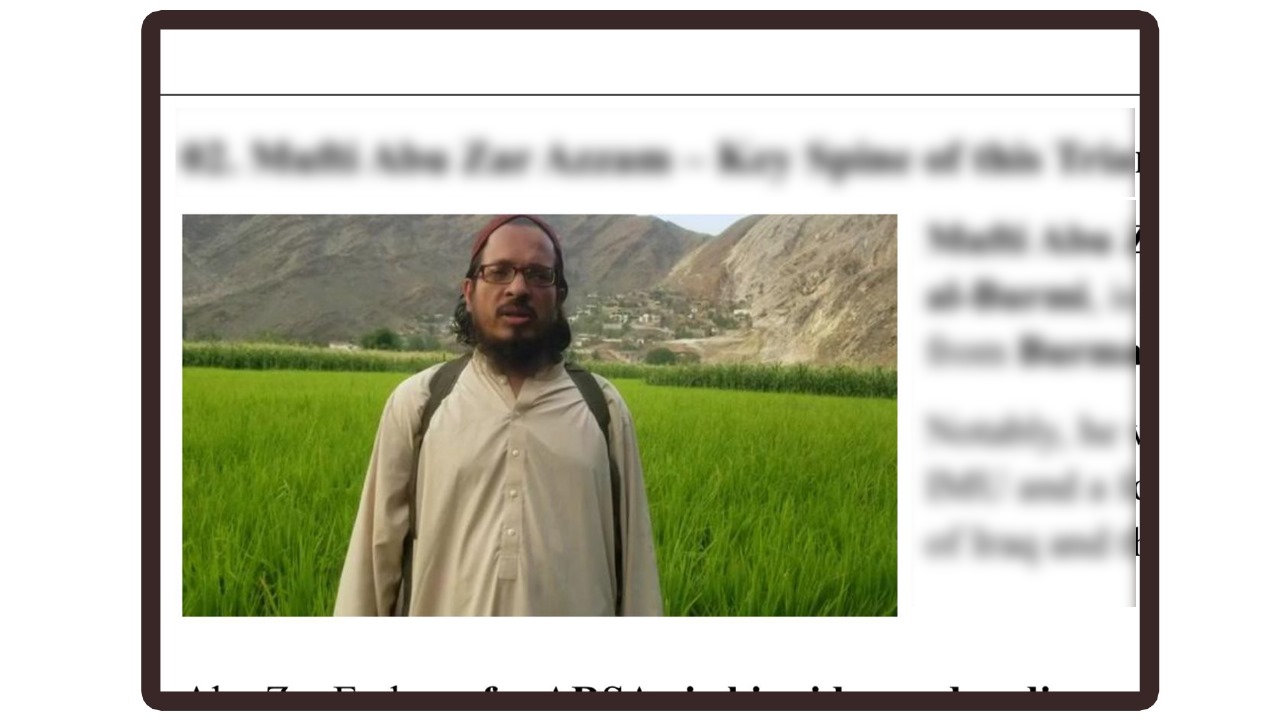
The
profile of Abu Zar–also referred to in reporting as Abu Zar al-Burmi or Abu
Dhar Azzam–illustrates how porous the boundary between messaging and
mobilization can be.
A
Rohingya-born cleric with a record in Central Asian and Pakistani militancy, he
has used Rohingya-language bayans and online channels to urge martyrdom and
vilify the Pakistani state, and intelligence analysts place him squarely as a
strategic enabler who funnels recruits from Burma Colony into TTP areas.
His cross-platform propaganda both conditions young listeners for violence and binds ARSA’s local grievances to TTP’s broader operational aims.
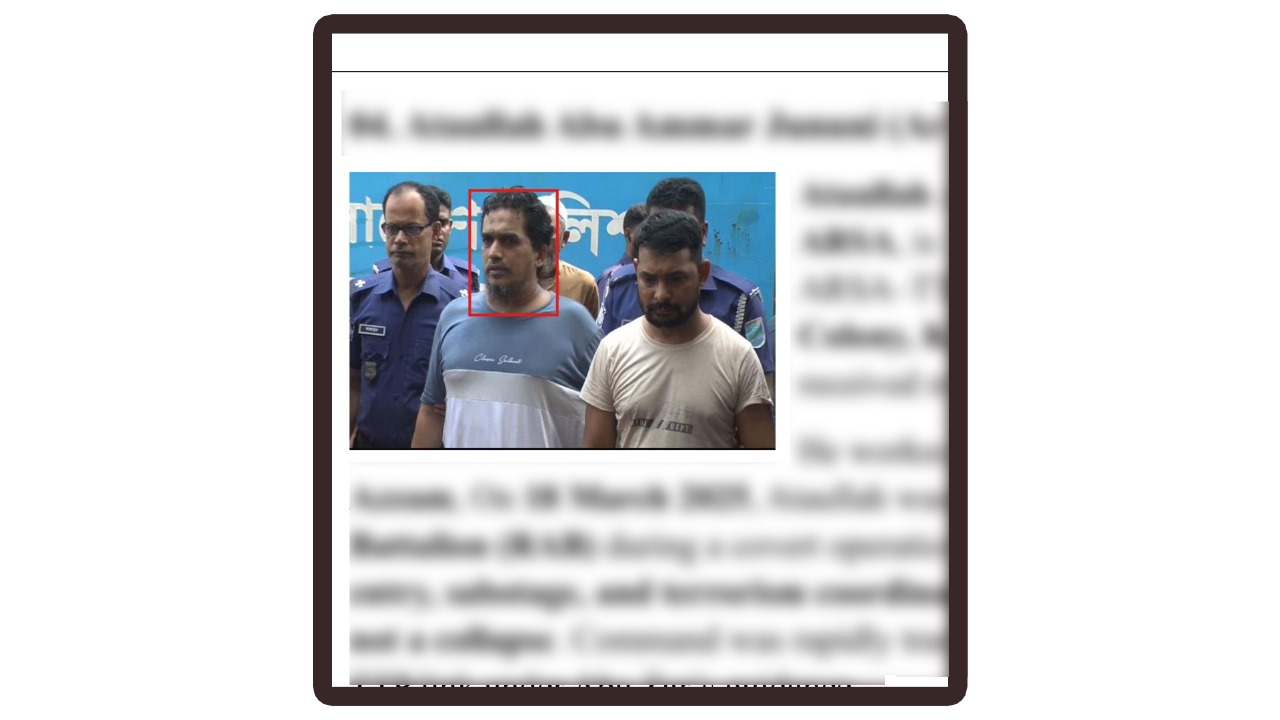
Meanwhile,
Ataullah Abu Ammar Jununi, long identified as the commander of ARSA, had
emerged as a central operational pillar in the triangular nexus.
His
background–born in the same Karachi refugee ecosystem, trained in Pakistan and
active in Gulf and regional circuits—gave him the mobility to coordinate
outside Bangladesh while maintaining ties to Rohingya recruits and external
jihadist networks.
His arrest by Bangladesh’s Rapid Action Battalion in March 2025 was a tactical blow; it exposed the scale of cross-border entanglement and momentarily disrupted command flows. Yet the capture did not collapse the network.
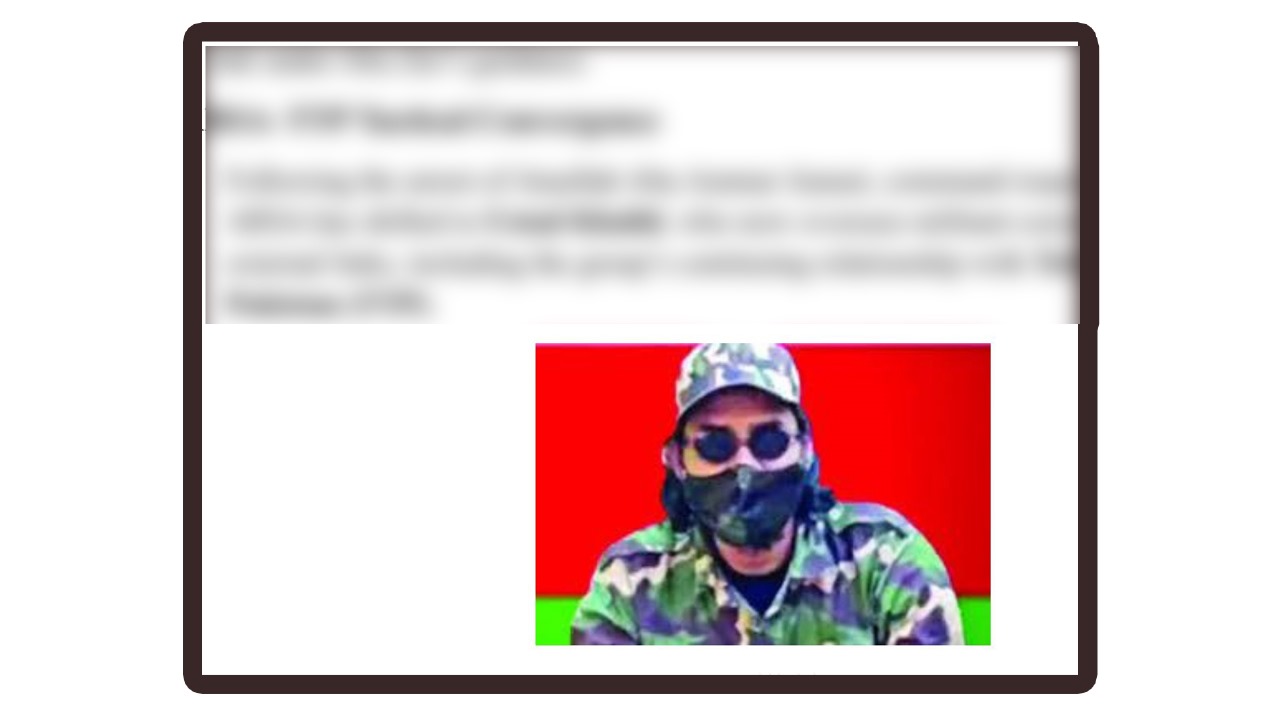
Leadership
quickly passed to a successor who continued to manage ARSA’s external links
under the ideological and logistical guidance of Karachi-based clerical nodes.
Experts
said the dynamics reveal a structure designed to survive decapitation: command
is transferable, propaganda channels are redundant, and local cells are too
diffuse to be neutralized with a single raid.
Financial
and logistical ties make the rhetoric dangerous in practice, experts added. The
network uses diaspora-linked remittance routes, Gulf staging points and
enclave-based recruitment hubs to move recruits and funds, while local
operators in Bangladesh provide cover, housing and initial ideological
grooming.
The
old militants of Jama’atul Ansar Fil Hindal Sharqiyah were not erased by security
operations; many of their members were reincorporated into these newer
circuits, bringing with them contacts a readiness to trade local knowledge for
continued access to external patronage.
The
case of Imran Haider and his associates therefore reads as a study in adaptive
insurgency rather than a snapshot of isolated criminality, experts on militancy
concluded.
The
network combines familiar tools–madrasas, refugee camps, diaspora
remittances–with modern ones–social media narratives, encrypted messaging and
cross-border facilitatio–to produce a resilient transnational organism, they
added.
—