

Inside the TV–PR nexus: How Beximco-backed editor Shamsur Rahman blurs the lines of media ethics and practices

Zulkarnain Saer
Publish: 30 Oct 2025, 05:11 PM

In late July this year, a well-known media executive departed quietly through Dhaka’s Hazrat Shahjalal International Airport.
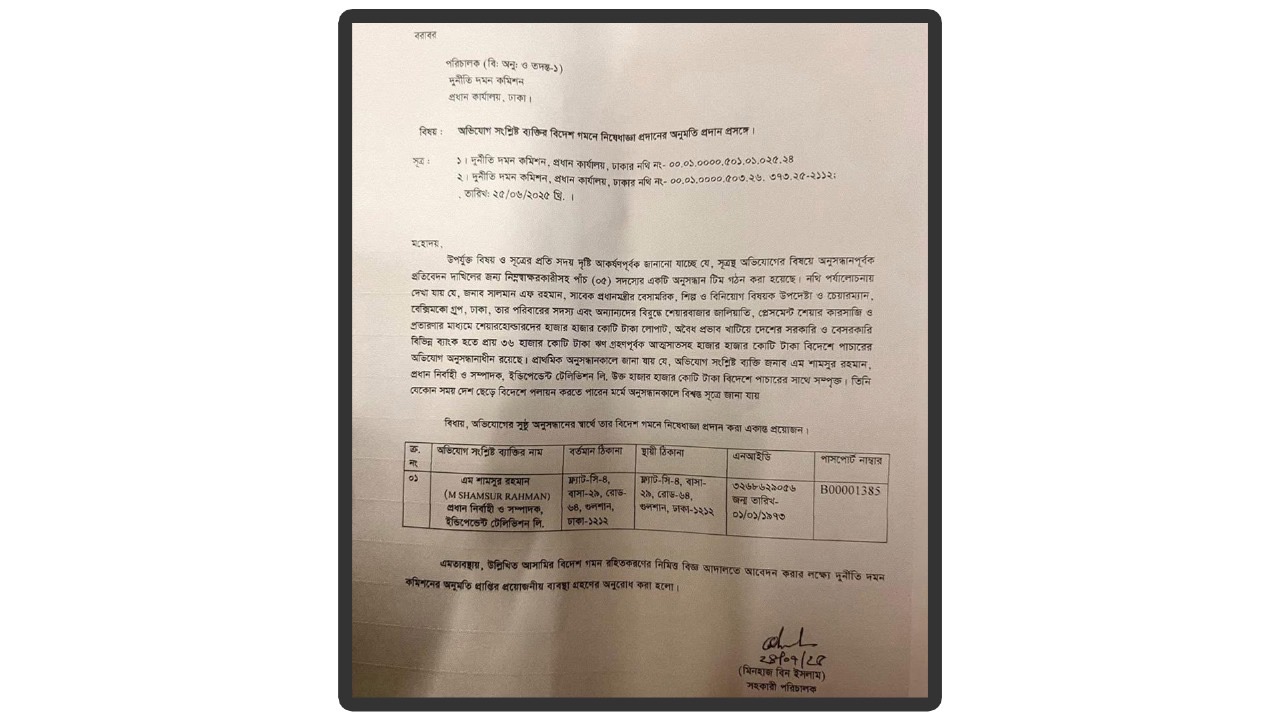
M. Shamsur Rahman Momen, the Editor-in-Chief and CEO of Independent Television, boarded a flight to Dubai–only for it to emerge later that he had left just days before a court order restricted his travel amid allegations of corruption and money laundering linked to Beximco Group, one of Bangladesh’s largest conglomerates.
By mid-August, the Anti-Corruption Commission (ACC) confirmed that investigators were probing Momen’s ‘undue’ financial links to Salman F. Rahman, Beximco’s vice chairman and adviser to the deposed prime minister Sheikh Hasina who also owns Independent Television.
The Dhaka Metropolitan Senior Special Judge, Zakir Hossain Galib, imposed a travel ban on August 13 after the ACC alleged that Momen had facilitated “transactions and influence operations” benefiting Beximco through his control of Independent Television and affiliated public-relations firms.
But by the time the order arrived, Momen was already in Dubai.
Officials within the ACC privately acknowledged that details of the pending restriction had been leaked, allowing him to fly out.
His name appeared on immigration records for at least ten international trips between August 2024 and June 2025, including Dubai, New York, and Bangkok– travel that investigators now suspect was linked to money-laundering circuits tied to Beximco Group after the July uprising.
Documents obtained by Bangla Outlook and corroborated by internal Independent TV sources outline a network of conflict-ridden interests revolving around Momen and his inner circle.
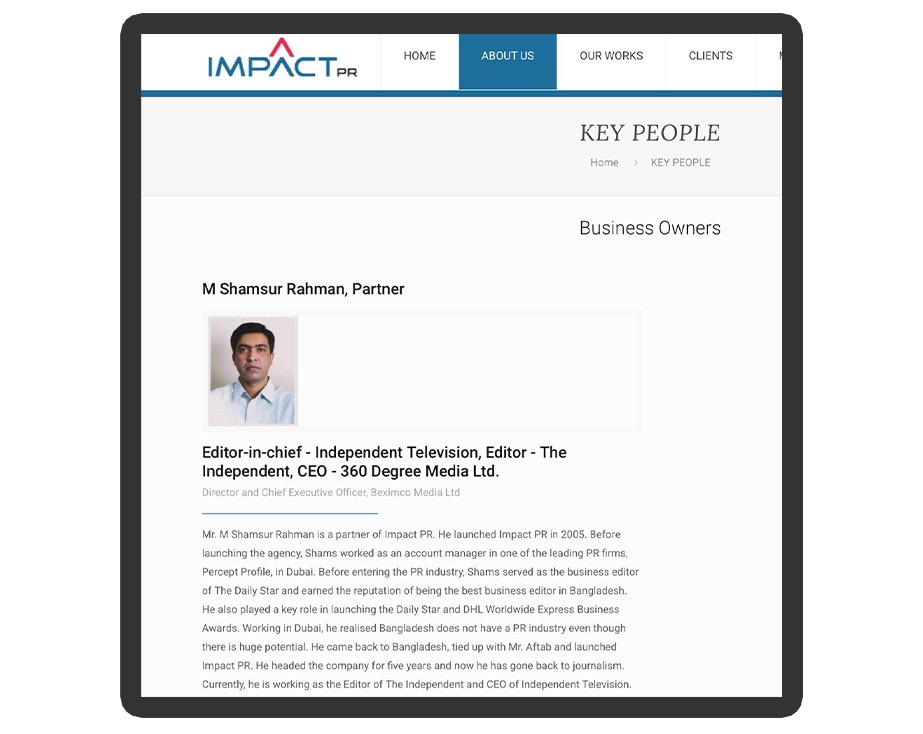
At the center stands Impact PR, a private communications agency co-founded by Momen and his wife, Sabrina Zaman, who serves as its managing partner and chief executive.
For more than a decade, Impact PR has quietly handled corporate accounts for major firms– Robi Axiata, British American Tobacco Bangladesh, and Unilever– while benefiting from favorable coverage on Independent Television, a clear breach of media-ethics guidelines.
The ethical breach
According to internal newsroom sources who talked with Bangla Outlook, Momen routinely instructed journalists to prioritize Impact PR’s clients, ensuring that promotional stories were aired prominently, while negative coverage was blocked.
“He turned editorial policy into a marketing arm,” said a former senior producer who requested anonymity out of fear of retaliation. “Reporters knew which clients were off-limits. Everyone knew where the money came from.”
The couple’s business interests extended further.
Corporate filings show that Momen and Zaman also held stakes in two other companies: Infopower Limited, a PR consultancy, and Infostation Digital, an advertising-buying agency that placed media content– including spots on Independent TV itself.
In essence, one of the country’s most visible news networks became a closed ecosystem of influence and profit, where the same individuals controlled the message and the medium.
Media analysts have cited Momen’s case as a textbook example of the structural rot within private broadcasting.
Rezaul Karim Rony, editor of Joban Magazine and a prominent media analyst, said “the ownership of PR agencies by newsroom leaders represents a severe conflict of interest and a direct violation of the ethical foundation of journalism.”
He added, “When a news executive profits from public relations contracts, the boundary between truth-telling and corporate lobbying collapses. This is precisely what Bangladesh must prevent if it wants a free and credible media.”
Rony’s warning echoes a growing sentiment within Dhaka’s press circles that corporate capture, not overt censorship, now poses the greatest threat to journalistic independence.
Different sources that Bangla Outlook talked with said, Sabrina Zaman, Momen’s wife and business partner, through Impact PR, allegedly leveraged her husband’s editorial position to secure lucrative corporate contracts and government campaigns, often channeled through Beximco-linked subsidiaries.
A review of procurement data shows that Impact PR received multiple communication assignments from companies under Beximco’s portfolio during the same period that Independent Television provided favorable news coverage of those entities.
One senior newsroom source said that Zaman also influenced beat assignments for reporters, ensuring that corporate clients received maximum visibility.
“Those who questioned her directives were sidelined or reassigned,” said the journalist, who has since left the network. “She wasn’t on the payroll, but she controlled who got to cover what.”
The couple’s influence extended into advertising. Infostation Digital, which they secretly co-owned, handled ad placements across television and print, allowing them to profit from both editorial and commercial sides of the business.
Such cross-ownership is prohibited under international media-ethics codes and considered a major structural vulnerability in Bangladesh’s broadcast sector.
Bangla Outlook contacted both Momen and Zaman but they didn’t provide any comment.
The inner circle
The rot was not confined to the CEO’s office.
Momen’s Head of News, Mamun Abdullah, is himself accused of parallel profiteering through another PR firm–Window Media Limited–where his wife, Rifat-e-Elahi, serves as a director.
According to multiple sources that Bangla Outlook talked with, Independent TV journalists were regularly ordered to cover events organized by Window Media’s clients, including the JMI Group, while bypassing stories of higher public importance.
“Mamun would call the assignment desk directly,” recalled a mid-level reporter. “If a client had a press briefing, we covered it live. If students were being beaten on the street, that story could wait.”
After social-media criticism exposed Rifat-e-Elahi’s role at Window Media, her photograph was removed from the company’s website.
Meanwhile, Ashis Saikat, another senior journalist and talk-show anchor, has been accused by student activists of vilifying demonstrators during the July uprising.
In several broadcast segments, Saikat described the student movement as “anarchic” and “foreign-influenced,” a framing that critics say helped justify the government’s crackdown.
Despite public backlash, neither Saikat nor Mamun Abdullah has faced any punitive measures.
Talking with Bangla Outlook, Information Adviser Mahfuj Alam said that while media houses have long “relied on corporate advertising to survive, the unchecked entanglement between editors and clients has eroded public trust.”
The Media Reform Commission, established after the July civic uprising to promote transparency and accountability in journalism, has recommended a “firewall between editorial and commercial operations” and proposed mandatory asset disclosures for senior newsroom executives.
Analyst Rony emphasized that “the Momen case shows what happens when personal business and public trust are mixed. It must be a turning point.”
—