

Why timeline, evidence raise doubts over murder cases against Asaduzzaman Noor

Faisal Mahmud
Publish: 25 Mar 2026, 01:17 AM
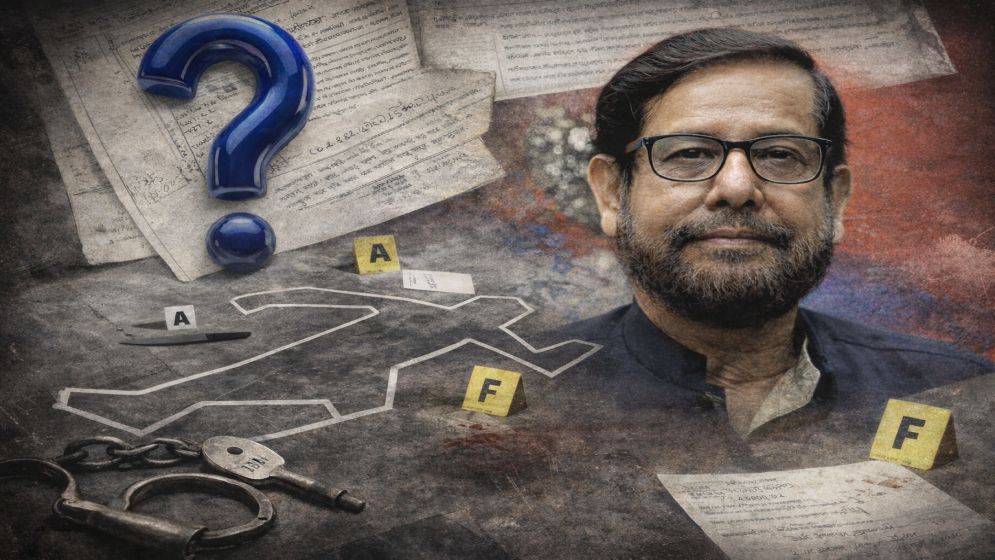
The arrest and continued detention of former Bangladeshi minister and parliamentarian Asaduzzaman Noor has emerged as one of the most questionable legal developments in Bangladesh’s shifting post–Awami League political landscape.
Noor—a widely known cultural figure and former minister for cultural affairs—now faces multiple murder charges tied to incidents of political violence dating back more than a decade.
Yet a close examination of court filings, contemporaneous media reports, and the documented timeline of the alleged incidents raises questions about whether the cases against him meet proper standards of evidentiary credibility.
A review of the case materials related to the killings of Golam Rabbani and Siddiq Ali, alongside the documented chronology of the Nilphamari violence of 2013–2014, reveals inconsistencies between the accusations and the established facts.
The evidence examined suggests that the allegations against Noor rest on contradictory timelines and sweeping accusations unsupported by specific proof.
The timeline evidence, corroborated by contemporaneous reporting and human rights documentation from the period, strongly indicates that Noor was unlikely to have been involved in the killings for which he is now accused.
Crucially, there is no credible evidence demonstrating that he either participated in or ordered the alleged acts.
Documents reviewed by Bangla Outlook show that the accusations against Noor conflict directly with the known sequence of events.
They contradict verifiable facts about his whereabouts at the time of the incidents and rely heavily on broad allegations rather than concrete evidence linking him personally to acts of violence.
In fact, the records suggest the opposite narrative. On the day central to the allegations, Noor himself was the target of a violent attack.
His motorcade was ambushed in Nilphamari during a period of intense political unrest, leaving several people dead and dozens injured.
The deaths cited in the cases against him also occurred in a wider climate of political turmoil marked by widespread clashes, communal attacks, and alleged extrajudicial operations by security forces in the lead-up to Bangladesh’s disputed 2014 elections.
Taken together, the documentary record paints a picture starkly at odds with the charges now being used to keep Noor in custody.
Complicated legacy of Noor
Noor’s political legacy is more complicated than the legal cases suggest.
As one of Bangladesh’s most recognizable cultural figures aligned with the Awami League, he played an important role in projecting the party’s ideological “soft power.”
Cultural personalities such as Noor helped reinforce the image of a secular, progressive political movement at a time when critics argued that the government was consolidating power in increasingly authoritarian ways.
When Noor entered politics under the banner of the Awami League, he brought with him the cultural credibility of Bangladesh’s progressive artistic community.
This reputation proved politically valuable. Cultural figures like him helped shape the narrative of the Awami League as the guardian of Bangladesh’s secular and cultural identity.
Through public events, artistic institutions, and cultural activism, they reinforced the party’s ideological legitimacy.
Critics of the Awami League have argued that this cultural legitimacy helped sustain a government that gradually became more authoritarian over time.
While the government promoted secular nationalism and cultural pluralism as part of its public image, human rights organizations increasingly documented political repression, enforced disappearances, and extrajudicial killings during the years surrounding the 2014 election.
An Al Jazeera investigation at the time reported that political killings were spreading fear across Bangladesh as violence escalated between rival political camps.
Activists from both the ruling party and opposition groups were targeted in a cycle of retaliation and intimidation that deepened the country’s political polarization.
The allegations against Noor largely stem from events that took place during one of the most volatile periods in Bangladesh’s recent history.
In December 2013, the country was experiencing widespread unrest in the lead-up to the 2014 national election. The execution of Jamaat-e-Islami leader Abdul Quader Mollah on 12 December triggered nationwide protests and violent clashes.
Nilphamari district in northern Bangladesh became one of the flashpoints of this unrest.
According to the documented timeline of events, Jamaat-Shibir activists carried out retaliatory attacks on minority Hindu communities in the area. Villages were targeted, and dozens of shops and businesses were burned.
Amid this tense situation, Asaduzzaman Noor traveled to several affected villages on 14 December 2013 to assess the damage and meet local residents.
Later that afternoon, as Noor was returning to Nilphamari town, his convoy came under attack near Ramganj Bazar.
Facts vs assumptions
Contemporaneous reporting cited in the event timeline indicates that hundreds of attackers had prepared an ambush.
Sections of the road had been dug up to block vehicles, and groups of men waited along the roadside in bamboo groves and nearby houses.
When Noor’s entourage attempted to repair the damaged road and continue their journey, the attackers began pelting the convoy with bricks and stones.
The confrontation escalated rapidly into a violent clash involving Awami League activists, Jamaat supporters, and law-enforcement personnel.
Five people were killed in the violence, including several Awami League activists who had been traveling with Noor. Dozens of others were injured.
Law-enforcement officers escorting the convoy fired tear gas and rubber bullets in an attempt to disperse the attackers.
Additional police and Border Guard Bangladesh personnel were eventually deployed to secure the area and allow Noor’s convoy to leave safely.
Police treated the incident as a major attack. A case was filed against approximately 1,500 individuals suspected of participating in the assault on Noor’s motorcade.
The murder cases later filed against Noor present a different narrative.
According to the complaints, Noor allegedly led a large group of supporters to attack the home of Golam Rabbani around 3:00–4:00 pm on the same day, 14 December 2013.
The problem with this claim is that the documented attack on Noor’s motorcade occurred at precisely the same time, as the police FIR suggested.
If Noor was traveling in the convoy and under police escort during the violent clash near Ramganj Bazar, it would have been physically impossible for him to simultaneously lead a separate attack elsewhere.
This contradiction between the timeline of events and the allegations in the case files significantly undermines the credibility of the accusations.
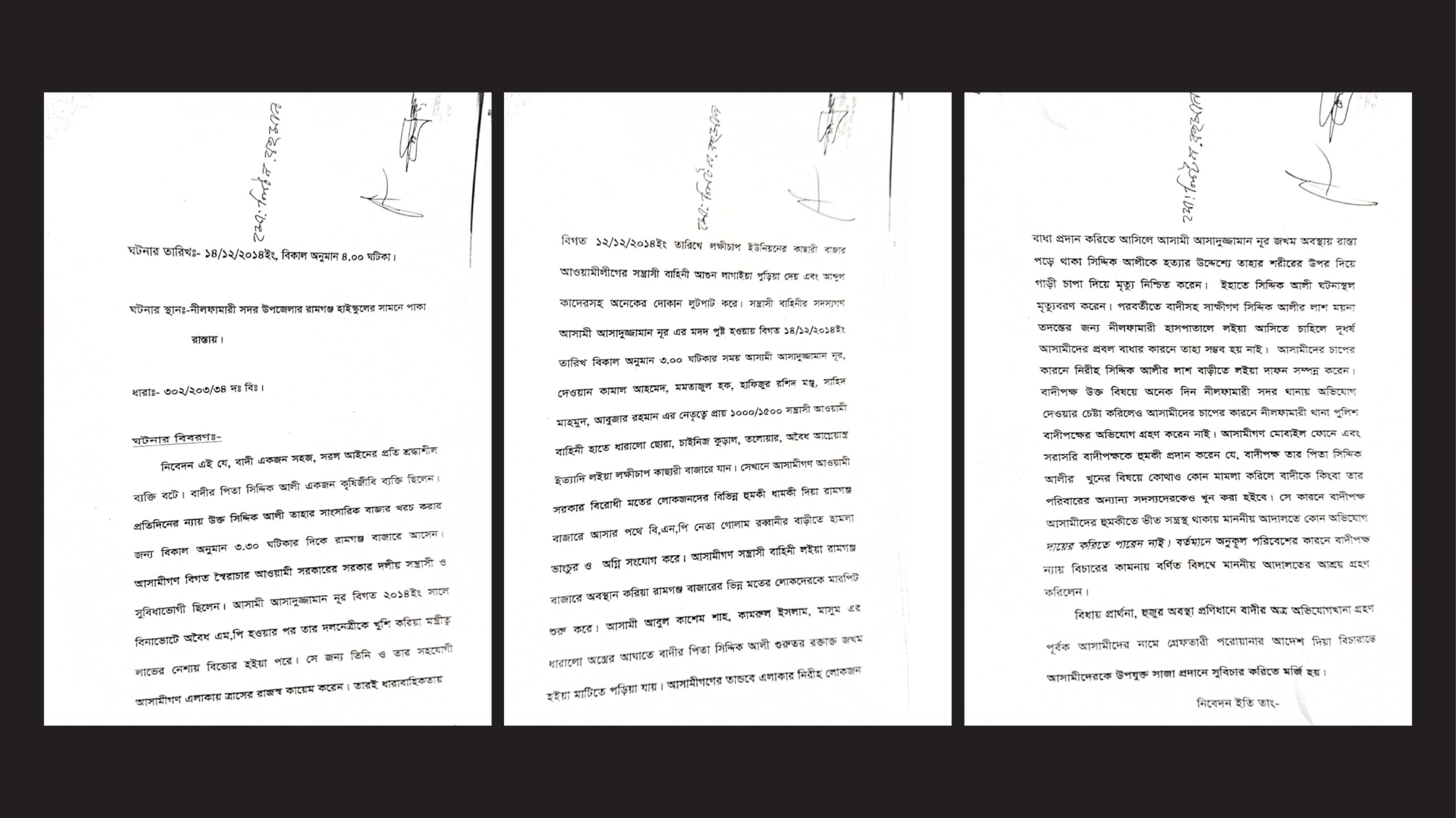
Another case against Noor involves the killing of a man named Siddiq Ali. According to the complaint, Noor personally ran over the victim with a car to ensure his death.
But the timeline document includes a detail that casts serious doubt on this claim: Noor does not know how to drive and has never driven a car, as was confirmed by his family members.
If this is accurate, the allegation that he personally drove a vehicle to kill someone becomes highly implausible.
Inclusion in a mass-list
The circumstances surrounding the death of Golam Rabbani raise further doubts about the strength of the case against Noor.
According to reports referenced in the documented event timeline, Rabbani disappeared on 15 January 2014 after being picked up by a group of around eighteen armed men who identified themselves as members of the Rapid Action Battalion (RAB).
Witnesses said the men arrived early in the morning at a relative’s house in Panchagarh district where Rabbani had been hiding and took him away.
Following the abduction, family members reportedly contacted officials in the police, RAB and the army in an effort to locate him.
None of the agencies provided any information about his whereabouts. Three days later, on 18 January 2014, Rabbani’s body was recovered.
If these accounts are accurate, they indicate that Rabbani was in the custody of individuals claiming to represent a state security force before his death.
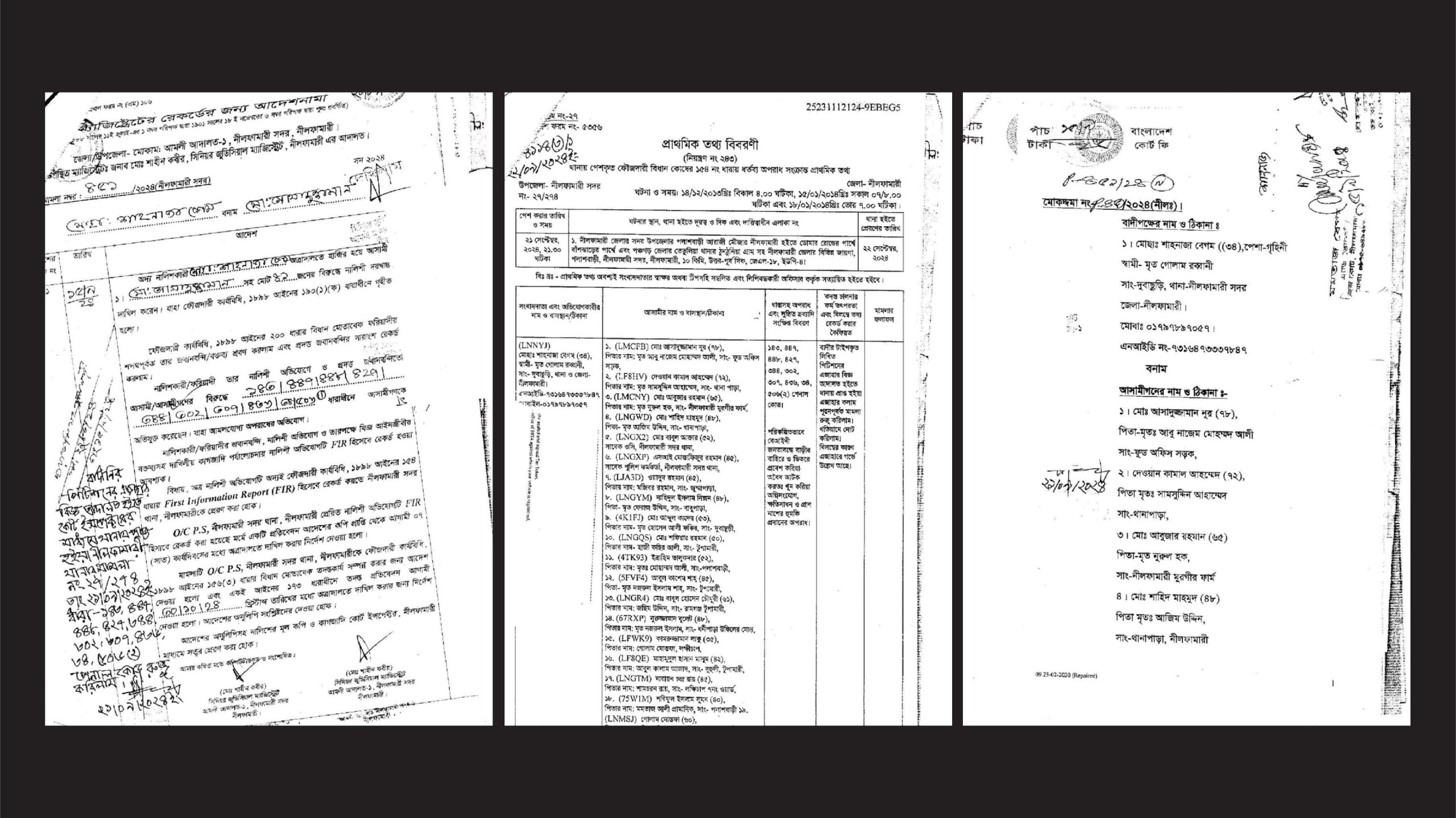
Yet the police report and the complaint filed by the plaintiff provide no explanation of how Asaduzzaman Noor was connected to this sequence of events, nor do they present any evidence that Noor instructed law-enforcement personnel to act on his behalf.
The case file itself offers little clarity. Instead, the Golam Rabbani complaint largely consists of extensive lists of accused individuals while failing to present concrete evidence linking Noor directly to the alleged killing.
Such “mass-accused” cases are not unusual in Bangladesh’s highly politicized legal environment, particularly during periods of political transition.
Criminal complaints often name large numbers of individuals associated with a particular political party without specifying the role each person allegedly played in the crime.
The Siddiq Ali case follows a similar pattern. The complaint names dozens of accused across multiple pages but does not clearly outline the specific actions attributed to each individual.
The broader political context of the period further complicates attempts to assign responsibility for specific killings. Early 2014 was marked by widespread political unrest and a sharp rise in violent incidents across the country.
Human rights organizations documented numerous allegations of extrajudicial killings and enforced disappearances during this time. Reports suggested that dozens of individuals were detained by security forces and later found dead.
One report cited in the event timeline recorded thirty-nine extrajudicial killings in January 2014 alone.
—