

Hydroponics sprouts in Bangladesh: A fresh approach to urban farming

Nazmul Islam
Publish: 14 May 2024, 06:28 PM
In a time when traditional farming struggles with declining yields and rising costs, Tanvir Hossain Siddiqui thrives. The founder of Agro Circuit boasts a daily harvest of 25-30 kg of premium, green, exotic vegetables – a stark contrast to the stories of agrarian woes plaguing many. His clientele includes Meena Bazaar, Unimart, and discerning families in affluent areas.
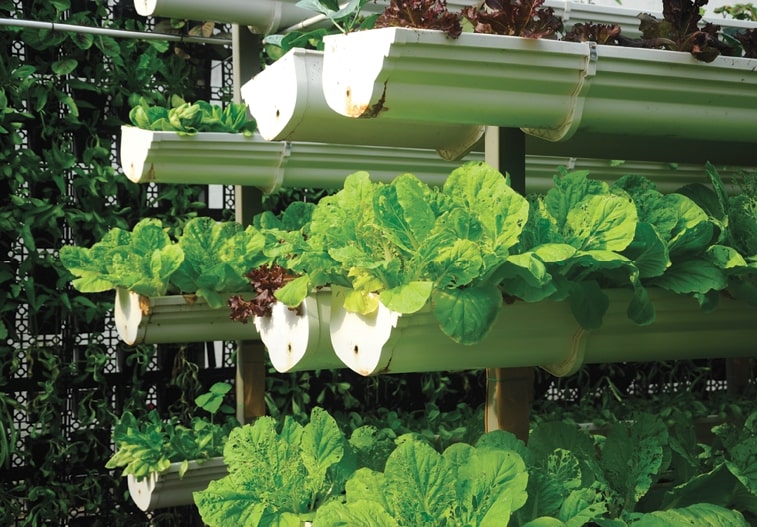
Siddiqui's success lies not in conventional methods, but in his innovative approach. At his 2,000-square-foot greenhouse, leafy greens like spinach, tomato, and lettuce flourish – not in soil, but on a bed of flowing water. This eliminates the need for soil amendments, pesticides, and insecticides.
The secret lies beneath the plants. Separate water tanks within the greenhouse teem with 8,000 freshwater fish, Tilapia and Curp. Their waste provides the essential nutrients for the vegetables above, creating a closed-loop ecosystem known as aquaponics.
So, this innovative method merges two established techniques: aquaculture (raising fish in tanks) and hydroponics (growing plants in water). Water from the fish tank, rich in nutrients from fish waste, is pumped onto beds where the plants grow. The plants filter this water, removing impurities and making it suitable for recirculation back to the fish.
While the initial setup costs might be higher, aquaponics boasts low recurring expenses. Additionally, it offers a double revenue stream – one from the fish themselves, and another from the vegetables.
This method's true advantage lies in water conservation. Aquaponics requires a mere tenth of the water needed in traditional agriculture, making it ideal for urban environments.
How the idea came into being
Siddiqui, an electrical engineering graduate from Dhaka's Ahsanullah University, his passion for agriculture blossomed during his master's studies in Australia, where he was drawn to aquaculture and hydroponics. He's now using his knowledge to revolutionize urban farming in Bangladesh.
Siddiqui first learned about aquaponics from his grocery shopping in Australian supermarkets. "I noticed the freshest, most expensive vegetables were always labeled 'hydroponic,'" he told Bangla Outlook. "They were also the juiciest and tastiest." This sparked his interest in exploring hydroponic agriculture.
"These days, knowledge is readily available," he says. "Just Google it or search YouTube - there are endless tutorials and resources." However, he acknowledges the practical challenges that follow. "Hands-on work is definitely harder than virtual learning."
His own journey began with a two-planter starter kit from a Sydney farmer's market. Using it to grow kale as an experiment, his success boosted his confidence. Returning to Bangladesh in 2015, he embarked on building the greenhouse at his father's house in Uttara. This initial foray with hydroponics would eventually lead him to develop his innovative aquaponic system.
The challenges of hydroponics farm
Tanvir said the first climate management challenge that hydroponic farmers must overcome is figuring out how much cooling, dehumidification and heating is required to manage the temperature and humidity of the grow space.
“In an aquaculture or hydroponic firm, lighting contributes the greatest source of heat, followed by motors used to operate fans, pumps and automation. Because hydroponics are often well-insulated and designed to operate day and night throughout the year, cooling is usually required 24/7 and year-round to remove the heat generated inside the space,” he said.
Dehumidification is also constantly required to remove the moisture added to the air via evapotranspiration from the plants and irrigation system. The rate and quantity of evapotranspiration depends on several variables, including light intensity, air temperature and humidity (or vapor pressure deficit), air movement and the irrigation method, he said.
The second biggest challenge is figuring out how to deliver the conditioned air everywhere within the hydroponic farm to create a uniform growing environment. “When racks are spaced tightly together — both vertically and horizontally — it is difficult to create uniform conditions everywhere,” said Tanvir.
The third biggest challenge is to properly set up the location of the cooling equipment or the HVAC equipment of the hydroponic farm. HVAC equipment can include air conditioners, dehumidifiers, circulation fans, ductwork, chillers, boilers, pumps and pipes.
Cooling and dehumidification equipment are best located outside the building, where heat and moisture can be rejected to the outdoor air. Some equipment (air conditioners, dehumidifiers, etc.) are ideally located on the roof of the building or on the ground outside and next to the room it is serving, helping to limit ductwork, said Tanvir.
“No matter what crop is grown, managing humidity control and air movement in a hydroponic farm is essential to plant productivity, harvesting schedules, quality control and, ultimately, profitability,” Tanvir added.
A rising trend
Many aspiring young farmers like Tanvir are coming forward to take up the hydroponic farming system professionally. The facebook page “Hydroponic in Bangladesh” has over 2900 members and they are actively engaging in various discussions on different problems and prospects of hydroponic agriculture.
Mizanur Rahman from Dohar is mainly a textile businessman but he is an amateur hydroponic vegetable growers. In his 3000 square feet greenhouse in Dohar, he cultivated mainly tomatoes in a hydroponic system with the technical help of the local agriculture department and Agriculture Research Institute.
The nutritional requirement of the plants in his system of soilless farming is met by the nutrient mixtures, called hydroponics fertilizer mixtures, added to the water in which the plant roots are kept submerged. These mixtures are made of chemical plant nutrients.
“I grow my tomatoes without the usage of any pesticides, so they are very organic. They taste better than any other tomatoes in the market,” he said.
Mizanur said some hydroponics enthusiasts abroad have been experimenting with various kinds of organic manures and mixtures of plants, but successful and commercially viable organic hydroponics models are still not available. “In fact, even globally accepted principles for certifying organic hydroponics products are also not yet available,” he said.
Highlighting the advantages of hydroponic farming, agriculturist and Professor of Bangladesh Agricultural University in Mymensingh Dr Abdus Salam told Bangla Outlook, “It requires 90 percent less water than the conventional soil-based farming. Since it is water-based, it has macro and micronutrients directly fed to the plant and plants grow 50 percent faster as well as have a better yield.”
He explains this with an example, saying, “If lettuce grown conventionally requires 60 days, lettuce grown using hydroponics yields double the produce in 28-30 days.”
Dr Abdus Salam emphasizes its water efficiencies saying, “Regular soil-based farming with 1,500 plants would require about 200 liters of water a day, but with hydroponics, only 20 liters of water is enough,” he said.