

Earthworms and Sacks: How simple farming techniques are transforming lives of ultra-poor

Faisal Mahmud
Publish: 22 May 2024, 06:52 PM
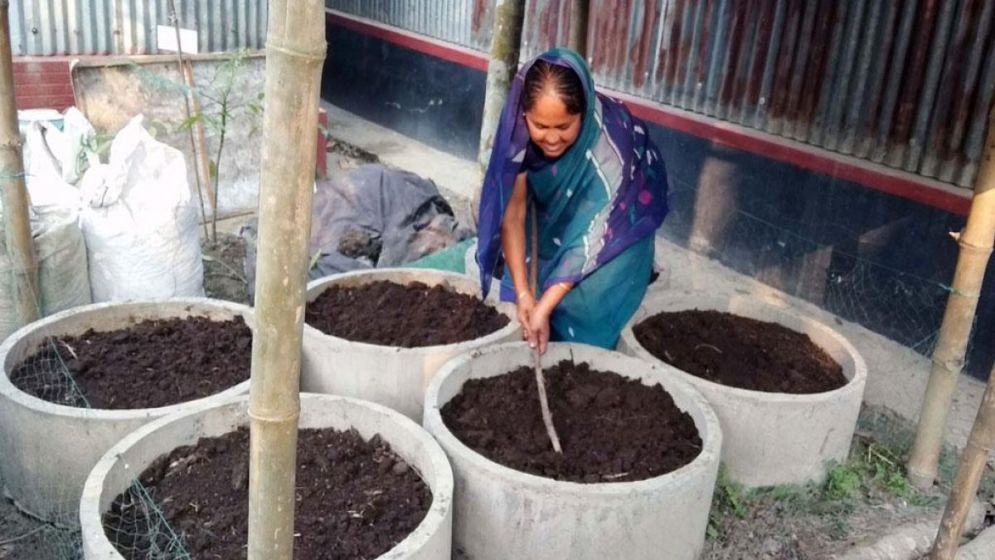
Momena Khatun, a lifelong resident of a quaint village in Muktagacha, vividly recalls the day she was first asked to handle earthworms and cow dung with her bare hands.
The thought of such intimate contact with these elements, though familiar, filled her with apprehension.
Kafil Uddin Ahmed, a technical specialist from the international NGO World Vision, sensed Momena's hesitation. In a bold move to break the ice, he scooped up a handful of the worm-filled dung and playfully brought it close to his mouth, demonstrating its harmless nature.
"I told her these earthworms enrich our soil and help us grow crops," Kafil explained. "There's no reason to shy away from them."
This simple act of reassurance proved transformative.
Momena shed her initial reservations and embraced the task at hand, learning to combine earthworms and cow dung to create vermicompost, a nutrient-rich organic fertilizer.
Vermicompost, the nutrient-rich byproduct of earthworms, has long been a staple of traditional farming practices in many rural communities.
However, in Muktagacha, Mymensingh, this knowledge was not widely practiced. Kafil, a technical specialist with World Vision, recognized the potential of vermicompost to transform the lives of local farmers and set about disseminating this valuable knowledge.
World Vision's livelihood program, aimed at empowering the ultra-poor, provided the perfect platform for Kafil's efforts.
Through this holistic initiative, individuals like Momena, who once hesitated to touch earthworms and cow dung, were given the opportunity to learn and apply new techniques to improve their livelihoods.
The ultra-poor graduation program, a three-year endeavor by World Vision, targets the most vulnerable families like Momena’s one living in extreme poverty.
By fostering self-employment and sustainable income-generating activities, such as vermicompost production, the program enables participants to break the cycle of poverty and achieve self-reliance.
"Our ultra-poor program focuses on empowering individuals to build their own assets through local value chain development," explains Ashutosh Rema, an Area Program Manager with World Vision in Muktagacha.
"We identify and utilize all available resources to achieve this goal," he said.
World Vision identifies ultra-poor families through social mapping and collaboration with local facilitators, and devises tailored plans to enhance their livelihoods using local resources.
This is where technical specialists like Kafil step in.
The magic of vermicompost
An agricultural graduate, Kafil recognized the potential of vermicompost to uplift communities about a decade ago.
"I realized that locals could easily earn a part of their living by preparing vermicompost," he says. "It's an activity that can involve individuals, families, and even entire communities."
Kafil also highlights the environmental benefits of vermicompost. "The overuse of harmful chemicals in agriculture has degraded soil quality in Bangladesh," he explains.
"Vermicompost can help restore the soil's purity."
Furthermore, he says, vermicompost production is accessible and efficient. "It only takes an hour or two of daily effort," Kafil notes. "And if produced in excess, it can be sold, creating a new income stream."
Rashida Begum, another local housewife, initially was skeptical about vermicompost, now sings its praises. "Kafil Bhai (Kafil Uddin Ahmed) showed us the benefits," she says, "and now we're hooked!"
Rashida not only uses the nutrient-rich fertilizer to grow bountiful organic vegetables but also sells the surplus for extra income.
"My crops are healthier, with fewer pests and less need for pesticides," she explains. "And the produce is delicious and nutritious!"
Laily Akter's story is equally inspiring. Starting with just 150 earthworms and a single earthen pot provided by World Vision, she diligently nurtured her vermicompost operation.
Now, with three pots, she produces 15 maunds (approximately 560 kilograms) of organic fertilizer per month, earning a tidy profit by selling it at Tk. 400 per maund.
Laily's passion for vermicompost is evident in her words. "I've seen the difference with my own eyes," she declares. "Vegetables grown with vermicompost are greener, fresher, and healthier than those grown with chemical fertilizers."
Sack farming shows the way
World Vision's ultra-poor program goes beyond introducing innovative techniques like vermicompost. It empowers participants to utilize every available resource, transforming their surroundings into productive agricultural spaces.
"We taught them how to cultivate vegetables in their courtyards and even inside sacks," explains Kafil.
This ingenious approach, known as sack farming, involves filling bags with soil, manure, and pebbles, creating a micro-environment for plants to thrive.
Sack farming is particularly beneficial in areas with limited water resources. The sacks facilitate efficient water flow to the roots and retain moisture effectively, allowing farmers to grow crops with minimal water usage.
Bulbuli Rani, a housewife in Muktagacha's Ghoga union, never envisioned her front courtyard as a thriving vegetable garden or imagined growing crops inside sacks. Yet, with the guidance and support of World Vision's innovative agricultural program, she has achieved both.
"I now grow a variety of vegetables in my courtyard and have even started cultivating chili peppers, spinach, and bitter gourd in sacks," Bulbuli proudly shares.
Years after embarking on this agricultural practice, Bulbuli now harvests enough vegetables to feed her family and sell the surplus to her community, supplementing her income and improving her family's quality of life.
"These innovative approaches are empowering ultra-poor families to change their destinies," says Kafil. "They are experiencing tangible improvements in their livelihoods and overall well-being."