


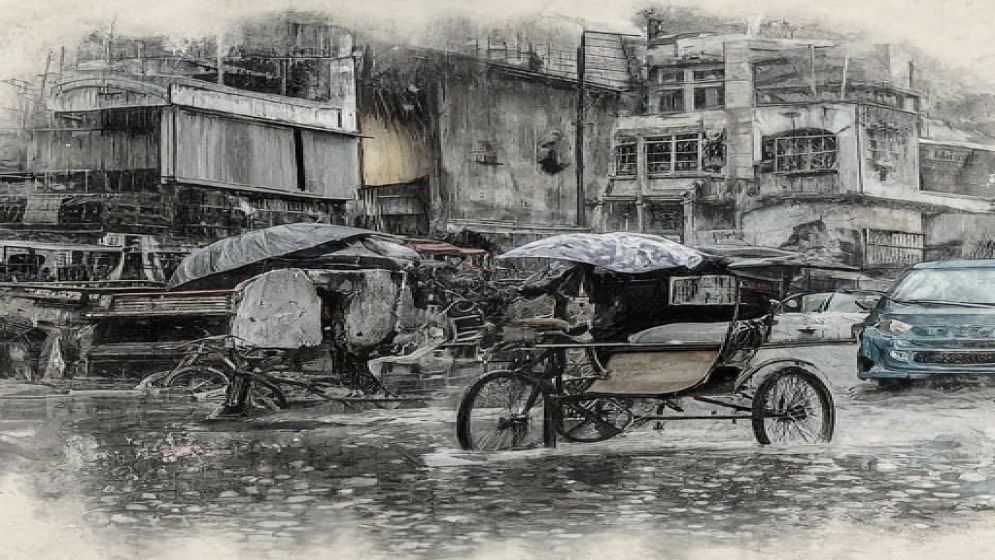
Cyclone Remal has not only ravaged coastal areas but also caused significant problems in the capital, Dhaka. The torrential rains brought by the cyclone have led to widespread waterlogging, a recurring issue for the city.
Although cyclones can worsen waterlogging in Dhaka due to heavy rainfall, the city's flooding issues are not solely dependent on such weather events. Waterlogging is a persistent problem in the capital, largely attributed to mismanagement rather than natural causes.
The monsoon rains, a welcome relief after the scorching summer heat, quickly become a bane for Dhaka's residents due to the city's inadequate drainage system. Heavy downpours inundate roads and streets with murky water, disrupting the already chaotic traffic.
Experts have long been saying that this waterlogging is a result of several interconnected factors.
Limited infrastructure, the inability of authorities and contractors to establish functional sewage systems, and the lack of awareness among citizens who unknowingly contribute to clogging the drainage network–all play their parts.
In paper, Dhaka boasts an extensive drainage system, with 370 km of storm sewers and 2,840 km of surface drains managed by Dhaka WASA, and over 2,000 km of feeder drains maintained by the two city corporations.
However, these figures are dwarfed by the challenges posed by the city's massive population of two million, its daily waste generation of 7,000 tons, and an average annual rainfall of 1,900 mm.
The core problem
Dr. Quazi Azizul Mawla, a BUET architecture professor with extensive research on Dhaka's sewage system, emphasizes that the reason for Dhaka's monsoon flooding is straightforward.
He explains, "Rainwater needs to flow out of the city to a lower elevation through a functional, well-maintained drainage network. In a properly designed system, rainwater would quickly drain into designated retention areas."
Prof. Mawla asserted that stagnant rainwater indicates either an insufficient or inefficient drainage system, and Dhaka suffers from both.
He said that Dhaka needs at least 20 retention ponds the size of Hatirjheel to manage stormwater effectively. Unfortunately, there's only one Hatirjheel in the city.
He further explains that Dhaka's stormwater drains, designed long ago, are inadequate for the current volume of rainwater.
Originally planned in the early 20th century, the system assumed a maximum rainfall of 25 mm per hour with half being absorbed by the soil.
However, rapid urbanization has led to widespread paving and concreting, drastically reducing the ground's absorption capacity.
Consequently, even with moderate rainfall, the drainage system is overwhelmed, struggling to handle twice its intended capacity.
Furthermore, Dhaka Wasa, responsible for the stormwater sewage system, can only handle 20 mm of rainfall per hour. Rainfall exceeding 30mm would take at least two hours to drain, exacerbating the waterlogging problem.
The problem is, Wasa and other relevant authorities tend to deflect responsibility and lack coordination in addressing this issue.
Pillow-passing of responsibility
During this government's previous term, a 23-year sewerage master plan worth US$2 billion was developed to improve the city's infrastructure.
However, while the first phase of this plan has been implemented over a seven-year period, the second phase is still going at a snail's pace.
Kamrul Hasan Chowdhury, Chief Engineer of Wasa, stated that the project work under the masterplan is ongoing.
“It's important to understand that we are responsible for the drainage of only 39% of the capital. In the areas under our purview, we carry out maintenance work every year,” he told Bangla Outlook.
He also pointed out that drain desilting is typically done once before the monsoon.
"We would like to perform desilting throughout the year, but the budget for this is only allocated in April-May," he added.
Meanwhile, construction debris left unattended near drains is further exacerbating the drainage issues in Dhaka.
Khairul Alam, CEO of Dhaka North City Corporation (DNCC) told Bangla Outlook that many construction projects, meant to increase transportation facilities in the city, are ironically contributing to the deterioration of its drainage system.
Alam said, Rajdhani Unnayan Kortipokkho is responsible for managing construction debris and preventing it from clogging drains.
“We only maintain feeder drains, this alone won't solve Dhaka's waterlogging crisis,” he said adding that the reclamation of Dhaka's 22 canals from illegal occupants is crucial.
“These water bodies are essential for discharging rainwater, even with a developed sewerage network,” he added.