

Cyclone Remal wreaks havoc on Bangladesh coasts, leaving deadly trail of destruction

Staff Reporter
Publish: 28 May 2024, 04:54 PM
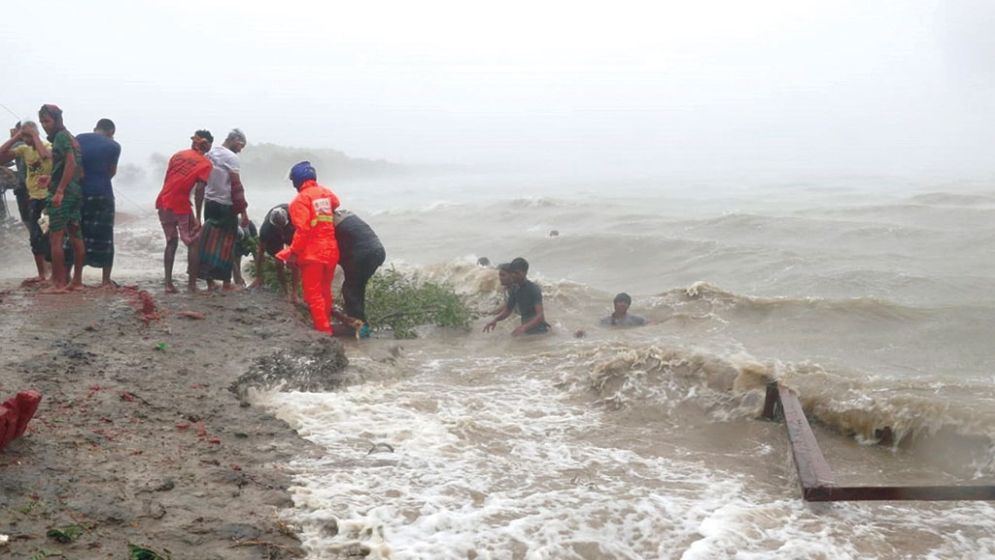
Cyclone Remal has caused widespread devastation, leaving at least 13 people dead, destroying more than 35,000 homes, and impacting over 3.7 million people across 19 districts.
Remal, making landfall with wind speeds of up to 130 kmph, weakened into a deep depression and moved northeastward, leaving widespread devastation in its wake.
The cyclone caused extensive damage in 19 coastal districts, including breached embankments, flooded neighborhoods, and uprooted trees.
The power outage in Barishal and Khulna divisions affected around 27 million people and disrupted 15,000 cell towers.
Both the Bangladesh Rural Electrification Board (BREB) and the West Zone Power Distribution Company Limited (WZPDCL) temporarily suspended power supply in affected areas during the storm to prevent further damage.
However, with the storm subsiding, officials are gradually restoring power connections.
The Liquefied Natural Gas (LNG) supply at the floating terminal was also reduced as a precaution but is expected to return to normal soon.
There has been no structural damage reported due to Cyclone Remal.
Remal however caused significant agricultural losses, destroying crops, vegetables, fruits, and fish farms, with an estimated loss of Tk 482 crore in fish alone in three districts.
As coastal residents in Bangladesh returned from storm shelters or relatives' homes, they were met with the devastation of their homes and livelihoods.
Vast stretches of cropland and shrimp farms were flooded, compounding the suffering caused by the deaths and property damage.
The cyclone also left 27 million people without power and disrupted around 22,000 telecom towers, cutting off mobile service for millions.
State Minister for Disaster Management and Relief Mohibbur Rahman told the media that Remal has caused widespread devastation in Bangladesh, destroying nearly 35,000 homes and partially damaging another 115,000 across 19 districts.
“The full extent of the damage is still being assessed, but it is clear that the storm has left many areas waterlogged and caused significant damage to fish enclosures and trees,” he said.
The cyclone has also put over 8.4 million people, including 3.2 million children, at risk of health, nutrition, sanitation, and safety issues, according to UNICEF.