


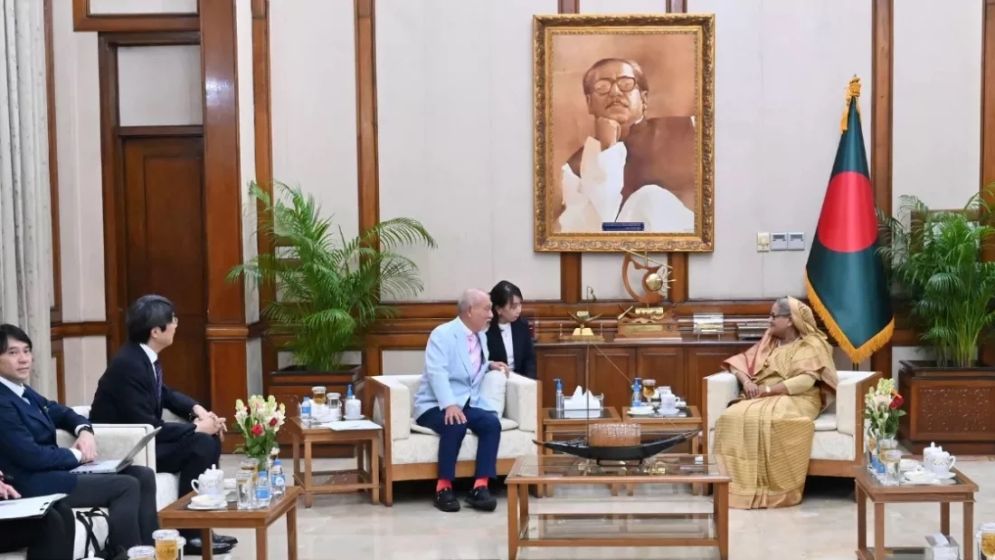
Bangladesh Prime Minister Sheikh Hasina on Tuesday said that her government would not allow any new structure in the Rohingya refugee camps.
Citing environmental reasons, PM Hasina told Japanese Special Envoy for National Reconciliation in Myanmar Yohei Sasakawa that the sprawling refugee camps at the southern part of Bangladesh have already caused severe “ecological imbalance.”
The Rohingya influx has severely worsened Bangladesh's long-standing environmental problems. In Cox's Bazar, the population has nearly tripled, disrupting the livelihoods of half a million Bangladeshi residents.
Hill-cutting, deforestation, declining soil fertility, and agricultural land damage have all been exacerbated in the past couple of years.
Rohingya refugees clearing around 8,000 acres of forest for shelter and cooking has also led to a significant loss of wildlife habitats, biodiversity, and forest resources in the region.
The ongoing collection of fuelwood, estimated at 6,800 tons per month with about 50% sourced from forests, has further exacerbated the problem.
This strain on forest resources has created tensions with local communities who also depend on these forests for their livelihoods.
Additionally, the Rohingya influx has damaged protected areas and critical habitats, including three Ecologically Critical Areas and two Protected Areas. This has further jeopardized the region's delicate ecosystem and its biodiversity.
Pointing out these problems, Hasina insisted that a large chunk of the refugees should be transferred to Bhashan Char, an island in the Bay of Bengal near the country’s coastline.
She asked Sasakawa, also the chairman of the Nippon Foundation, to promote the repatriation of Rohingyas to Myanmar.
Yohei Sasakawa praised the Rohingyas' living amenities in Bhashan Char and stated that the Nippon Foundation is interested in providing training to the Rohingyas to increase their income as well as education to Rohingya children.