

Ulamas dismiss Bangla Outlook report as “baseless”. Outlet defends its story

Staff Reporter
Publish: 25 Oct 2025, 12:07 AM
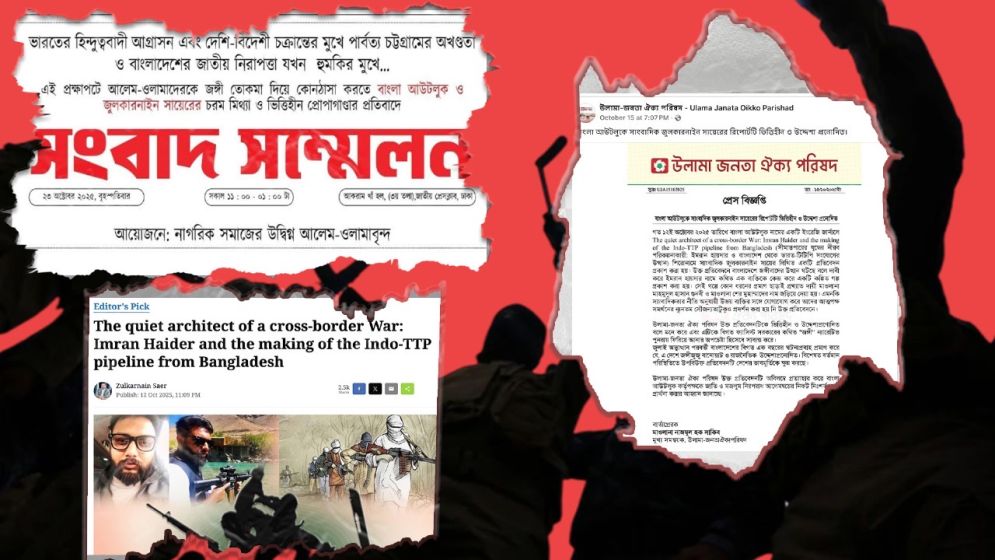
Prominent Ulamas and Alems under multiple banners have strongly condemned a recent Bangla Outlook report linking Islamic scholars to cross-border terrorism, calling it “misleading,” “baseless,” and “fabricated.”
The report, authored by journalist Zulkernain Saer and titled “The Quiet Architect of a Cross-Border War: Imran Haider and the Making of the Indo-TTP Pipeline from Bangladesh,” alleged involvement of several renowned scholars in illegal activities.
Following its publication, the Ulama Janata Oikkya Parishad issued a statement denouncing the report for lacking credible evidence and unfairly targeting scholars by speculating on their supposed links to terrorism.
The statement, signed by Maulana Nazmul Haque Saqib, described the report as “essentially fiction.”
On October 23, a press conference was held at the Jatiyo Press Club under the banner “Concerned Ulamas of Civil Society.” Speakers rejected the allegations and pointed out their activism in exposing past injustices.
Mohammad Abu Sayeed, named in the report, recounted his efforts after the overthrow of the Awami League government to reveal the Aynaghar (“House of Mirrors”) detention facility at the CTTC building on Minto Road.
“On August 7, we launched a movement demanding the unveiling of Aynaghar. The media and army subsequently arrived, allowing the site to be exposed to the public,” Sayeed said.
He added that protests continued in front of the RAB camp at the airport, and that the ‘Council Against Injustice’, an organization he helped form with members from diverse professions, sustained the movement.
Sayeed also warned that attempts had been made to destroy evidence at Aynaghar, and that timely government action could have preserved the site for public scrutiny.
The Ulamas also defended Mufti Mahmudul Hasan Gunavi, another scholar named in the report, highlighting his work as Amir of Dawatul Islam Bangladesh and founding director of Madrasatu Dawatil Islam Bangladesh.
They noted his contributions to promoting Islamic education and Dawah in the Chittagong Hill Tracts, emphasizing that his efforts have positively impacted regional stability.
Addressing the broader allegations, the Ulamas said, “We believe this is why Mufti Gunavi came under the notice of a certain group,” adding that linking scholars’ names to a fictional network is an attempt to spread fear and confusion.
They described the report as failing to meet minimum journalistic standards, calling it a commissioned narrative that blends imagination with arbitrary claims.
In a written statement, the Ulamas also categorically highlighted the following concerns:
1: The report presents an extensive, information-heavy narrative and then uses phrases like “found in the investigation” to link individuals without providing any evidence.
“There is no proof to support these claims, yet the report deliberately conceals this fact,” the statement said, noting that similar methods were historically used to persecute Islamic scholars, raising fears of a repeat pattern.
2: The report claims some individuals traveled abroad and were involved in foreign affiliations, but fails to provide any reliable sources or verifiable evidence for a single person.
3: To avoid proving its claims, the report states, “Even if it is not possible to uncover it, Mr. Y is carrying out this work under the guise of teaching the Quran and Hadith.”
The Ulamas condemned this method as conjecture-driven, warning that it allows anyone to be accused without evidence.
4: The report implies that because one individual believes in democracy or liberal ideals, others with similar beliefs are automatically complicit in the same crimes.
The Ulamas described this reasoning as “ridiculous and thoughtless,” comparing it to claiming that all liberals worldwide are complicit in Israel’s actions—a clearly unacceptable argument.
The statement also reaffirmed that all Ulamas’ activities are guided by Islamic responsibilities and duties, grounded in local and national realities. Any suggestion of involvement with external armed groups is “entirely false and constitutes propaganda.”
They stressed that the honor, dignity, and security of Bangladesh’s Muslims are inseparable from national stability, and that strict action must be taken against groups such as the Shanti Bahini, UPDF, KNF, and Arakan Army, whose leniency would threaten the country’s integrity.
Highlighting the historical and social significance of devout Muslims and Islamic scholars in Bangladesh, the Ulamas said their societal role forms a foundational pillar of national security.
“This influence must be respected and valued in the interest of the country’s stability,” they said.
The Ulamas concluded by urging Bangla Outlook, its editors, and publishers to immediately remove the report from all platforms, publicly express regret, and issue a prominent retraction. They warned that failure to comply would leave them with no choice but to pursue legal action.
Bangla Outlook’s response
Bangla Outlook published its report based on a set of intelligence files that the reporter independently cross-verified through multiple sources.
The intelligence dossier itself was compiled from credible, on-ground information gathered through an operational intelligence network. It indicated, with reasonable confidence, that the individuals named in the report were involved in certain questionable activities.
The story began with the reported death of a TTP operative who had crossed borders into Pakistan to join the group. The linkage between that incident and a possible recruitment process in Bangladesh emerged from an independent journalistic investigation supported by the intelligence dossier.
While a group of Ulamas has termed the report “misleading” and “fabricated,” they have not provided any credible rebuttal refuting the plausibility of the individuals’ alleged involvement in TTP-related recruitment efforts.
Bangla Outlook expresses sympathy for victims of enforced disappearances and the “Aynaghar,” yet maintains that invoking past incidents to obscure ongoing activities does not negate the possibility of continued involvement in destabilizing operations.
Mufti Gunavi–whose name appeared in the report–has been publicly associated with multiple speeches on Ghazwatul Hind, the prophetic “final battle.”
He was cited as an ideological preacher whose sermons could influence individuals toward joining TTP. His name was not linked in any way to affairs concerning the Chittagong Hill Tracts.
In response to the categorical “flaws” pointed out by the Ulamas, Bangla Outlook stands firmly by its reporting.
The outlet reiterates that the report was produced on the basis of a credible intelligence dossier, corroborated and verified through independent reporting from multiple sources.
—