

Social media posts by “Influencers” preceded attacks on Prothom Alo, The Daily Star and Chhayanaut

Staff Reporter
Publish: 19 Dec 2025, 09:54 PM
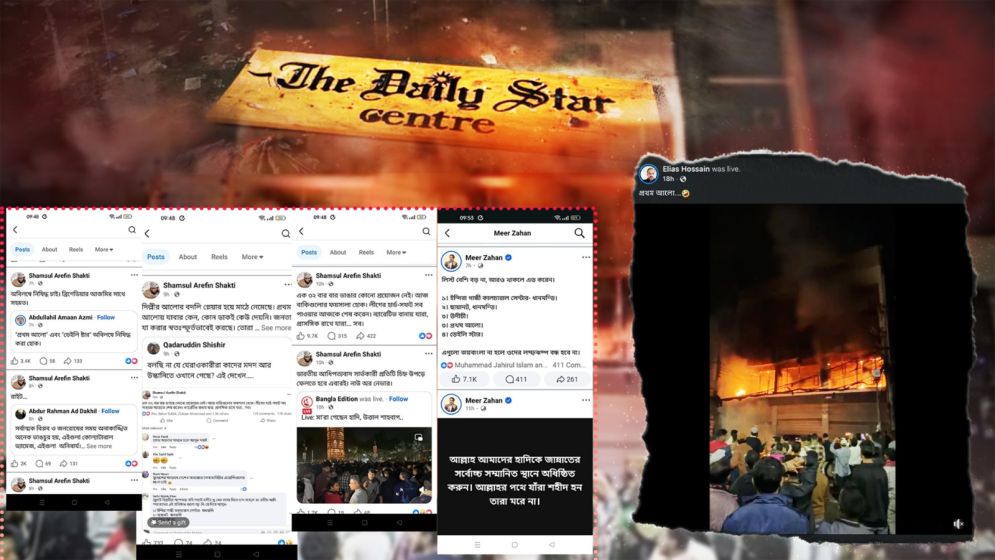
In the hours leading up to “coordinated attacks” on the offices of Prothom Alo, The Daily Star, and the cultural institution Chhayanaut, a series of incendiary social media posts by some online figures helped create a climate that critics say directly encouraged mob action against independent media and cultural spaces.
Youtuber Elias Hossain appeared to incite attacks on the two newspaper offices and his name and facebook posts inciting attacks were repeatedly shared and invoked in the same online ecosystem that amplified these calls.
Observers note that Elias Hossain’s facebook page and his channel Bangla Edition and allies have long framed Prothom Alo, The Daily Star, and Chhayanaut as symbols of cultural and political opposition, a narrative that was echoed and intensified by the Facebook posts documented here.
The result was a rapid escalation from online agitation to street action. Video footage shared by Bangla Edition shows large crowds gathering near targeted sites, while live posts celebrated the confrontations as victories against perceived enemies.
Religious and martyrdom language, visible in several posts mourning the martyred cultural and political activist Sharif Osman Bin Hadi, further intensified emotions and legitimized violence in the eyes of supporters.
Screenshots circulating widely on Facebook show commentator Meer Zahan using his verified facebook page publishing a post listing institutions he described as enemies, writing that the “list is not long” and could be expanded.
Among those named were Prothom Alo, The Daily Star, Chhayanaut, and Indira Gandhi Cultural Centre. The post concluded with a warning that unless these entities were “defeated,” the objectives of his supporters would not be achieved.
The framing—naming targets and linking them to a broader political struggle — was widely interpreted by many as a call for direct action.
Around the same time, activist Shamsul Arefin Shakti posted multiple messages urging followers to move beyond online debate and act physically.
In one widely shared post, he wrote that there was “no need to debate again and again” and that the remaining “targets” should be finished that very day, emphasizing control of narratives “by force, by presence, by everything.”
In another post, he explicitly demanded the immediate banning of Prothom Alo and The Daily Star, a message that received thousands of reactions and shares within hours.
Shakti also reposted and endorsed calls from other users that framed attacks on media houses as part of a broader uprising, repeatedly characterizing mainstream newspapers and cultural platforms as extensions of a hostile ideological camp.
Media analysts warn that this pattern—naming institutions, delegitimizing them, demanding bans, and urging immediate action—mirrors classic incitement dynamics, even when no single post explicitly orders an attack.
“When influential figures publish target lists and insist that debate is over and action must begin, the outcome is often predictable,” said one Dhaka-based media researcher who preferred to be unnamed.
As of now, none of the individuals named have publicly acknowledged responsibility for the violence.
However, the screenshots show a clear timeline in which online calls to ‘finish’ and ‘ban’ specific media houses preceded physical attacks on those very institutions.
—